CPC and Limitation Act Notes

Difference Between Preliminary Decree and Final Decree

Introduction ✨📘⚖️

A decree is a formal decision of a civil court that settles the rights of the parties. Under the Code of Civil Procedure, 1908 (CPC), courts may issue two types of decrees: preliminary decrees and final decrees. Both play essential roles in resolving civil disputes, but they serve different purposes. Understanding these distinctions helps students clearly follow how a civil suit progresses from filing to final judgment. ⚖️📖✨

Meaning of Preliminary Decree 📘🧾⚖️

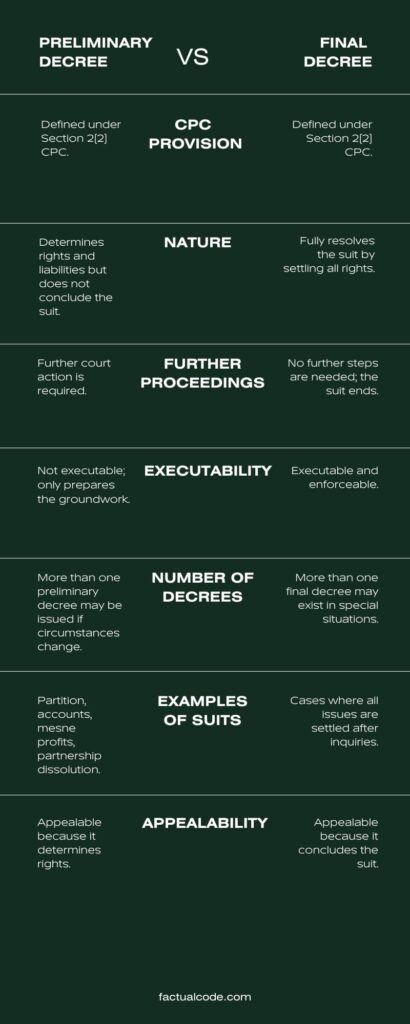
A preliminary decree decides the rights and liabilities of the parties, but it does not completely end the case. Additional steps or inquiries must be completed before the suit reaches its final conclusion. This type of decree usually appears in suits where further calculations, division, or inquiries are necessary.

Preliminary decrees commonly arise in:

  • Partition suits

  • Suits for dissolution of partnership

  • Suits for accounts

  • Suits for mesne profits

  • Mortgage suits

  • Administration suits

  • Pre-emption suits

A court may also issue more than one preliminary decree if circumstances change during the proceedings—for example, the death of a party requiring modification of shares.

Meaning of Final Decree 🏛️📜✔️

A final decree brings the suit to a complete end. It resolves all outstanding issues and fully determines the rights of the parties. After a final decree is passed, no further inquiry by the court is required.

A final decree may be passed:

  • After the inquiries or steps directed in a preliminary decree are completed, or

  • When the court can settle all issues at once without needing a preliminary decree

In some circumstances, more than one final decree may be issued, particularly when separate executable directions are needed at different stages.

Difference Between Preliminary Decree and Final Decree

Important Case Laws ⚖️📚🧠

These cases clarify how courts interpret and apply preliminary and final decrees:

Phoolchand v. Gopal Lal (AIR 1967 SC 1470)

The Supreme Court held that courts may issue multiple preliminary decrees when required by changing circumstances.

Shankar v. Chandrakant (1995)

The Court confirmed that a preliminary decree determines rights but does not end the suit.

Narayanan v. Laxmi Narayan (AIR 1953 SC 69)

The Court explained that a decree becomes final when nothing remains for the court to decide.

Conclusion 📘⚖️🏛️

A preliminary decree identifies and defines the rights of the parties without concluding the suit. A final decree, on the other hand, brings the case to its complete end by fully determining and enforcing those rights. Understanding the difference between these two decrees is essential for grasping civil procedure under the CPC and analyzing how courts progress from dispute to resolution.

Responsive Social Media Badges

Leave a Comment

Your email address will not be published. Required fields are marked *

Scroll to Top