
📘 Start with the CPC Master Guide
Introduction ✨⚖️📘
Order IX of the Code of Civil Procedure plays an important role in the restoration of suit under CPC, ensuring fairness in civil proceedings. When a suit is dismissed because the plaintiff fails to appear, the law provides a remedy so that genuine mistakes do not lead to permanent loss of rights. Order IX Rule 9 allows the plaintiff to apply for restoration when they can show a valid and sufficient reason for their absence.
Order IX of the Code of Civil Procedure, 1908, specifically addresses situations where parties do not appear in court. If the plaintiff is absent on the hearing date while the defendant is present, the suit may be dismissed for default under Order IX Rule 8. To prevent injustice, Rule 9 provides a method to restore such suits.
What is Dismissal for Default ✍️📘⚖️?
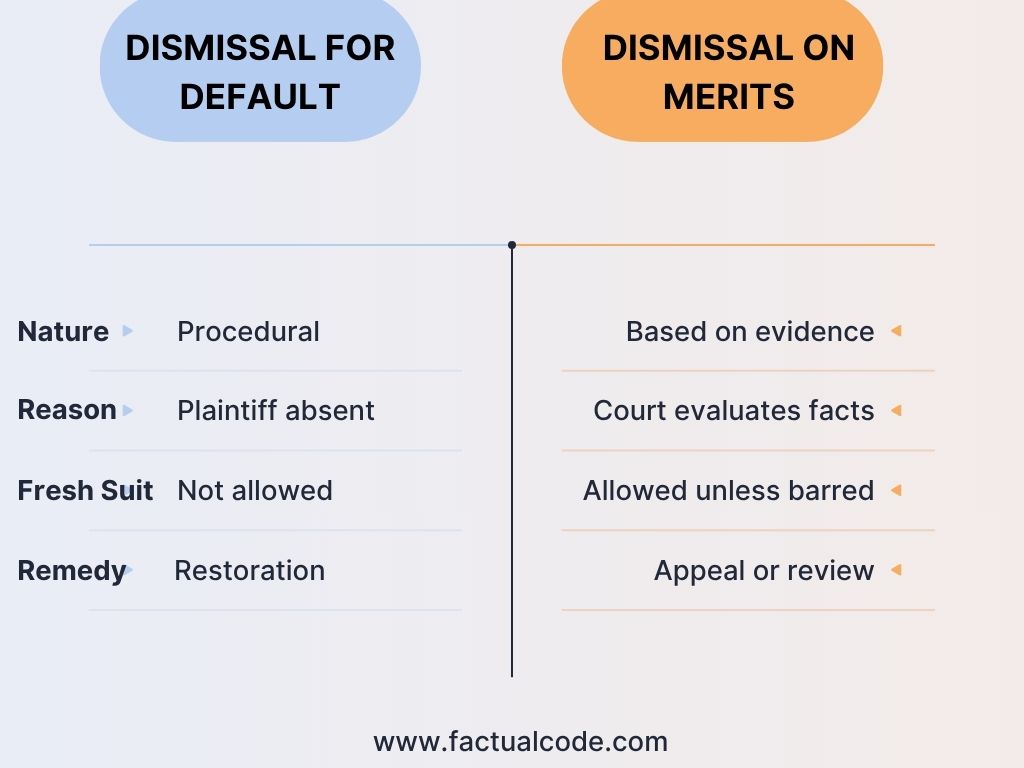
A dismissal for default occurs when the plaintiff is absent on the day of hearing while the defendant is present. It is a procedural dismissal, meaning the case is not examined on facts or evidence. This situation is governed by Order IX Rule 8 CPC.
Remedy Under Order IX Rule 9 CPC 🏛️📜✔️
Order IX Rule 9 allows the plaintiff to seek restoration by proving “sufficient cause” for their absence. This safeguard prevents plaintiffs from losing their rights because of errors, emergencies, or circumstances beyond their control.
Short Example Scenario 📝
Suppose a lawyer mistakenly notes the next hearing date as 12th May instead of 2nd May. On the actual date—2nd May—the plaintiff is absent, and the suit gets dismissed for default. After discovering the mistake, the plaintiff may file a restoration application explaining the error. Courts generally accept such genuine reasons and restore the suit.
Requirements for Restoration
Filing a restoration application.
Providing a clear and honest explanation for non-appearance.
Filing within 30 days (Article 122, Limitation Act, 1963).
Defendant receives notice.
Court must be satisfied that the absence was not deliberate or careless.
Meaning of “Sufficient Cause” 📚⚖️🧾
Courts interpret “sufficient cause” liberally to avoid injustice. Common acceptable reasons include illness, incorrect noting of dates, unexpected emergencies, transport problems, or failure of a lawyer to inform the client.
Relevant cases (showing consistent judicial approach):
- The Supreme Court held that procedural rules are meant to advance justice, not defeat it. Courts must adopt a justice-oriented approach, but such leniency is not available when the party shows intentional delay, negligence, or lack of bona fides.
Bar on Fresh Suit
Under Order IX Rule 9(1), a plaintiff cannot file a fresh suit on the same cause of action if the previous suit was dismissed for default. Restoration is the only remedy.
Procedure for Restoration
Before filing, the plaintiff must pay the required court fee for the restoration application based on local court rules.
File the restoration application.
Submit an affidavit explaining the sufficient cause.
Court issues notice to the defendant.
Both parties are heard.
If satisfied, the court restores the suit.
Once restored, the case continues from the same stage at which it was dismissed.
Limitation Period
Under Article 122 of the Limitation Act, 1963, the plaintiff has 30 days from the date of dismissal to file the restoration application. Delay may be condoned under Section 5 of the Limitation Act if sufficient cause is shown.
Nature of Order Under Rule 9
If restoration is refused → it is treated as a decree, appealable under Section 96 CPC.
If restoration is allowed → it is not appealable.
Important Case Laws
G.P. Srivastava v. R.K. Raizada (2000)
The Court emphasized a liberal interpretation of “sufficient cause” to promote justice.
Arjun Singh v. Mohindra Kumar (AIR 1964 SC 993)
The Court held that a dismissal under Order IX Rule 8 is not a decision on merits, so restoration is permissible.
Bhagwan Swaroop v. Mool Chand (1983)
The Court reaffirmed that filing a fresh suit is barred after dismissal for default; the correct remedy is restoration.
Conclusion 📘⚖️🏛️
Order IX Rule 9 provides an essential procedural safeguard, ensuring that plaintiffs do not lose their rights due to genuine mistakes or unavoidable circumstances. Key points to remember: the limitation period is 30 days, refusal of restoration is a decree (appealable), and allowing restoration is not appealable. This framework ensures fairness without compromising procedural discipline.
Quick recap: Rule 8 results in dismissal for the plaintiff’s absence, while Rule 9 offers the remedy to restore such dismissed suits.