By factualcode.com | Complete CPC Notes for LLB Students, Lawyers & Judiciary Aspirants
Looking for a complete guide to the Code of Civil Procedure, 1908 (CPC)? This comprehensive CPC guide explains important sections and orders, jurisdiction, pleadings, plaint, written statement, trial procedure, judgment and decree, execution, injunctions, appeals, and other important concepts for LLB students, lawyers, and judiciary aspirants.
🏛 Introduction
The Code of Civil Procedure, 1908 (CPC) is the principal general procedural law governing civil proceedings in India.
While substantive laws define legal rights, duties, and liabilities, the CPC provides the procedural framework and legal machinery through which civil rights are adjudicated and enforced by courts.
The CPC deals with the procedure applicable to a wide range of civil proceedings, including disputes relating to:
Property and possession
Contracts and money recovery
Injunctions
Partition
Commercial disputes
Other suits of a civil nature
The Code also lays down important rules relating to jurisdiction, institution of suits, pleadings, summons, discovery, framing of issues, trial, judgment and decree, execution, appeals, review, revision, and other civil court procedures.
“Procedure is the handmaid of justice, not its mistress.”
This principle reflects the broader judicial approach that procedural rules are intended to advance the administration of justice and should not ordinarily be treated as an end in themselves.
⚖️ 1. Basics of the Code of Civil Procedure, 1908
The Code of Civil Procedure, 1908 (CPC) is primarily a procedural law. It does not ordinarily create or define the substantive rights of parties; rather, it lays down the procedure through which civil rights and liabilities are adjudicated and enforced by courts.
What Does the CPC Aim to Achieve?
The CPC aims to provide an orderly and fair framework for the administration of civil justice. Its important objectives include:
- ⚖️ Fair adjudication of civil disputes
- 🤝 Fair opportunity to the parties to present their respective cases
- 📘 Uniform and orderly procedure for civil proceedings
- 🏛️ Judicial discipline and consistency in the conduct of proceedings
- ⚡ Expeditious and effective disposal of civil cases
- ✅ Effective enforcement of civil rights and court decrees
The CPC is therefore concerned not merely with technical procedure, but with providing the legal machinery for the effective administration of civil justice.
Scope of Civil Courts
Section 9 of the CPC lays down the general principle that civil courts have jurisdiction to try all suits of a civil nature, except those whose cognizance is expressly or impliedly barred.
Thus, jurisdiction of civil courts is the general rule, while exclusion of such jurisdiction is an exception that must arise from law.
Exam Tip: Remember the basic principle under Section 9: Civil courts have jurisdiction over suits of a civil nature unless their jurisdiction is expressly or impliedly barred.
🏛 2. Structure of the Code of Civil Procedure, 1908
The Code of Civil Procedure, 1908 (CPC) is broadly structured around two principal components:
A. Sections (Sections 1–158)
The main body of the CPC contains statutory provisions dealing with the broader framework of civil procedure, including:
- Jurisdiction of civil courts
- Institution and conduct of suits
- Place of suing
- Judgments and decrees
- Execution of decrees and orders
- Appeals, reference, review and revision
- Supplemental proceedings and other procedural matters
The Sections generally lay down the statutory framework and governing principles of civil procedure.
B. First Schedule — Orders and Rules
The First Schedule contains the detailed procedural rules arranged into Orders I to LI. These Orders prescribe the practical procedure to be followed by courts and parties in civil proceedings.
They cover matters such as:
- Parties to suits
- Pleadings
- Plaint and written statement
- Summons and service
- Discovery and inspection
- Admissions and documents
- Framing of issues
- Witnesses and trial
- Judgment and decree
- Execution
- Appeals and other proceedings
Sections vs Orders and Rules
| Component | Coverage | Primary Purpose |
|---|---|---|
| Sections | Sections 1–158 | Broad statutory framework and procedural principles |
| Orders | Orders I–LI | Detailed procedural stages and subjects |
| Rules | Rules contained within the Orders | Specific procedural requirements and mechanisms |
Important: The Orders and Rules in the First Schedule operate within the framework of the CPC. Where a rule is inconsistent with a statutory provision of the Code, the statutory provision prevails to the extent of the inconsistency.
Easy Way to Remember
Sections = broader statutory framework
Orders & Rules = detailed procedural machinery
Together, they provide the principal procedural framework for civil litigation under the CPC.
📚 3. Key Definitions under Section 2 of the CPC
Section 2 of the Code of Civil Procedure, 1908 contains important definitions used throughout the Code. Understanding these definitions is essential for understanding civil procedure and for answering LLB examination questions.
| Term | Section | Meaning |
|---|---|---|
| Decree | 2(2) | The formal expression of an adjudication which, so far as regards the Court expressing it, conclusively determines the rights of the parties with regard to all or any of the matters in controversy in the suit. |
| Judgment | 2(9) | The statement given by the Judge of the grounds of a decree or order. |
| Order | 2(14) | The formal expression of any decision of a Civil Court which is not a decree. |
| Legal Representative | 2(11) | A person who in law represents the estate of a deceased person, including a person who intermeddles with the estate and certain persons on whom the estate devolves in representative proceedings. |
| Mesne Profits | 2(12) | Profits which a person in wrongful possession of property actually received, or might with ordinary diligence have received, together with interest, excluding profits attributable to improvements made by that person. |
Important Points to Remember
1. Decree
A decree may be:
- Preliminary
- Final
- Partly preliminary and partly final
A decree may be passed in respect of the whole or part of the matters in controversy in the suit, provided the statutory requirements of Section 2(2) are satisfied.
2. Judgment and Decree
A judgment contains the grounds or reasons given by the Judge, whereas a decree is the formal expression of the adjudication that conclusively determines the rights of the parties.
3. Order
Every formal decision of a Civil Court is not necessarily a decree. A formal decision which does not amount to a decree is an order within the meaning of Section 2(14).
Exam Tip: For quick revision, remember:
Judgment = grounds of the decision
Decree = formal expression conclusively determining rights
Order = formal decision that is not a decree
⚖️ 4. Jurisdiction of Civil Courts
Jurisdiction means the legal authority of a court to hear, adjudicate, and decide a matter. Before a court proceeds with a civil case, it must have jurisdiction over the subject matter, territory, and pecuniary value, as applicable.
Main Types of Jurisdiction
- 🏛️ Subject-Matter Jurisdiction — concerns the nature or category of the dispute that a particular court is legally competent to decide.
- 🌍 Territorial Jurisdiction — concerns the geographical area within which a court can exercise its authority.
- 💰 Pecuniary Jurisdiction — concerns the monetary value of a suit that a court is competent to entertain.
Important CPC Provisions
Section 9 — Jurisdiction of Civil Courts
Section 9 lays down the general rule that civil courts have jurisdiction to try all suits of a civil nature, except suits whose cognizance is expressly or impliedly barred by law.
Section 10 — Res Sub Judice
Section 10 provides for the stay of trial of a subsequently instituted suit where the matter in issue is directly and substantially in issue in a previously instituted suit between the same parties, or parties claiming under them, subject to the statutory conditions.
Section 11 — Res Judicata
Section 11 embodies the doctrine of res judicata, which prevents a court from trying a suit or issue that has already been directly and substantially decided in a former suit between the parties or persons claiming under them, where the statutory requirements are satisfied.
Place of Suing
The CPC also contains specific provisions governing where a suit should be instituted:
- Section 15 — Court in which suits are to be instituted
- Section 16 — Suits concerning immovable property
- Sections 17–18 — Immovable property situated within the jurisdiction of different or uncertain courts
- Section 19 — Suits for compensation for wrongs to person or movables
- Section 20 — Other suits, including cases based on the defendant’s residence or where the cause of action arises
Easy Way to Remember
Section 9 → Can the civil court hear the suit?
Sections 15–20 → Where should the suit be filed?
Section 10 → Is a similar matter already pending?
Section 11 → Has the matter already been finally decided?
Exam Tip: Do not describe Sections 10 and 11 simply as “types of jurisdiction.” They are important procedural doctrines dealing with parallel proceedings and finality of litigation, although they are located under the CPC’s heading concerning jurisdiction and res judicata.
📝 5. Parties & Pleadings
A civil suit is ordinarily instituted by presenting a plaint before the competent court. The plaint sets out the plaintiff’s case, while the defendant ordinarily responds through a written statement.
Pleadings are fundamental to civil litigation because they identify the material facts and issues in dispute between the parties.
Essentials of a Plaint
A plaint generally contains:
- 👥 Particulars of the parties
- 📝 Material facts constituting the cause of action
- 📍 Facts establishing jurisdiction
- 💡 Relief or reliefs claimed
- 💰 Valuation of the suit and court-fee particulars, where applicable
- 🏠 Description of the subject matter or property, where necessary
- ✍️ Verification and other procedural requirements
The plaint must contain the material facts on which the plaintiff relies, rather than the evidence by which those facts are to be proved.
Written Statement
The defendant ordinarily answers the plaint by filing a written statement. It may contain:
- Specific admissions or denials
- Preliminary or legal objections
- Defences available to the defendant
- Set-off, where legally permissible
- Counterclaim, where applicable
- Other facts constituting the defendant’s defence
The written statement is governed principally by Order VIII CPC.
Pleadings and Amendment
Pleadings are governed principally by Order VI CPC. The CPC also provides for amendment of pleadings under Order VI Rule 17, subject to the statutory requirements and judicial principles governing such amendments.
Return of Plaint vs Rejection of Plaint
A return of plaint and rejection of plaint are legally different concepts.
| Feature | Return of Plaint | Rejection of Plaint |
|---|---|---|
| Provision | Order VII Rule 10 | Order VII Rule 11 |
| Basic idea | Plaint is returned for presentation to the court in which the suit should have been instituted | Plaint is rejected when one or more specific statutory grounds under Rule 11 are satisfied |
| Effect | The plaint is returned for presentation before the appropriate court | Rejection of the plaint brings the suit to an end at that stage, subject to the remedies available in law |
| Key point | Concerned principally with the proper court for institution | Concerned with the statutory grounds for rejection of the plaint |
Exam Tip: Remember the distinction:
Order VII Rule 10 → Return of Plaint
Order VII Rule 11 → Rejection of PlaintDo not treat every defect in a plaint as a ground for rejection. Rule 11 contains specific statutory grounds for rejection.
⚖️ 5A. Pre-Trial Procedure under the CPC
Pre-trial procedure refers to the procedural steps generally undertaken after institution of a suit and before the actual trial. Its purpose is to ensure proper notice to the parties, clarify the pleadings, identify the documents and matters in dispute, and prepare the case for trial.
🔹 Main Stages
- Summons & Service — Order V: The defendant is formally notified of the suit and required to appear and answer the claim.
- Appearance of Parties — Order IX: The CPC provides for appearance and consequences of non-appearance, including ex parte proceedings in appropriate cases.
- Pleadings — Orders VI & VIII: The plaint, written statement, set-off and counterclaim define the claims, defences and matters in controversy.
- Discovery & Inspection — Order XI: Relevant information and documents may be disclosed and inspected in accordance with the applicable procedure.
- Admissions — Order XII: Admissions can narrow the controversy and, where legally permissible, may enable judgment on admissions.
- Documents — Order XIII: The production, admission, rejection, impounding and return of documents are dealt with under the CPC.
- Settlement / Framing of Issues — Order XIV: The court identifies the material questions of fact and law actually in dispute, which form the framework for the trial.
🔄 Simple Flow
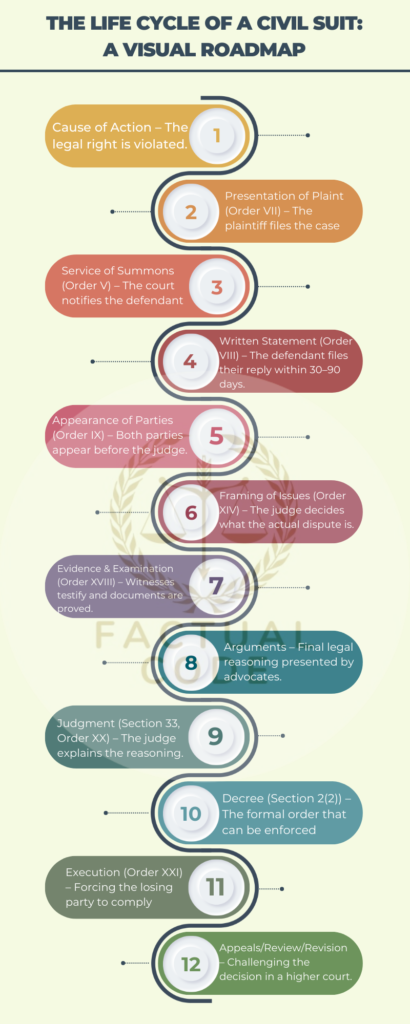
Institution of Suit → Summons → Appearance → Pleadings → Discovery & Documents → Admissions → Framing of Issues → Trial
🎯 Exam Point
The pre-trial stage prepares the case for effective adjudication by identifying the real controversy, narrowing disputed matters and determining the issues that require trial.
Easy memory:
Summons → Appearance → Pleadings → Discovery → Documents → Issues → Trial
🤝 5B. Alternative Dispute Resolution (ADR)
Section 89 of the Code of Civil Procedure, 1908 provides a framework for settlement of disputes outside the court where the court finds that the dispute may be capable of settlement and there are elements of settlement acceptable to the parties.
Under the current framework, Section 89 permits the court to refer the dispute to:
- Arbitration — governed by the Arbitration and Conciliation Act, 1996.
- Mediation — including court-annexed mediation or mediation through another mediation service provider/mediator, governed by the Mediation Act, 2023.
- Lok Adalat — in accordance with the Legal Services Authorities Act, 1987.
- Judicial settlement/compromise — where the court facilitates a settlement between the parties.
The present Section 89 framework was substituted through the Mediation Act, 2023, which came into force on 9 October 2023.
🔄 Basic ADR Process
Dispute before the Civil Court
↓
Court identifies elements of settlement
↓
Reference to an appropriate ADR mechanism under Section 89
↓
Settlement reached → settlement is given effect according to the applicable law
OR
No settlement → matter proceeds before the court in accordance with law
⚖️ Important Point
ADR is intended to facilitate settlement rather than replace judicial adjudication in every case. For example, a Lok Adalat does not adjudicate a dispute like a civil court; it facilitates settlement on the basis of compromise between the parties. If settlement is not reached, the matter is returned to the referring court for disposal according to law.
📌 Exam Tip
Remember:
Section 89 CPC = Settlement of disputes outside the Court
For detailed study, understand the distinction between arbitration, mediation, conciliation, Lok Adalat and judicial settlement, along with the effect of a successful or unsuccessful ADR reference.
⚔️ 6. Trial Procedure
After pleadings are completed, the suit proceeds through the stages required for adjudication. The exact sequence may vary depending on the nature of the suit and the orders passed by the court.
📋 Major Stages of Trial
- Framing of Issues — The court identifies the material propositions of fact or law in dispute between the parties under Order XIV CPC.
- Production and Recording of Evidence — Parties lead evidence in support of their respective cases, subject to the applicable procedural and evidentiary rules.
- Examination of Witnesses — Witnesses may be examined, cross-examined and, where permitted, re-examined.
- Final Arguments — After evidence is completed, the parties address the court on the facts, law and evidence supporting their respective cases.
- Judgment — The court considers the pleadings, issues, evidence and submissions before pronouncing judgment in accordance with the CPC.
⚠️ Non-Appearance of a Party
Failure of a party to appear does not produce the same consequence in every situation. Depending on which party is absent and the stage of the proceedings, the court may proceed under the applicable provisions of the CPC.
Possible consequences include:
- Ex parte proceedings/decree against a defendant who fails to appear despite due service of summons, subject to the requirements of Order IX.
- Dismissal of the suit for non-appearance in circumstances covered by Order IX.
- Restoration of a suit or setting aside of an ex parte decree, where the statutory requirements and applicable limitation provisions are satisfied.
🧠 Easy Trial Flow
Pleadings
↓
Issues
↓
Evidence
↓
Examination / Cross-Examination of Witnesses
↓
Final Arguments
↓
Judgment & Decree
Exam Tip: The trial stage is not merely the examination of witnesses. It is the adjudicatory process through which the court determines the disputed issues on the basis of the pleadings, evidence and submissions of the parties.
📂 6A. Special Suits
The CPC contains special procedural provisions for particular classes of suits, litigants and situations. Important examples include:
⚡ Summary Suits — Order XXXVII
Order XXXVII provides a special and expedited procedure for specified classes of suits, including certain suits based on written contracts and suits relating to bills of exchange, hundies and promissory notes.
The defendant does not have an unconditional right to defend a summary suit. The defendant must enter appearance and, where required, obtain leave to defend in accordance with Order XXXVII.
🏛️ Suits Against the Government — Section 80
Section 80 generally requires two months’ prior notice before instituting a suit against the Government or a public officer in respect of an act purportedly done in official capacity.
Exception: Under Section 80(2), a suit seeking urgent or immediate relief may be instituted with the leave of the court without serving the notice required by Section 80(1), subject to the statutory requirements.
Non-compliance with Section 80(1), where the Section 80(2) exception does not apply, may render the suit not maintainable and the plaint liable to rejection under Order VII Rule 11(d).
💰 Suits by Indigent Persons — Order XXXIII
Order XXXIII permits a person who satisfies the statutory requirements relating to indigency to institute a suit without paying the prescribed court fee at the initial stage.
The court may inquire into the applicant’s means and may reject or revoke permission in circumstances provided by the CPC. The liability relating to court fees is dealt with under the applicable provisions of Order XXXIII and the relevant court-fee law.
👶 Suits by or Against Minors and Persons of Unsound Mind — Order XXXII
Order XXXII provides special safeguards for suits involving minors and persons of unsound mind.
A minor ordinarily sues through a next friend, while a minor defendant is represented through a guardian for the suit appointed in accordance with the CPC.
🔀 Interpleader Suits — Section 88 & Order XXXV
An interpleader suit enables a person who claims no interest in the subject matter except the charges or costs properly claimable and who is ready to hand it over to the rightful claimant to require rival claimants to litigate their competing claims.
The plaintiff therefore seeks the court’s determination as to which defendant is entitled to the subject matter, rather than claiming the property for himself.
📌 Important Safeguards & Consequences
- In a summary suit, failure to obtain leave to defend may result in the plaintiff becoming entitled to judgment, subject to the requirements of Order XXXVII.
- In a suit covered by Section 80(1), failure to serve the required notice may make the suit not maintainable and may lead to rejection of the plaint where the statutory requirements for Order VII Rule 11(d) are satisfied.
- In an indigent-person suit, exemption from payment of court fee at the institution stage does not necessarily mean that court fee is permanently extinguished; the CPC contains provisions dealing with recovery and payment of court fees in specified circumstances.
🧠 Easy Memory
O. XXXVII → Summary Suits
S. 80 → Government Notice
O. XXXIII → Indigent Persons
O. XXXII → Minors & Persons of Unsound Mind
S. 88 + O. XXXV → Interpleader
📜 7. Judgment, Decree & Order
After hearing the parties and considering the issues, pleadings and evidence, the court pronounces its judgment. The judgment provides the grounds for the decision, while the resulting decree, where the adjudication amounts to a decree within Section 2(2), formally expresses the court’s adjudication of the rights of the parties.
An order is the formal expression of a decision of a Civil Court which does not amount to a decree.
⚖️ Judgment vs Decree vs Order
| Feature | Judgment | Decree | Order |
|---|---|---|---|
| CPC provision | Section 2(9) | Section 2(2) | Section 2(14) |
| Meaning | Statement of the grounds of a decree or order | Formal expression of an adjudication conclusively determining rights of parties regarding matters in controversy in the suit | Formal expression of a decision of a Civil Court which is not a decree |
| Main function | Explains the basis/reasons for the decision | Formally expresses the adjudication of rights | Records a decision that does not amount to a decree |
| Appeal/execution | Its legal effect depends on the decision and applicable provision | Decrees are generally executable and may be appealable subject to the CPC | Certain orders are appealable under Section 104 and Order XLIII; other orders may not be independently appealable |
📌 Important Points
- A decree may be preliminary, final, or partly preliminary and partly final.
- A judgment generally precedes and provides the reasons for the decree or order.
- Not every judicial decision is a decree; an order is a formal decision that does not satisfy the statutory definition of a decree.
- The distinction is important for determining appeal rights, execution and available procedural remedies.
🧠 Easy Memory
Judgment → Grounds / Reasons
Decree → Formal adjudication of rights
Order → Formal decision that is not a decree
💰 8. Execution Proceedings
A successful decree does not always result in immediate satisfaction of the relief granted by the court. Where the judgment-debtor does not voluntarily comply, the decree-holder may seek execution of the decree in accordance with the CPC.
Execution proceedings are principally governed by Sections 36–74 CPC and Order XXI CPC.
⚖️ Important Provisions
- Sections 36–74 CPC — General provisions relating to execution.
- Section 47 CPC — Questions relating to execution, discharge or satisfaction of the decree are determined by the executing court.
- Order XXI CPC — Detailed procedure and modes of execution.
🔨 Common Modes of Execution
Depending on the nature of the decree, the court may enforce it through one or more modes recognised by the CPC, including:
- 🔒 Attachment and Sale of Property
- 🏠 Delivery of Possession of Property
- 🚨 Arrest and Detention in Civil Prison, subject to the statutory safeguards and conditions
- 👤 Appointment of a Receiver
- 📜 Execution of a document or endorsement by the court where permitted by the CPC
- 💰 Other modes provided under Order XXI, depending on the nature of the decree
👥 Decree-Holder & Judgment-Debtor
The person in whose favour a decree has been passed is generally called the decree-holder, while the person against whom the decree has been passed is the judgment-debtor.
🧠 Easy Execution Flow
Decree Passed
↓
Voluntary Compliance → Relief Satisfied
OR
Execution Application
↓
Executing Court
↓
Appropriate Mode of Execution
↓
Decree Satisfied
📌 Exam Tip
Remember:
Sections 36–74 = General framework of execution
Section 47 = Questions relating to execution, discharge or satisfaction
Order XXI = Detailed execution procedure
The executing court ordinarily cannot go behind the decree; its function is to enforce the decree according to law rather than reopen the merits of the original adjudication.
🔁 9. Appeals, Review, Revision & Reference
The Code of Civil Procedure, 1908 provides several procedural remedies for challenging, reconsidering, or obtaining judicial guidance regarding civil court decisions. The principal remedies are Appeal, Review, Revision, and Reference.
| Remedy | Meaning | Principal CPC Provision |
|---|---|---|
| Appeal | A statutory remedy by which a decision is challenged before a higher court, subject to the conditions prescribed by law. | Sections 96–112 |
| Review | Reconsideration of a judgment or order by the same court that passed it, on the limited grounds permitted by law. | Section 114 & Order XLVII |
| Revision | Supervisory jurisdiction of the High Court in specified cases where a subordinate court has exercised jurisdiction illegally or with material irregularity, subject to Section 115. | Section 115 |
| Reference | A subordinate court refers a case involving a question of law to the High Court for its decision in circumstances provided by the CPC. | Section 113 & Order XLVI |
Important Types of Appeals
- First Appeal: Generally lies from an original decree under Section 96 CPC, subject to statutory exceptions.
- Second Appeal: Lies to the High Court under Section 100 CPC only when the case involves a substantial question of law.
- Appeal from Orders: Certain specified orders are appealable under Section 104 and Order XLIII Rule 1 CPC.
- Appeals to the Supreme Court: Governed principally by Section 109 CPC, together with the constitutional and other statutory framework applicable to the case.
Easy Way to Remember
Appeal → Higher Court
Review → Same Court
Revision → High Court’s limited supervisory jurisdiction
Reference → Subordinate Court → High Court
Exam Tip: Appeal is a statutory right where the law provides it; review is a limited power of the same court; revision is a restricted supervisory jurisdiction under Section 115; and reference involves obtaining the High Court’s decision on a question of law in the circumstances specified by the CPC.
⚡ 10. Interim & Supplemental Relief under the CPC
Civil courts may grant certain interim or supplemental reliefs during the pendency of proceedings to preserve the subject matter of the dispute, prevent frustration of the proceedings, or protect the interests of the parties until the matter is finally decided.
Common Interim & Supplemental Reliefs
- ⛔ Temporary Injunctions — principally governed by Section 94(c) and Order XXXIX CPC
- 👤 Appointment of a Receiver — Section 94(d) and Order XL CPC
- 📌 Attachment Before Judgment — Section 94(b) and Order XXXVIII CPC
- ⏸ Stay of Proceedings or Execution — available under various provisions of the CPC depending on the proceeding
- 📜 Commissions — principally governed by Sections 75–78 and Order XXVI CPC
- 🛡️ Security and Other Supplemental Measures — Section 94 permits the court to adopt specified supplemental proceedings where necessary to prevent the ends of justice from being defeated.
Section 151 CPC — Inherent Powers of the Court
Section 151 preserves the court’s inherent powers to make orders necessary:
- to secure the ends of justice; or
- to prevent abuse of the process of the court.
These powers are supplementary in nature and are not intended to override or circumvent an express provision of the CPC. Where the Code specifically provides a procedure or remedy, Section 151 ordinarily cannot be used to defeat that statutory scheme.
Easy Memory
Injunction → Preserve / restrain
Receiver → Protect / manage property
Attachment Before Judgment → Secure claim
Stay → Suspend proceedings or execution
Commission → Assist the court in specified matters
Section 151 → Ends of justice + Prevent abuse of process
Exam Tip: Section 151 does not create an independent substantive right of relief. It preserves the court’s inherent procedural powers where their exercise is necessary to secure the ends of justice or prevent abuse of the process of the court.
| Order | Topic |
|---|---|
| Order I | Parties to Suits |
| Order V | Summons and Service of Summons |
| Order VI | Pleadings Generally |
| Order VII | Plaint |
| Order VIII | Written Statement, Set-off and Counterclaim |
| Order IX | Appearance of Parties and Consequences of Non-Appearance |
| Order XIV | Settlement of Issues |
| Order XVIII | Hearing of the Suit and Examination of Witnesses |
| Order XXI | Execution of Decrees and Orders |
| Order XXXVII | Summary Procedure |
| Order XXXVIII | Arrest and Attachment Before Judgment |
| Order XXXIX | Temporary Injunctions and Interlocutory Orders |
| Order XL | Appointment of Receivers |
| Order XLI | Appeals from Original Decrees |
| Order XLIII | Appeals from Orders |
| Order XLVI | Reference |
| Order XLVII | Review |
🏁 Conclusion
The Code of Civil Procedure, 1908 (CPC) is the principal procedural framework governing civil litigation in India. It provides the procedural machinery through which civil disputes are instituted, adjudicated, decided, and, where necessary, enforced.
From jurisdiction and institution of suits to pleadings, summons, issues, trial, judgment and decree, execution, appeals, review, revision, reference, and interim relief, the CPC regulates the major stages of civil proceedings.
The CPC may appear extensive because its provisions are spread across Sections and Orders, but its structure becomes much easier to understand when studied stage by stage.
For LLB students, the most effective approach is to understand the overall scheme of the CPC first and then study individual Sections, Orders, Rules, and leading case laws in detail.
In short: Understand the structure first, then master the provisions.
References- THE CODE OF CIVIL PROCEDURE, 1908