
📘 Start with the CPC Master Guide
1. Introduction
Jurisdiction is a fundamental concept in civil procedure. It refers to the legal authority of a court to hear and decide disputes brought before it. Without jurisdiction, a court cannot validly adjudicate a case, and any decision delivered without jurisdiction may be treated as legally ineffective.
The jurisdiction of civil courts in India is primarily governed by Section 9 of the Code of Civil Procedure, 1908 (CPC). This provision establishes the general rule that civil courts shall have jurisdiction to try all suits of a civil nature, except those whose cognizance is expressly or impliedly barred by law.
Thus, Section 9 embodies the principle that civil courts are the ordinary courts of justice for enforcement of civil rights.
2. The Twin Conditions under Section 9 CPC
For a civil court to exercise jurisdiction under Section 9 CPC, two essential conditions must exist simultaneously:
(1) The Suit Must Be of a Civil Nature
The dispute must involve civil rights or obligations, such as rights relating to property, contracts, inheritance, or other legally enforceable rights.
(2) Cognizance Must Not Be Barred
The jurisdiction of the civil court must not be excluded by any statute, either:
Expressly, or
By necessary implication.
Only when both conditions are satisfied can the court entertain the suit.
3. Meaning of “Suit of a Civil Nature“
The expression “suit of a civil nature“ is interpreted broadly by courts. It includes disputes concerning private rights and obligations between individuals or entities.
Civil courts may entertain disputes even if they contain religious or social elements, provided the matter involves an enforceable civil right.
Examples of Suits of Civil Nature
Civil courts may adjudicate disputes relating to:
Ownership or possession of property
Breach of contract
Recovery of money or damages
Specific performance of agreements
Easement rights
Inheritance and succession
Right to worship
Management of religious property
4. The Principal Question Test
Courts frequently apply the Principal Question Test to determine whether a suit is of a civil nature.
If the principal issue concerns religious rites or ceremonies, the dispute is not considered a civil matter.
If the principal issue concerns a civil right, and the religious element is merely incidental, the suit remains one of a civil nature.
For example, a dispute relating to the management or control of temple property is considered a civil dispute because it involves property rights.
5. Explanation II to Section 9 CPC
Explanation II to Section 9 provides further clarification regarding civil disputes.
It states that a suit relating to an office is a suit of a civil nature, even when:
The office is connected with a religious institution, and
No remuneration or fees are attached to the office.
Therefore, disputes regarding the right to hold or occupy a religious office may still fall within the jurisdiction of civil courts.
6. Presumption in Favour of Jurisdiction
An important principle governing civil court jurisdiction is the presumption in favour of jurisdiction.
Civil courts are regarded as the general courts of justice for enforcing civil rights. Therefore, when a dispute arises, courts ordinarily assume jurisdiction unless a statute clearly excludes it.
Burden of Proof
Where a party claims that the jurisdiction of the civil court is barred, the burden of proof lies on that party to establish such exclusion.
Thus:
Jurisdiction is presumed to exist, and
The party alleging exclusion must prove it.
This principle ensures that individuals are not deprived of judicial remedies unless the legislature clearly intends such exclusion.
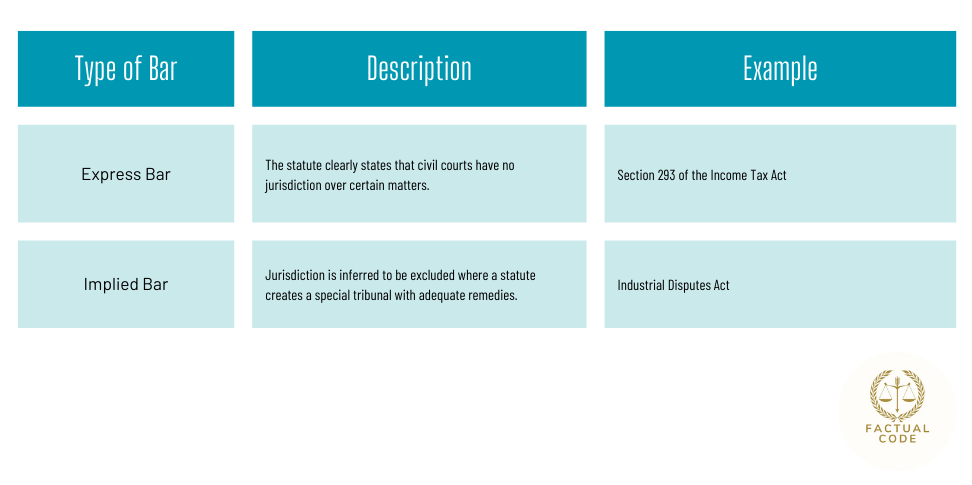
7. Bar of Jurisdiction of Civil Courts
Although civil courts possess wide jurisdiction, certain statutes may exclude their authority in specific matters.
The exclusion of jurisdiction may occur in two ways:
8. Types of Jurisdiction of Civil Courts
Civil court jurisdiction may be classified into several categories.
(1) Territorial Jurisdiction
Territorial jurisdiction refers to the geographical limits within which a court can exercise authority.
Sections 16–19 CPC deal with suits relating to:
Immovable property
Wrong to person or movable property
Section 20 – Residual Provision
Section 20 acts as a residual or catch‑all provision for suits not covered under Sections 16–19.
Under this section, a suit may be instituted where:
The defendant resides or carries on business, or
The cause of action arises wholly or in part.
(2) Pecuniary Jurisdiction
Pecuniary jurisdiction refers to the monetary limits within which courts are authorized to try suits.
Each court is empowered to hear cases depending on the value of the subject matter of the dispute, and suits must be filed before the court competent according to these limits.
(3) Subject‑Matter Jurisdiction
Subject‑matter jurisdiction refers to the authority of a court to decide specific types of cases.
Examples include:
Family Courts dealing with matrimonial disputes
Small Causes Courts dealing with minor civil claims
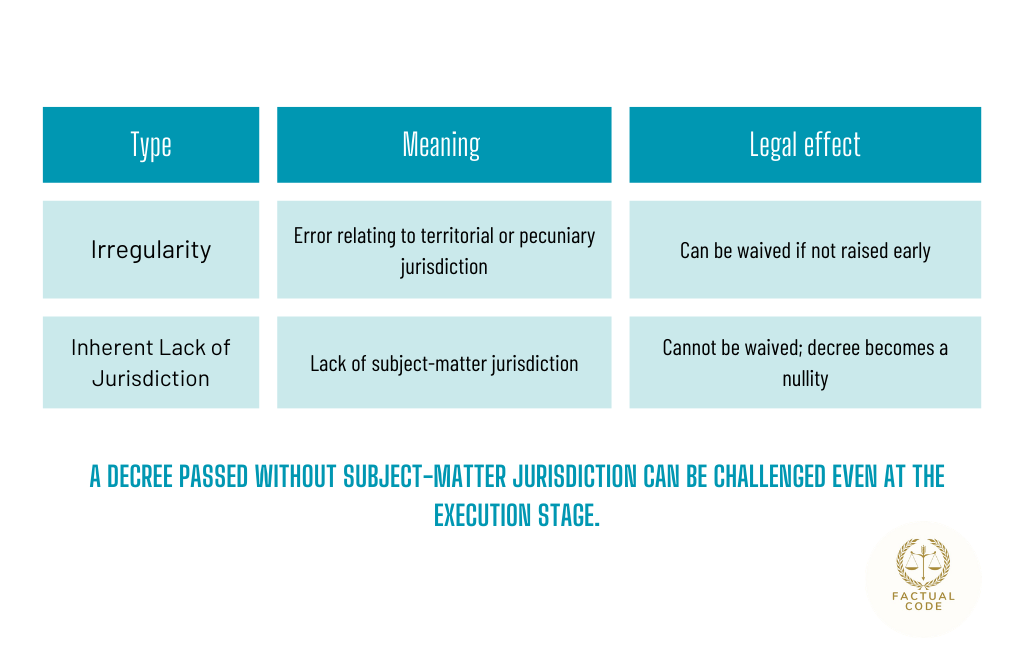
If a court lacks subject‑matter jurisdiction, any decree passed by it is void and without legal effect.
(4) Personal Jurisdiction
Personal jurisdiction refers to the authority of a court over the parties to the suit, particularly the defendant.
A court may exercise jurisdiction over a person if the defendant:
Resides within the territorial limits of the court
Carries on business within that jurisdiction
Is connected to the cause of action arising in that territory
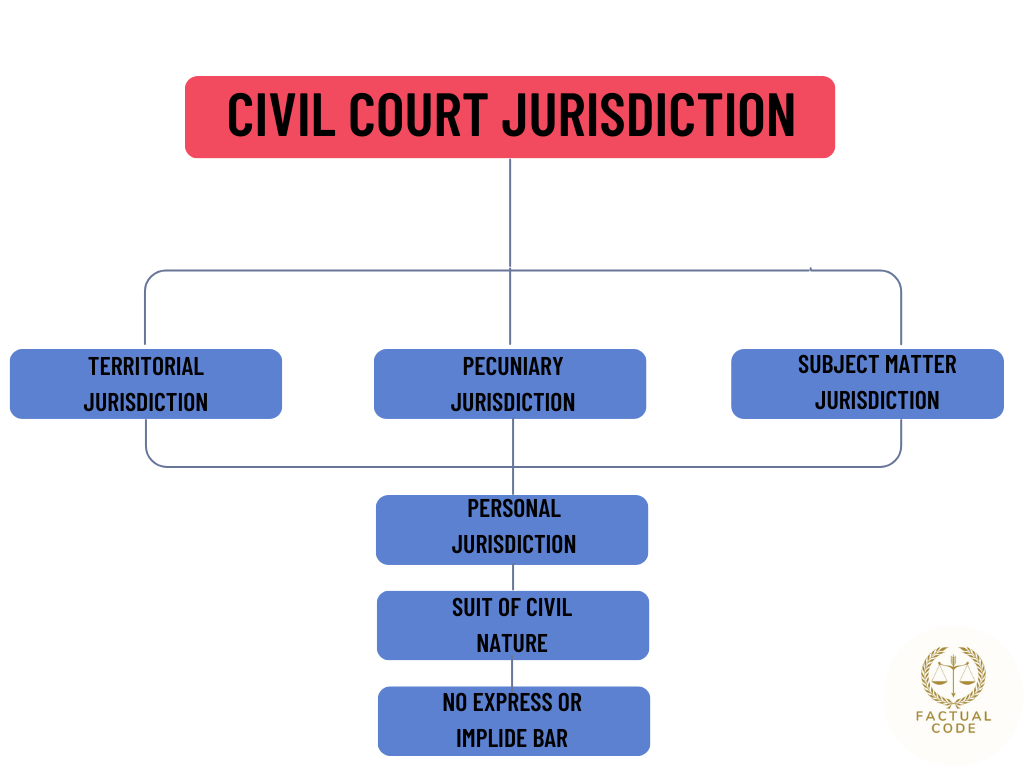
9. Hierarchy of Jurisdiction (Conceptual Overview)
A civil court must satisfy several jurisdictional requirements simultaneously before entertaining a suit.
10. Objections to Jurisdiction – Section 21 CPC
Section 21 CPC provides that objections relating to territorial or pecuniary jurisdiction must be raised at the earliest possible opportunity.
If a party fails to raise such objections at the proper stage, the objection may be deemed waived.
This rule prevents parties from challenging jurisdiction only after an adverse judgment.
11. Irregularity vs Inherent Lack of Jurisdiction
A distinction must be made between procedural irregularity and inherent lack of jurisdiction.
12. Judicial Interpretation
Courts have clarified the scope of civil court jurisdiction through several important judicial decisions.
In the landmark case Dhulabhai v. State of Madhya Pradesh (1968), the Supreme Court laid down seven propositions concerning the exclusion of civil court jurisdiction.
Key Principles from the Dhulabhai Case
Proposition 1: Where a statute gives finality to decisions of special tribunals and provides adequate remedies, civil court jurisdiction is excluded.
Proposition 2: Civil courts may still intervene where the tribunal fails to follow the fundamental principles of judicial procedure.
Proposition 3: If provisions of a statute are declared ultra vires, civil courts retain jurisdiction.
Another important decision, Secretary of State v. Mask and Co. (1940), established that exclusion of civil court jurisdiction should not be readily inferred unless clearly expressed or implied.
13. Ouster of Jurisdiction by Agreement
In commercial transactions, parties sometimes include exclusive jurisdiction clauses, specifying that disputes shall be resolved by courts in a particular place.
However, the following principles apply:
Parties cannot confer jurisdiction on a court that inherently lacks jurisdiction.
Where two or more courts are competent, parties may choose one of them by agreement.
Such clauses are generally upheld when they select one among multiple competent forums.
14. Forum Non Conveniens
Courts may sometimes apply the doctrine of forum non conveniens, particularly in cases involving inter‑state or international disputes.
Under this doctrine, a court that technically possesses jurisdiction may decline to exercise it if another forum is clearly more appropriate for adjudication.
Factors considered by courts include:
Convenience of witnesses and parties
Availability of evidence
Place where the cause of action substantially arose
Overall interests of justice
Although the doctrine is more frequently applied in international litigation, it reflects the principle that disputes should be resolved in the most appropriate and convenient forum.
15. Conclusion
The jurisdiction of civil courts forms the foundation of the civil justice system. Section 9 CPC ensures that courts can adjudicate disputes involving civil rights unless jurisdiction is clearly excluded by law.
The provision reflects the fundamental legal maxim:
Ubi Jus Ibi Remedium — Where there is a right, there is a remedy.
By providing broad access to courts for enforcement of civil rights, The law promotes the effective administration of justice by ensuring that disputes are resolved by competent courts having proper jurisdiction.