📘 Start with the CPC Master Guide
1. Introduction (Constitutional Perspective) ⚖️🇮🇳✨
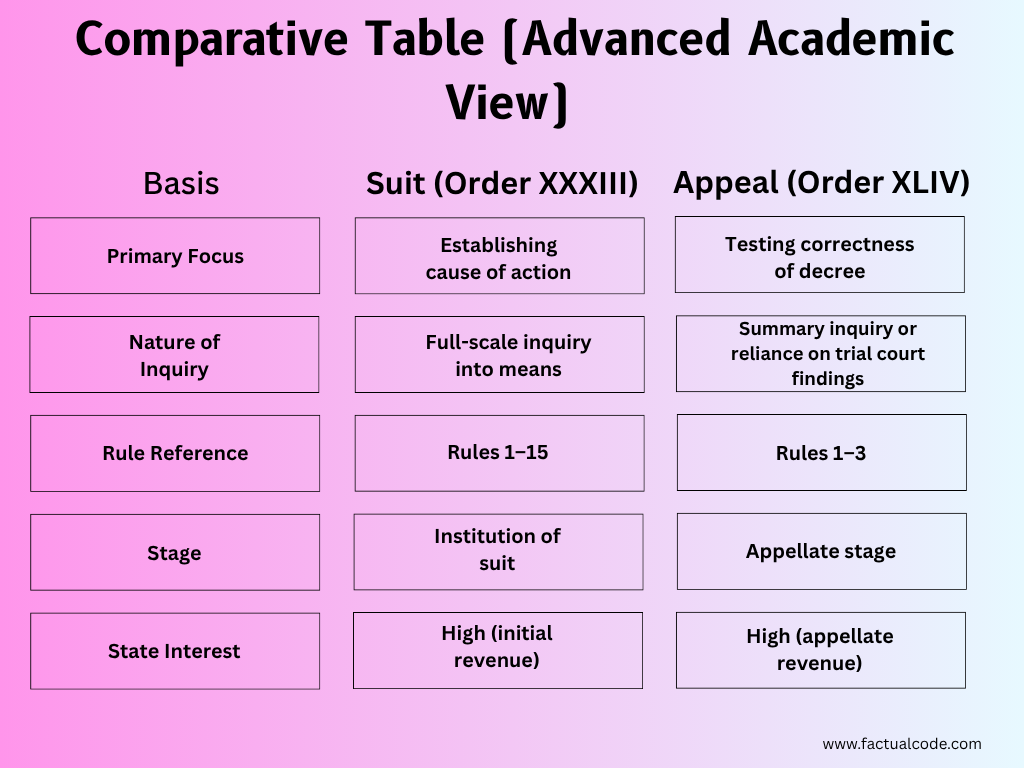
The Code of Civil Procedure, 1908 provides a mechanism for appeals by indigent persons under Order XLIV, ensuring that financial incapacity does not obstruct access to justice. ⚖️💰✨
This provision is a procedural reflection of Article 39A of the Constitution of India, which mandates the State to ensure equal justice and provide free legal aid. Thus, Order XLIV represents the practical implementation of constitutional principles, enabling economically weaker sections to exercise their statutory right of appeal. 🇮🇳⚖️✨
Historically, this concept was referred to as a “Pauper Appeal”, a term replaced by “indigent person” after the 1976 amendment. However, the older terminology still appears in judicial decisions and examinations. 📜⚖️✨
2. Meaning of Indigent Person 💼⚖️✨
Order XLIV adopts the definition from Order XXXIII Rule 1 CPC. 📘⚖️✨
An indigent person is one: 💰⚖️✨
Who does not possess sufficient means to pay court fees;
Whose property (excluding exempt property and the subject matter of the suit) is insufficient to pay such fees.
Interpretation of “Sufficient Means” 🔍⚖️✨
It does not imply absolute poverty or destitution.
It refers to the capacity to raise funds to pay the required court fees.
Case Law 📚⚖️✨
Mathai M. Paikeday v. C.K. Antony (2011): “Sufficient means” must be assessed practically and realistically.
A.A. Haja Muniuddin v Indian Railways (1992): The Supreme Court affirmed that access to justice is a high priority. It held that even Tribunals must allow indigent persons to seek remedies, as poverty should not be a bar to legal redress.
3. Statutory Framework (Order XLIV CPC) 📘⚖️✨
Order XLIV Rule 1 📜⚖️✨
Any person entitled to appeal may apply to do so as an indigent person. ⚖️📘✨
Proviso to Rule 1 ⚠️⚖️✨
The court shall reject the application if: ⚖️❗✨
The decree is not erroneous; or
The appeal lacks merit or justification.
This introduces a higher threshold compared to ordinary appeals.
Since Order XLIV operates in the appellate stage, understanding the distinction between a judgment and decree under CPC is also useful.
Order XLIV Rule 1-A (Death of Applicant) ⚖️👤✨
If the applicant dies during the pendency of the application: ⚖️📌✨
The legal representative (LR) may continue the application, provided that:
The LR is also indigent; or
The estate is insufficient to pay court fees.
4. Application Process 📝⚖️✨
(A) Filing Requirements 📄⚖️✨
The applicant must submit: 📝⚖️✨
A Memorandum of Appeal; and
An application to appeal as an indigent person.
(B) Contents of Application 📋⚖️✨
Full particulars of property
A statement showing inability to pay court fees
Verification similar to a plaint
5. Limitation Period and Doctrine of Relation Back ⏳⚖️✨
The limitation is governed by the Limitation Act, 1963 ,and the applicable period must be computed according to the rules governing limitation.
Under Article 128: The limitation period is generally 30 days.
Doctrine of Relation Back (Deeming Fiction) 🔁⚖️✨
Where: ⚖️📌✨
An application to appeal as an indigent person is rejected; and
The court grants time to pay court fees,
Then, upon payment of court fees: ⚖️💰✨
The appeal is deemed to have been filed on the date of the original application.
Thus, the appeal is not barred by limitation, as the payment relates back to the initial filing date. This principle is known as the Doctrine of Relation Back and is frequently tested in judiciary examinations. ⚖️📚✨
6. Inquiry Mechanism (Order XLIV Rule 3 CPC) 🔍⚖️✨
Modes of Inquiry ⚖️📊✨
The appellate court may: ⚖️📌✨
Conduct the inquiry itself
Direct an officer of the court to conduct the inquiry
Direct the trial court to conduct the inquiry and submit a report
When Inquiry May Be Dispensed With (Rule 2) ⚖️📘✨
If the applicant was already declared indigent in the trial court: ⚖️📌✨
No fresh inquiry is required;
Unless there is a change in financial circumstances.
Role of Government Pleader ⚖️🏛️✨
Notice is issued to the Government Pleader because: ⚖️📌✨
The State has a direct financial interest in the recovery of court fees; and
The Government Pleader acts as a watchdog to prevent misuse of indigent status.
7. Rejection vs. Grant of Leave ⚖️❗✨
Grounds for Rejection ⚖️📌✨
The applicant is not indigent
The application is defective
The appeal lacks merit (Rule 1 proviso)
The application is fraudulent or vexatious
Grant of Permission ⚖️✅✨
The appeal proceeds without initial payment of court fees
Full appellate rights are preserved
8. Post-Decision Scenarios 🔄⚖️✨
(A) If Application is Rejected ⚖️❗✨
The court may grant time to pay court fees
Upon payment:
The appeal becomes a regular appeal; and
The Doctrine of Relation Back applies
(B) Recovery of Court Fees ⚖️💰✨
| Situation | Consequence |
|---|---|
| Appeal succeeds | Fees are recovered from the respondent |
| Appeal fails | The State may recover fees from the appellant |
(C) Withdrawal of Indigent Status ⚖️🚫✨
The court may revoke permission if: ⚖️📌✨
There is misrepresentation
The applicant acquires sufficient means
There is abuse of the process of the court
9. Applicability to Appeals from Orders ⚖️📘✨
Although Order XLIV primarily applies to appeals from decrees, similar principles are generally applied to appeals from orders under Order XLIII, where court fees are payable. ⚖️📊✨
10. Object and Jurisprudential Significance ⚖️📖✨
Ensures access to justice irrespective of economic status
Prevents denial of appellate remedies due to poverty
Reflects principles of:
Equality before law (Article 14)
Free legal aid (Article 39A)
Order XLIV serves as a procedural bridge between statutory law and constitutional mandates, thereby reinforcing substantive justice. ⚖️🌉✨
11. Conclusion ⚖️✅✨
The provision for appeal by indigent persons under Order XLIV CPC ensures that the right to appeal is not defeated by financial incapacity. By incorporating procedural safeguards, judicial scrutiny, and the Doctrine of Relation Back, it upholds fairness, inclusivity, and access to justice in the appellate process. ⚖️📚✨
12. Quick Procedural Flow (Revision Tool) 🔄⚖️✨
Application Filed → Inquiry (Court / Officer / Trial Court) → Notice to Respondent & Government Pleader → Decision (Reject / Allow) → If Rejected: Time Granted to Pay Fees → Doctrine of Relation Back Applies → Appeal Proceeds ⚖️📊✨
★ Exam Tip 🎯📚✨
Always mention: 📌⚖️✨
Order XLIV and its linkage to Order XXXIII
Rule 1 Proviso (higher scrutiny)
Doctrine of Relation Back
Role of the Government Pleader
Article 39A (constitutional backing)