
📘 Start with the CPC Master Guide
Introduction
The proper constitution of parties is an essential requirement of civil litigation. A court should ordinarily adjudicate a dispute in the presence of persons whose legal rights and interests are directly involved in the controversy. At the same time, unnecessary multiplication of parties should be avoided so that litigation remains focused, efficient and capable of final determination.
The Code of Civil Procedure, 1908 (CPC) contains provisions regulating the joinder of parties principally under Order I. Among these, Rules 1, 3, 9, 10 and 13 are particularly important.
The expressions “necessary party” and “proper party” are not expressly defined in the CPC. Their meaning has been developed through judicial decisions.
In simple terms:
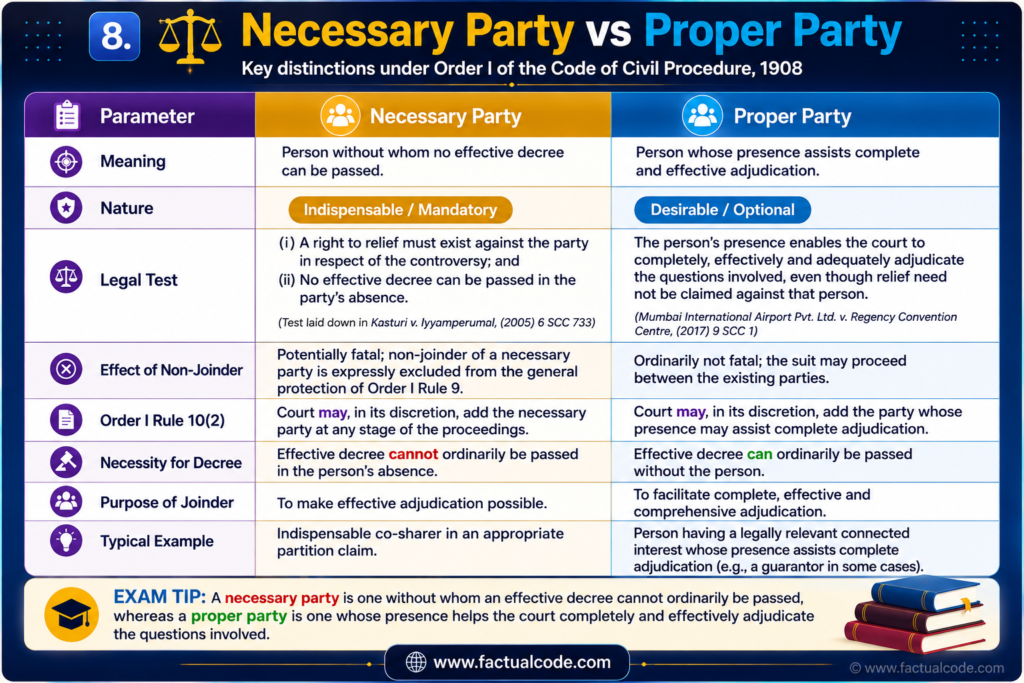
A necessary party is a person without whom no effective decree can be passed, whereas a proper party is a person whose presence enables the court to completely and effectively adjudicate the questions involved in the suit.
The distinction is significant because the non-joinder of a necessary party may prevent effective adjudication and may ultimately be fatal if the defect remains uncured, whereas the non-joinder of a proper party ordinarily does not defeat the suit.
1. Meaning of Joinder of Parties
Joinder of parties means bringing two or more persons before the court as plaintiffs or defendants in the same suit where the requirements of the CPC are satisfied.
Order I contains provisions dealing with:
- Rule 1 — joinder of plaintiffs;
- Rule 3 — joinder of defendants;
- Rule 9 — misjoinder and non-joinder;
- Rule 10 — addition, striking out and substitution of parties; and
- Rule 13 — objections regarding misjoinder and non-joinder.
The purpose of these provisions is to ensure that all legally relevant parties are appropriately before the court so that the real controversy can be determined effectively while avoiding unnecessary multiplicity of proceedings.
2. Necessary Party
Meaning
A necessary party is a person:
- who ought to have been joined as a party, and
- in whose absence no effective decree can be passed by the court.
The presence of such a person is therefore indispensable for effective adjudication.
A necessary party ordinarily possesses a direct and substantial legal interest in the subject matter, and the relief claimed in the suit cannot effectively be determined without his participation.
Essential Characteristics
A necessary party generally:
- has a direct legal interest in the subject matter;
- is directly connected with the relief claimed;
- may have his legal rights determined or affected by the decree; and
- is indispensable for an effective adjudication.
Illustration
Suppose A files a partition suit concerning jointly owned property against B, while C is another co-sharer whose rights and share necessarily have to be determined in the proceedings.
Depending upon the nature of the property and relief claimed, C may be a necessary party, because the court may not be able to effectively determine the entire controversy without C being before it.
3. Proper Party
Meaning
A proper party is a person whose presence is not indispensable for passing an effective decree, but whose presence enables the court to completely, effectively and adequately adjudicate upon the questions involved in the suit.
Thus, a proper party is desirable rather than indispensable.
The court may add such a person where his presence would assist in resolving the entire controversy or avoiding unnecessary subsequent litigation.
Essential Characteristics
A proper party:
- has a legally relevant connection with the controversy;
- is not indispensable for passing an effective decree;
- may assist the court in completely determining the questions involved; and
- may be added in the judicial discretion of the court under Order I Rule 10(2).
Illustration
Suppose A sues B concerning a transaction, and C has a legally relevant connected interest. If the court can pass an effective decree between A and B without determining C’s independent rights, but C’s presence would assist in completely resolving the controversy, C may be treated as a proper party.
4. Statutory Framework under Order I CPC
Order I Rule 1 — Joinder of Plaintiffs
Persons may be joined as plaintiffs where:
- the right to relief arises out of the same act, transaction or series of acts or transactions; and
- a common question of law or fact would arise if separate suits were instituted.
The provision facilitates the joint adjudication of connected claims.
Order I Rule 3 — Joinder of Defendants
Persons may be joined as defendants where:
- the right to relief against them arises out of the same act, transaction or series of acts or transactions; and
- a common question of law or fact would arise if separate suits were instituted.
Rules 1 and 3 thus provide the basic framework for determining when multiple plaintiffs or defendants may be joined in the same proceeding.
5. Order I Rule 10(1) — Wrong Plaintiff
Order I Rule 10(1) deals with a situation where a suit has been instituted in the name of the wrong person as plaintiff due to a bona fide mistake.
Where the court is satisfied that the mistake was bona fide, it may:
- strike out the name of the wrong plaintiff; and
- substitute or add the proper plaintiff.
Distinction from Rule 10(2)
Students should clearly distinguish the two provisions:
Rule 10(1) → wrong plaintiff arising from a bona fide mistake.
Rule 10(2) → striking out, adding and, where appropriate, transposing parties for effective adjudication.
6. Order I Rule 10(2) — Addition and Striking Out of Parties
Order I Rule 10(2) is the principal provision concerning necessary and proper parties.
The court may, at any stage of the proceedings, either upon or without an application:
- strike out the name of a person improperly joined;
- add a person who ought to have been joined as plaintiff or defendant; or
- add a person whose presence before the court is necessary to enable it to effectually and completely adjudicate upon and settle all the questions involved in the suit.
The provision therefore gives the court a broad procedural power to ensure that the suit is properly constituted.
The power may be exercised:
- upon an application by a party;
- suo motu by the court; and
- at any stage of the proceedings.
The power is discretionary in its exercise and must be guided by the requirements of effective and complete adjudication.
7. Transposition of Parties
Transposition means changing the position of an existing party from one side of the litigation to the other—for example, transferring a defendant to the position of plaintiff.
The power of transposition may be exercised under Order I Rule 10(2), read with the inherent powers of the court under Section 151 CPC, where such a course is necessary in the interests of justice and to avoid multiplicity of proceedings.
Transposition may be particularly relevant in partition suits, where the interests of one defendant may be identical or substantially aligned with those of the plaintiff.
It may also become important where the plaintiff seeks to withdraw or abandon the suit and another party having an independent or aligned interest would otherwise be left without an effective remedy.
Case Law
R. Dhanasundari v. A.N. Umakanth, (2019) 14 SCC 357 is a useful authority concerning the principles governing transposition.
Examination Point
Transposition is not merely a change in nomenclature. In appropriate cases, it enables a party having a legitimate interest to continue the litigation and helps prevent multiplicity of proceedings.
9. Judicial Test — Kasturi v. Iyyamperumal
One of the leading authorities is:
Kasturi v. Iyyamperumal, (2005) 6 SCC 733
The Supreme Court explained the principles for determining whether a person is a necessary party.
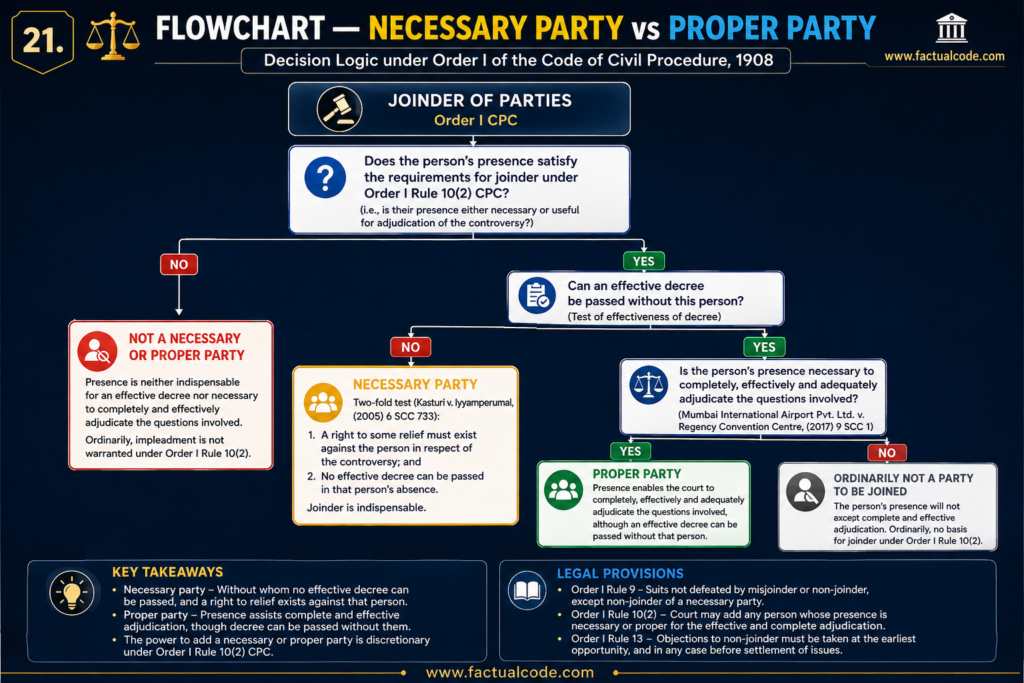
Two conditions are particularly important:
First — Right to Relief
There must be a right to relief against the person sought to be added in respect of the controversy involved in the suit.
Second — Effective Decree
The court must not be able to pass an effective decree in the absence of that person.
Therefore:
Right to relief + inability to pass an effective decree without the person = Necessary Party.
The decision is particularly important in the context of specific performance suits, where courts must distinguish genuinely necessary parties from persons who merely claim an interest in the property.
Ratio for Examination
Kasturi v. Iyyamperumal lays down the two-pronged test for determining a necessary party: there must be a right to relief against the person in respect of the subject matter, and an effective decree cannot be passed in that person’s absence.
10. Mumbai International Airport v. Regency Convention Centre
Mumbai International Airport Pvt. Ltd. v. Regency Convention Centre & Hotels Pvt. Ltd., (2010) 7 SCC 417
This is another leading authority concerning Order I Rule 10(2).
The Supreme Court emphasized that the power to add parties is discretionary and must be exercised judicially.
The court must determine whether the proposed party is:
- a necessary party; or
- a proper party whose presence is required for complete and effective adjudication.
A person should not be added merely because he has some indirect, commercial or factual interest in the result of the litigation.
Ratio for Examination
Mumbai International Airport establishes that impleadment under Order I Rule 10(2) is a discretionary judicial power and that a mere indirect or commercial interest is insufficient to make a person a proper party.
11. Vidur Impex and Traders v. Tosh Apartments
Vidur Impex and Traders Pvt. Ltd. v. Tosh Apartments Pvt. Ltd., (2012) 8 SCC 384
The Supreme Court reiterated the principles governing the addition of parties under Order I Rule 10.
The court must examine:
whether the proposed party has a direct or legally recognizable interest; and
whether his presence is required for effective adjudication.
The power of impleadment therefore cannot be exercised mechanically.
Ratio for Examination
Vidur Impex emphasizes that impleadment depends upon a legally recognizable interest and the need for the person’s presence for effective adjudication, rather than merely upon a factual connection with the subject matter.
12. Order I Rule 9 — Effect of Misjoinder and Non-Joinder
Order I Rule 9 contains the general rule that:
A suit shall not be defeated merely by reason of the misjoinder or non-joinder of parties.
The court may therefore proceed to determine the controversy so far as concerns the rights and interests of the parties actually before it.
Exception — Necessary Party
The protection contained in Rule 9 does not extend to the non-joinder of a necessary party.
Accordingly:
Misjoinder → ordinarily does not defeat the suit.
Non-joinder of a proper party → ordinarily does not defeat the suit.
Non-joinder of a necessary party → may prevent effective adjudication and may ultimately be fatal if the defect remains uncured.
This is one of the most important statutory distinctions in the law of parties.
13. Order I Rule 13 — Timely Objection
A complete discussion of non-joinder should include Order I Rule 13 CPC.
The rule provides that objections concerning misjoinder or non-joinder of parties should be taken at the earliest possible opportunity and, where issues are settled, ordinarily at or before such settlement, unless otherwise agreed by the parties.
Purpose of Rule 13
The provision is intended to prevent a party from keeping a procedural objection in reserve and raising it only after the proceedings have substantially progressed.
Therefore:
Rule 9 deals principally with the consequence; Rule 10 provides the mechanism for correction; and Rule 13 governs the stage at which objections should ordinarily be raised.
Quick Framework
| Provision | Function |
| Order I Rule 9 | General rule concerning consequences of misjoinder and non-joinder |
| Proviso to Rule 9 | Preserves the special consequence of non-joinder of a necessary party |
| Order I Rule 10(1) | Deals with wrong plaintiff caused by a bona fide mistake |
| Order I Rule 10(2) | Enables addition, striking out and appropriate transposition of parties |
| Order I Rule 13 | Requires objections regarding misjoinder/non-joinder to be raised at the earliest appropriate stage |
14. Necessary Party and the Doctrine of Dominus Litis
The plaintiff is traditionally described as the dominus litis, meaning the master of the litigation.
Ordinarily, the plaintiff has the right to determine:
- whom to sue;
- what relief to claim; and
- the scope of the litigation.
However, the doctrine is not absolute.
Where a person’s presence is necessary for effective and complete adjudication, the court may exercise its power under Order I Rule 10(2) to add that person even if the plaintiff does not wish to do so.
Thus:
The plaintiff is dominus litis, but cannot insist upon excluding a person whose presence is legally necessary for effective adjudication.
The court’s power under Rule 10(2) ensures that the plaintiff’s choice of parties does not prevent the court from deciding the real controversy effectively.
15. Mere Interest Does Not Make a Person a Necessary or Proper Party
A crucial principle is that every person having some connection with the subject matter is not necessarily a party to the suit.
A person may:
know about the transaction;
have an indirect commercial interest;
claim a remote interest;
be factually connected with the dispute; or
be incidentally affected by the outcome,
without becoming a necessary or proper party.
The court must examine:
the pleadings;
the relief claimed;
the nature of the person’s legal interest; and
whether his presence is required for complete adjudication.
This prevents Order I Rule 10 from being used to unnecessarily enlarge the scope of litigation.
16. Consequences of Non-Joinder
A. Non-Joinder of Necessary Party
Non-joinder of a necessary party is a serious procedural defect because the court may be unable to pass an effective decree in his absence.
Where such a defect is identified, the court may consider curing it by exercising its power under Order I Rule 10(2).
The court may therefore:
- permit or direct impleadment;
- allow consequential amendment of pleadings;
- provide an opportunity to cure the defect; or
- where the necessary party remains absent and effective relief cannot be granted, dispose of the suit according to law.
The important point is that non-joinder does not automatically mean immediate dismissal. The court ordinarily considers whether the defect can and should be cured.
B. Non-Joinder of Proper Party
The non-joinder of a proper party ordinarily does not defeat the suit.
Since an effective decree can generally be passed between the existing parties, the court may proceed without the proper party unless, on the facts of the case, his presence is necessary for complete adjudication.
17. Non-Joinder and Rejection of Plaint under Order VII Rule 11
A significant distinction must be maintained between non-joinder of a necessary party and rejection of plaint under Order VII Rule 11 CPC.
The omission of a necessary party does not, by itself, constitute an automatic ground for rejection of the plaint under Order VII Rule 11.
Order VII Rule 11 contains specific statutory grounds upon which a plaint may be rejected. Non-joinder of parties is principally dealt with under Order I Rules 9 and 10.
The normal procedural approach is to consider whether the defect can be cured by impleading the necessary party under Order I Rule 10(2).
If the necessary party is not joined and the defect remains uncured so that effective adjudication or relief is impossible, the court may ultimately deal with the suit according to law.
Therefore, remember:
Order VII Rule 11 → Rejection of plaint on specified statutory grounds.
Order I Rules 9 and 10 → Consequences and cure of misjoinder/non-joinder.
18. Effect of a Decree on Persons Not Impleaded
As a general principle, a decree ordinarily operates between the parties to the litigation and persons legally represented through them. A person who is a complete stranger to the proceedings and whose independent rights were not adjudicated cannot ordinarily be treated as personally bound merely because a decree was passed in a suit concerning the same subject matter.
However, this proposition should not be stated as an absolute rule of res judicata.
Section 11 CPC contains specific requirements and explanations concerning the operation of res judicata, and questions of representation, common interest and the nature of the earlier adjudication may become relevant.
Therefore, the safer examination formulation is:
A person who was neither a party nor properly represented in the earlier proceedings will not ordinarily be personally bound by the decree merely because the decree concerns the same subject matter. The applicability of Section 11 must, however, be determined according to its statutory requirements and the circumstances of the case.
This should be distinguished from the doctrine of res inter alios acta, which concerns the general principle that acts or adjudications between other persons do not ordinarily determine the independent rights of a stranger.
19. Necessary Party, Proper Party and Stranger
It is useful to distinguish three categories.
Necessary Party
A person whose presence is indispensable for an effective decree.
Proper Party
A person whose presence is legally relevant and desirable for complete and effective adjudication.
Stranger
A person who has no sufficient legal interest or connection to justify his impleadment.
Thus, the court should not add every person who expresses an interest in the litigation.
20. Illustrations
Illustration 1 — Partition Suit
A files a suit for partition of jointly owned property against B.
C is another co-sharer whose share and rights necessarily have to be determined.
Depending upon the relief claimed and the nature of the proceedings, C may be a necessary party.
Illustration 2 — Connected Legal Interest
A sues B concerning a transaction.
C has a legally relevant connected interest. The court can pass an effective decree between A and B without determining C’s independent rights, but C’s presence may assist the court in completely resolving the controversy.
C may be a proper party.
Illustration 3 — Mere Factual Connection
D witnessed the transaction but has no legal interest in the relief claimed.
D is ordinarily neither a necessary nor a proper party merely because he possesses knowledge of the facts.
22. Leading Case Law — Quick Revision
| Case Citation | Key Ratio Decidendi / Core Principle |
| Kasturi v. Iyyamperumal (2005) 6 SCC 733 | Lays down the important two-pronged test for a necessary party: a right to relief against the person and inability to pass an effective decree in that person’s absence. |
| Mumbai International Airport Pvt. Ltd. v. Regency Convention Centre & Hotels Pvt. Ltd. (2010) 7 SCC 417 | Establishes that impleadment under Order I Rule 10(2) is a discretionary judicial power; indirect or merely commercial interest is insufficient. |
| Vidur Impex and Traders Pvt. Ltd. v. Tosh Apartments Pvt. Ltd. (2012) 8 SCC 384 | Reaffirms that impleadment requires a legally recognizable interest and relevance to effective adjudication. |
| R. Dhanasundari v. A.N. Umakanth (2019) 14 SCC 357 | Discusses the principles relevant to transposition of parties and the court’s power to protect legitimate interests and prevent multiplicity of proceedings. |
23. Critical Analysis
The distinction between necessary and proper parties represents a balance between procedural efficiency, fairness and substantive justice.
If every person having any connection with the subject matter were treated as a necessary party, civil proceedings would become unnecessarily complicated and prolonged.
Conversely, if a plaintiff were permitted to exclude a person whose legal rights must necessarily be determined, the court might be unable to pass an effective decree, resulting in further litigation.
The law therefore adopts a balanced approach:
Necessary parties protect the effectiveness of adjudication, while proper parties promote completeness of adjudication.
Order I Rule 10(2) gives the court the procedural flexibility required to correct the constitution of the suit. At the same time, the judicial tests developed by the Supreme Court prevent impleadment from becoming an unrestricted mechanism for introducing persons who merely have an indirect interest.
The doctrine of dominus litis must consequently operate alongside the court’s power to add parties. The plaintiff ordinarily controls the litigation, but that control cannot be exercised in a manner that prevents the court from effectively determining the real controversy.
24. Important Examination Points
For a 15-mark LLB answer, the following points should be clearly mentioned:
- Order I CPC regulates the joinder of parties.
- The CPC does not expressly define “necessary party” or “proper party.”
- A necessary party is indispensable for an effective decree.
- A proper party is desirable for complete and effective adjudication.
- Order I Rule 9 contains the general rule concerning misjoinder and non-joinder.
- The proviso to Rule 9 excludes non-joinder of a necessary party from the general protection.
- Order I Rule 10(1) deals with a wrong plaintiff arising from a bona fide mistake.
- Order I Rule 10(2) empowers the court to add or strike out parties.
- The power under Rule 10(2) may be exercised at any stage.
- The court may exercise the power upon application or suo motu.
- Transposition may be permitted in appropriate circumstances under Rule 10(2), read with Section 151 CPC.
- Order I Rule 13 requires objections concerning misjoinder/non-joinder to be raised at the earliest appropriate opportunity.
- The plaintiff is generally dominus litis, but that principle is subject to the court’s power under Rule 10(2).
- Mere indirect, commercial or factual interest does not automatically make a person a proper party.
- Kasturi v. Iyyamperumal provides the leading two-pronged test.
- Mumbai International Airport explains the discretionary nature of impleadment.
- Vidur Impex emphasizes legally recognizable interest and effective adjudication.
- Non-joinder of a necessary party should be distinguished from rejection of plaint under Order VII Rule 11.
- The normal procedural response is to consider curing the defect through Order I Rule 10(2).
- The ultimate objective is complete, effective and final adjudication of the real controversy.
Conclusion
The doctrine of necessary and proper parties under Order I of the Code of Civil Procedure, 1908 ensures that civil litigation is conducted between persons whose presence is genuinely relevant to the controversy.
A necessary party is one without whom an effective decree cannot ordinarily be passed. A proper party, although not indispensable, is one whose presence enables the court to completely and effectively adjudicate the questions involved.
The distinction has important procedural consequences. Order I Rule 9 establishes the general principle that a suit should not ordinarily be defeated by misjoinder or non-joinder, while preserving the special position of a necessary party. Order I Rule 10(2) gives the court power to add necessary or proper parties, strike out improperly joined parties and, where appropriate, transpose parties. Order I Rule 13 requires objections concerning misjoinder and non-joinder to be raised at the earliest appropriate stage.
The Supreme Court decisions in Kasturi v. Iyyamperumal, Mumbai International Airport Pvt. Ltd. v. Regency Convention Centre & Hotels Pvt. Ltd. and Vidur Impex and Traders Pvt. Ltd. v. Tosh Apartments Pvt. Ltd. provide the principal judicial framework for determining whether a person should be impleaded.
Ultimately, the distinction reflects the fundamental principle that procedural law should facilitate, rather than frustrate, the administration of justice. The court must distinguish between a person who is indispensable for an effective decree, a person whose presence is legally relevant for complete adjudication, and a person who has no sufficient legal basis for being joined. In this way, Order I CPC balances the plaintiff’s control over litigation, the rights of affected persons, and the court’s duty to finally and effectively resolve the real controversy.