
1. Introduction
The traditional civil justice system resolves disputes through pleadings, framing of issues, evidence, arguments and judgment. Although adjudication remains indispensable, delay, expense, procedural complexity and judicial pendency have made alternative methods of dispute resolution increasingly important.
Alternative Dispute Resolution (ADR) refers to processes through which disputes may be resolved without undergoing a full-fledged trial. The principal ADR mechanisms are arbitration, mediation, conciliation, Lok Adalat and judicial settlement.
Under the Code of Civil Procedure, 1908, the principal provision dealing with court-facilitated settlement is Section 89, read with Order X Rules 1A–1C. Section 89 was introduced by the Code of Civil Procedure (Amendment) Act, 1999, with the object of encouraging settlement and reducing the burden of civil litigation.
The constitutional foundation of this objective is found in Article 39A, which directs the State to secure equal justice and provide free legal aid. Accessible and affordable ADR mechanisms, including Lok Adalats and court-connected mediation, further this constitutional goal.
2. Meaning and Object of ADR
ADR refers to procedures for resolving disputes by methods other than ordinary court adjudication. It is not external to the legal system; several ADR processes are governed by statute and may be initiated or facilitated by courts.
The principal objectives of ADR are:
- speedy resolution of disputes;
- reduction of litigation costs;
- reduction of judicial backlog;
- greater participation and autonomy of parties;
- flexibility of procedure;
- preservation of commercial, family and social relationships;
- confidentiality, where applicable;
- availability of solutions wider than ordinary judicial relief; and
- improved access to justice.
ADR is therefore not merely a means of avoiding courts. It is an important component of the modern civil justice system.
3. Statutory Framework
The principal statutory provisions are:
- Section 89 CPC — settlement of disputes outside court;
- Order X Rules 1A–1C CPC — procedural mechanism for referring parties to ADR;
- Order XXIII Rule 3 CPC — recording of lawful compromise;
- Arbitration and Conciliation Act, 1996 — arbitration and the statutory framework historically governing conciliation;
- Legal Services Authorities Act, 1987 — Lok Adalats;
- Mediation Act, 2023 — mediation, including pre-litigation and court-referred mediation;
- Section 16 of the Court Fees Act, 1870, or the corresponding State provision — court-fee refund incentive in appropriate cases.
The Mediation Act, 2023 amended and substituted Section 89 CPC through its Fourth Schedule. Consequently, a current answer must distinguish the original text and judicial interpretation of Section 89 from its present statutory framework.
4. Basic Scheme of Section 89 CPC
The present Section 89 applies where:
- the court finds that elements of settlement exist; and
- the dispute may be acceptable for settlement by the parties.
The court may then adopt an appropriate statutory mechanism.
(a) Arbitration
A dispute may be referred to arbitration under the Arbitration and Conciliation Act, 1996. Where there is no pre-existing arbitration agreement, such a reference requires the consent of all parties.
(b) Mediation
The parties may be referred to mediation in accordance with the Mediation Act, 2023, through a court-annexed mediation centre, mediator, mediation service provider or other recognised mechanism.
(c) Lok Adalat
The dispute may be referred to a Lok Adalat under Section 20(1) of the Legal Services Authorities Act, 1987.
(d) Judicial settlement or compromise
The court may facilitate or record a settlement and follow the applicable procedure, including Order XXIII Rule 3 CPC where appropriate.
A reference to ADR does not guarantee settlement. If settlement fails, the matter ordinarily returns to the court for adjudication.
5. Drafting Defect in the Original Section 89: Afcons
In Afcons Infrastructure Ltd. v. Cherian Varkey Construction Co. (P) Ltd., (2010) 8 SCC 24, the Supreme Court noted that the original Section 89 contained a drafting error in which the expressions “mediation” and “judicial settlement” had been interchanged.
The Court interpreted the provision in a workable manner and explained the practical operation of the different ADR mechanisms. It clarified that:
- arbitration operates under the Arbitration and Conciliation Act, 1996;
- mediation and conciliation are settlement-oriented processes;
- Lok Adalat reference operates under the Legal Services Authorities Act, 1987; and
- judicial settlement involves settlement facilitated through the court or a judicial authority.
The decision is important because it demonstrates that Section 89 must be understood through both its statutory language and judicial interpretation. The Mediation Act, 2023 has subsequently modernised and altered the statutory framework.
6. Pre-Litigation and Court-Referred Mediation
This distinction is essential.
Pre-litigation mediation
Pre-litigation mediation occurs before institution of a suit or proceeding. The Mediation Act, 2023 provides a statutory framework for such mediation, subject to applicable requirements and exemptions. Its purpose is to prevent litigation from commencing.
Court-referred mediation
Court-referred mediation occurs after a suit or proceeding has been instituted. It is connected with Section 89 CPC and is governed by the Mediation Act, 2023, together with applicable rules and institutional procedures.
Thus:
Section 89 primarily concerns court-referred ADR after institution of proceedings, whereas the Mediation Act, 2023 provides a broader framework covering both pre-litigation and court-referred mediation.
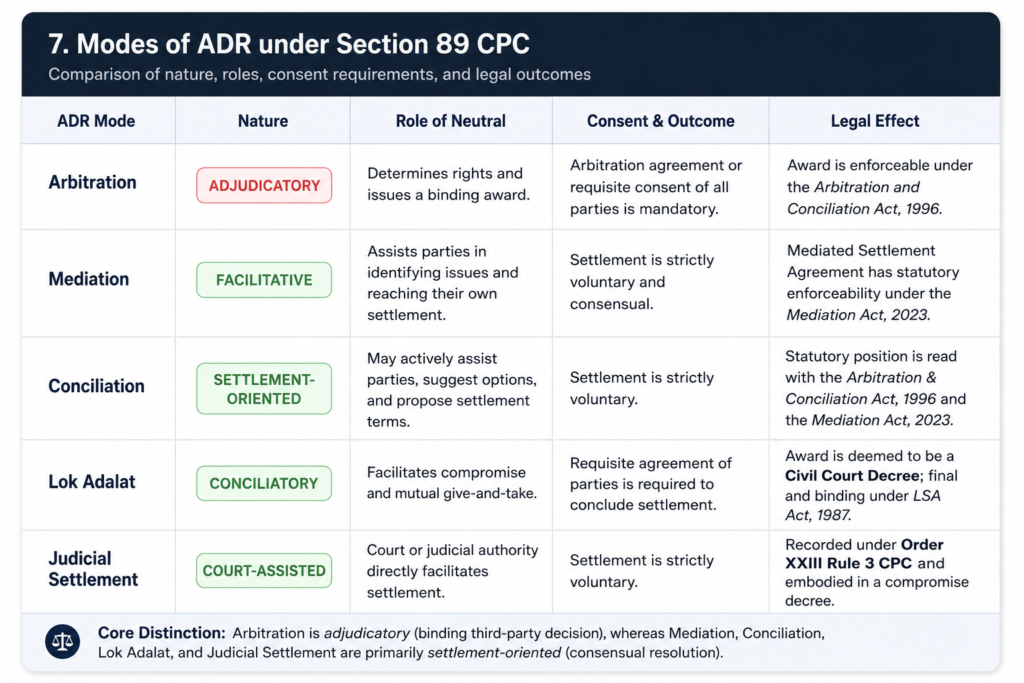
8. Arbitration under Section 89
Arbitration is governed principally by the Arbitration and Conciliation Act, 1996. Unlike mediation, an arbitrator determines the dispute and makes a binding award.
In Afcons Infrastructure, the Supreme Court held that a civil court cannot refer parties to arbitration under Section 89 against their wishes where there is no pre-existing arbitration agreement. Consent of all parties is required in such a case.
This principle was also recognised in Jagdish Chander v. Ramesh Chander, (2007) 5 SCC 719.
Therefore:
Arbitration under Section 89 is consent-based where no prior arbitration agreement exists.
The court may encourage arbitration, but it cannot impose an arbitral process upon unwilling parties merely because the dispute appears suitable for ADR.
9. Mediation
Mediation is a non-adjudicatory and facilitative process in which a neutral mediator assists parties in identifying issues, communicating interests and negotiating a mutually acceptable settlement. The mediator does not decide who is right or wrong.
Its essential features are:
- neutrality and impartiality;
- confidentiality;
- party participation;
- voluntariness of settlement;
- self-determination; and
- procedural flexibility.
The Mediation Act, 2023 provides a comprehensive statutory framework dealing with pre-litigation mediation, court-referred mediation, mediators, mediation service providers, confidentiality, mediated settlement agreements, enforcement, online mediation and community mediation.
A court may refer parties to mediation, but the mediator cannot impose a settlement. The final agreement must be voluntary.
10. Conciliation
Conciliation is a settlement-oriented process. A conciliator may take a more active role than a mediator by identifying areas of disagreement, suggesting possible solutions and assisting parties in formulating settlement terms.
However, conciliation remains non-adjudicatory. The conciliator cannot impose a binding decision upon the parties.
Historically, conciliation was governed by Part III of the Arbitration and Conciliation Act, 1996. Its present legal position must be understood in light of the Mediation Act, 2023, applicable statutory provisions and transitional arrangements. It should not be stated, without qualification, that conciliation has been entirely abolished or automatically subsumed by mediation.
11. Lok Adalat
Lok Adalats are statutory ADR forums established under the Legal Services Authorities Act, 1987. They facilitate amicable settlement of pending cases and certain pre-litigation disputes.
Important features include:
- inexpensive and speedy resolution;
- settlement through compromise and conciliation;
- an award deemed to be a decree of a civil court or an order of a tribunal;
- an award that is final and binding on the parties;
- no ordinary appeal against the award; and
- refund of court fee in appropriate cases.
A Lok Adalat does not ordinarily adjudicate a contested dispute merely because it has been referred to it. Settlement requires the requisite agreement of the parties.
12. Judicial Settlement and Compromise
Judicial settlement refers to settlement facilitated through the judicial system. The court may assist parties in reaching a mutually acceptable compromise.
A compromise in a pending suit is principally governed by Order XXIII Rule 3 CPC. Where the parties arrive at a lawful compromise in writing and signed by them, the court may record it and pass a decree in accordance with the compromise, so far as it relates to the parties to the suit.
The purpose is to give legal effect to a settlement reached by the parties instead of unnecessarily proceeding to trial.
13. Section 89 and Order X Rules 1A–1C
Section 89 operates with Order X Rules 1A–1C. The broad procedural sequence is as follows.
Stage 1 — Admissions, denials and settlement consideration
After recording admissions and denials, the court considers the nature of the dispute and whether elements of settlement exist.
Under Order X Rule 1A, the court directs the parties to consider an ADR mode referred to in Section 89, having regard to the circumstances of the case.
Stage 2 — Appearance before ADR forum
Under Order X Rule 1B, the parties appear before the selected mediator, conciliatory forum, institution or authority.
Stage 3 — ADR proceedings
The selected process takes place under the applicable statute and rules.
Stage 4 — Settlement or failure
If settlement is achieved, it is placed before the court or given the legal effect prescribed by the relevant statute.
If settlement fails, the matter returns to the trial court.
Stage 5 — Continuation of suit
Under Order X Rule 1C, the court resumes the suit and proceeds with the ordinary civil process, including framing of issues, evidence, hearing and judgment.
The sequence may be summarised as:
Admissions and denials → ADR direction → Appearance before ADR forum → Settlement or failure → Return to court if necessary
This sequence must be applied sensibly. The provisions should be read with Salem Advocate Bar Association, Afcons and the Mediation Act, 2023, rather than mechanically referring every dispute to ADR.
14. Role of the Court
The court remains important even after referring a matter to ADR. Its functions include:
- identifying whether settlement is possible;
- excluding disputes unsuitable for ADR;
- selecting an appropriate ADR mechanism;
- making the reference;
- ensuring that settlement is lawful and voluntary; and
- resuming adjudication if settlement fails.
The court must consider the nature of the dispute, the interests of the parties, the need for consent and the suitability of the selected process.
15. Cases Suitable and Unsuitable for ADR: Afcons
In Afcons Infrastructure, the Supreme Court gave non-exhaustive guidance.
Generally suitable disputes
- commercial, trade and contractual disputes;
- appropriate tort and motor-accident claims;
- matrimonial and family disputes where settlement is legally and factually appropriate;
- partnership disputes;
- disputes between co-owners;
- disputes between neighbours; and
- other disputes involving predominantly private rights capable of consensual resolution.
Generally unsuitable disputes
- representative suits involving public interest;
- disputes concerning rights of persons not before the court;
- certain cases involving serious allegations of fraud, forgery or coercion where detailed adjudication is necessary;
- probate and testamentary matters;
- certain guardianship matters;
- proceedings involving criminal prosecution or non-compoundable offences; and
- matters where public interest or the nature of relief requires authoritative adjudication.
These categories are not absolute. The word “generally” is important. The court must examine the facts, seriousness of the allegations, nature of the relief and possibility of a fair settlement.
16. Court-Fee Refund
Section 16 of the Court Fees Act, 1870, or the corresponding State court-fee provision, provides an incentive for settlement through prescribed ADR mechanisms.
Where a matter is referred under Section 89 and settled through the specified process, the party may be entitled to a refund of court fee, subject to statutory requirements and applicable State law.
The provision seeks to:
- encourage early settlement;
- reduce litigation expenses;
- make ADR more attractive; and
- recognise the saving of judicial resources.
The correct examination statement is:
Section 16 of the Court Fees Act, 1870, or the corresponding State provision, may provide for refund of court fee where a matter referred under Section 89 is settled through the prescribed ADR mechanism, subject to applicable legal requirements.
It should not be stated as an unconditional rule that every ADR reference automatically results in a full refund.
17. Important Cases
Salem Advocate Bar Association, Tamil Nadu v. Union of India
The Supreme Court upheld the constitutional validity of the CPC amendments and examined the implementation of Section 89. The decision recognised ADR as an important part of civil procedure and encouraged the development of practical mechanisms for its effective use.
Afcons Infrastructure Ltd. v. Cherian Varkey Construction Co. (P) Ltd., (2010) 8 SCC 24
This is the leading authority on Section 89. It clarified:
- the scope and object of Section 89;
- the drafting defect in the original provision;
- the distinction between ADR mechanisms;
- the requirement of consent for arbitration;
- the role of the court; and
- disputes generally suitable or unsuitable for ADR.
Jagdish Chander v. Ramesh Chander, (2007) 5 SCC 719
The decision supports the principle that arbitration requires a valid arbitration agreement or the requisite mutual consent.
18. Consent and Legal Effect
Reference to ADR and successful settlement are separate questions.
- Arbitration: requires a prior arbitration agreement or consent of all parties.
- Mediation: settlement must be voluntary; the mediator cannot impose a decision.
- Conciliation: the conciliator cannot impose a binding settlement.
- Lok Adalat: compromise requires agreement of the parties.
- Judicial settlement: the court records and gives effect to a lawful compromise.
The legal effect of the outcome depends upon the mechanism used:
- arbitral award — Arbitration and Conciliation Act, 1996;
- mediated settlement — Mediation Act, 2023;
- Lok Adalat award — Legal Services Authorities Act, 1987;
- court-recorded compromise — Order XXIII Rule 3 CPC.
19. Advantages and Limitations
Advantages
ADR offers:
- speedy resolution;
- reduced judicial backlog;
- lower costs;
- procedural flexibility;
- preservation of relationships;
- confidentiality;
- party autonomy;
- broader and more practical solutions; and
- improved access to justice.
Limitations
ADR is not suitable for every dispute. Problems may arise from:
- power imbalance between parties;
- pressure to settle;
- lack of genuine consent;
- enforcement difficulties;
- unsuitable referral;
- unnecessary delay caused by an additional ADR stage; and
- the need for authoritative adjudication in matters involving public rights or serious legal issues.
ADR is therefore most effective when the court selects the appropriate process for the appropriate dispute and ensures fairness and voluntariness.
20. Present Position after the Mediation Act, 2023
The Mediation Act, 2023 significantly strengthens India’s mediation framework. It deals with:
- pre-litigation mediation;
- court-referred mediation;
- appointment and role of mediators;
- mediation service providers;
- confidentiality;
- mediated settlement agreements;
- enforcement and challenge;
- online mediation; and
- community mediation.
A current answer must distinguish:
- the original Section 89 and its interpretation in Salem Advocate Bar Association and Afcons;
- court-referred mediation after institution of a suit; and
- pre-litigation mediation under the Mediation Act, 2023.
The Act has therefore made mediation a more structured and comprehensive part of the civil justice system.
21. Conclusion
Section 89 CPC integrates ADR into the Indian civil justice system. It encourages courts and litigants to explore appropriate methods of resolving disputes without undergoing the entire process of conventional litigation.
The provision covers arbitration, mediation, Lok Adalat and judicial settlement or compromise, each governed by its own statutory framework. Salem Advocate Bar Association established the importance and implementation of ADR, while Afcons Infrastructure clarified the scope of Section 89, the drafting defect in its original text, the distinction between ADR mechanisms, the requirement of consent for arbitration and the suitability of different disputes for ADR.
The Mediation Act, 2023 has further modernised the framework by regulating both pre-litigation and court-referred mediation and by substituting Section 89 CPC. Order X Rules 1A–1C, Order XXIII Rule 3, Article 39A and the court-fee refund mechanism together demonstrate the breadth of the modern ADR system.
Thus, Section 89 reflects a modern conception of civil justice in which adjudication is not the only route to justice. Where the nature of the dispute permits, a fair, voluntary and legally enforceable settlement may provide a faster, less expensive and more satisfactory resolution for litigants and the justice system.