Introduction
The Code of Civil Procedure, 1908 (CPC) forms the procedural backbone of civil justice administration in India. Almost every civil dispute—whether relating to property, contracts, recovery of money, injunctions, partition, or declaration of rights—is governed by the procedural framework established under this Code.
While substantive laws create legal rights and obligations, the CPC provides the procedural machinery through which those rights are enforced before civil courts.
In practical litigation, the Code answers several fundamental questions:
Where should a civil suit be filed?
What must be included in a plaint?
How does a civil trial proceed?
What is the difference between a judgment, decree, and order?
How is a decree executed?
Under what circumstances can an appeal, review, or revision be filed?
For LLB students and legal practitioners, CPC is not merely an academic subject but one of the most important procedural laws governing civil litigation practice.
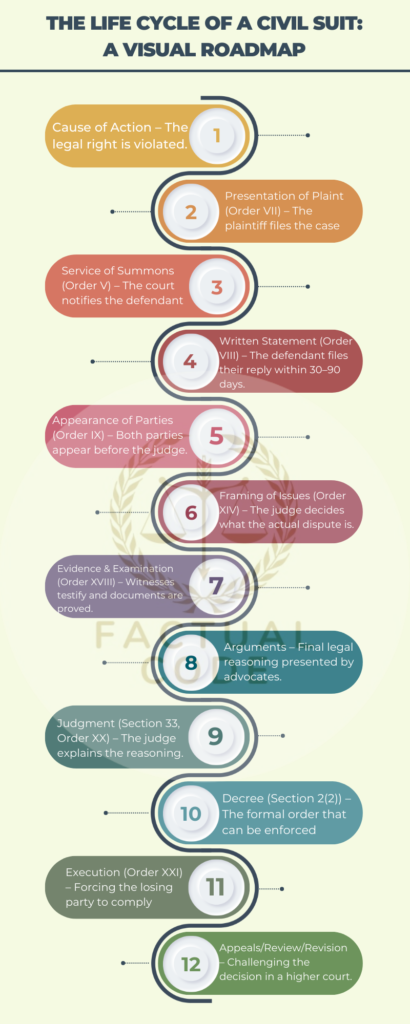
Understanding the structure and scheme of the Code transforms it from a complex statute into a logical system governing the entire life cycle of a civil suit—from institution to final execution of the decree.
CPC Study Roadmap for LLB Students
To understand the Code effectively, it is useful to study CPC through the logical stages of a civil suit.
| Stage | Topic | Purpose |
|---|---|---|
| Stage 1 | Nature, Scope and Jurisdiction | Understanding when civil courts can hear disputes |
| Stage 2 | Institution of Suit and Pleadings | Learning how a civil case begins |
| Stage 3 | Trial and Judgment | Understanding how courts determine disputes |
| Stage 4 | Execution and Appeals | Learning how court decisions are enforced and challenged |
This roadmap helps students visualize the complete life cycle of a civil suit from beginning to end.
1. Nature, Object and Scope of CPC
The primary objective of the Code of Civil Procedure is to ensure the fair, uniform, and systematic adjudication of civil disputes.
The Code operates on three fundamental principles:
Natural justice
Equality of opportunity for the parties
Orderly and efficient judicial procedure
The CPC applies to all civil proceedings, unless its operation is expressly or impliedly excluded by a special statute.
Courts have repeatedly emphasized that procedural law is a handmaid of justice. Therefore, CPC provisions are interpreted in a manner that advances justice rather than defeats substantive rights.
2. Structure and Scheme of the Code
The Code of Civil Procedure is carefully structured to provide both general procedural principles and detailed operational rules.
The Code consists of two principal components.
A. Sections (Sections 1–158)
The Sections contain the foundational procedural principles governing matters such as:
Jurisdiction of courts
Institution of suits
Judgments and decrees
Appeals
Execution of decrees
B. Orders and Rules (Order I – Order LI)
The Orders and Rules provide detailed procedural mechanisms regulating specific stages of civil litigation such as:
Pleadings
Discovery and inspection
Trial procedure
Execution proceedings
Appeals
Quick Overview of CPC Structure
| Component | Coverage | Purpose |
|---|---|---|
| Sections | 1–158 | Fundamental procedural principles |
| Orders | Order I – Order LI | Detailed procedural framework |
| Rules | Rules under each Order | Operational guidelines |
Important Rule:
If any inconsistency arises between the Sections and the Orders or Rules, the Sections prevail.
Understanding this hierarchy is essential for proper interpretation of the Code.
3. Key Definitions under Section 2 CPC
Section 2 of the CPC provides several statutory definitions that form the conceptual foundation of the entire Code.
Some of the most important definitions include:
Decree
Order
Judgment
Legal Representative
Mesne Profits
Basic Distinction
Judgment
The statement of reasons given by the judge explaining the decision.
Decree
The formal adjudication conclusively determining the rights of the parties in a suit.
Order
A decision of the court relating to procedural or interlocutory matters.
Understanding these definitions is crucial when studying appeals, execution, abatement of suits, and procedural remedies.
Further Reading
Decree, Order and Judgment — [Read More: Detailed Guide on Decree, Order and Judgment under CPC]
Legal Representative — [Read More: Who is a Legal Representative under CPC]
Mesne Profits — [Read More: Mesne Profits under CPC Explained]
4. Jurisdiction of Civil Courts
Jurisdiction refers to the legal authority of a court to hear and decide a case.
A decree passed by a court without jurisdiction may be void and unenforceable.
Jurisdiction is generally classified into three categories.
1. Subject-Matter Jurisdiction
Authority of a court to hear a particular type of dispute.
2. Territorial Jurisdiction
Determines the geographical limits within which a court may exercise authority.
3. Pecuniary Jurisdiction
Relates to the monetary value of the suit that a court is competent to try.
Section 9 CPC provides that civil courts shall try all suits of a civil nature unless their jurisdiction is expressly or impliedly barred.
Special Note: Commercial Disputes
For certain high-value commercial disputes, civil procedure operates under a stricter framework introduced by the Commercial Courts Act, 2015.
In such matters:
Mandatory pre-institution mediation is generally required before filing a suit (except in urgent cases).
Strict timelines apply for filing written statements and documents.
The objective is speedy disposal of commercial litigation.
Two important doctrines related to jurisdiction are:
Doctrine of Res Sub Judice — [Read More: Detailed Guide on Res Sub Judice]
Doctrine of Res Judicata — [Read More: Detailed Guide on Res Judicata]
These doctrines prevent multiplicity of litigation and conflicting judicial decisions.
5. Institution of Suit and Pleadings
A civil proceeding begins with the presentation of a plaint before a competent court.
A valid plaint must contain:
Material facts constituting the cause of action
Jurisdictional facts
Relief sought by the plaintiff
Valuation of the suit and court-fee details
If the plaint does not satisfy legal requirements, the court may reject the plaint.
The defendant responds by filing a written statement, addressing the allegations made in the plaint.
The defendant may also raise:
Set-off
Counterclaim
Pleadings determine the scope of the trial, and courts generally cannot grant relief beyond the pleadings of the parties.
6. Trial and Hearing of the Suit
After the completion of pleadings, the court proceeds with the trial process.
Important stages include:
Framing of issues
Recording of evidence
Examination and cross-examination of witnesses
Final arguments by the parties
The court issues summons to ensure the appearance of the parties.
Failure to appear may result in:
The trial stage ensures adherence to the principles of natural justice, particularly the rule of audi alteram partem (hear the other side).
7. Judgment, Decree and Orders
After completion of the trial, the court pronounces its judgment.
A proper judgment generally contains:
Statement of the case
Points for determination
Decision on each issue
Reasons for the decision
Following the judgment, the court prepares the decree, which formally records the adjudication of rights.
Understanding the distinction between judgment, decree, and order is essential for appeals and execution proceedings.
8. Execution of Decrees
Obtaining a decree does not automatically grant relief. The decree-holder must initiate execution proceedings to enforce the judgment.
Execution procedure is governed primarily by Order XXI CPC.
Common modes of execution include:
Attachment and sale of property
Arrest and detention of the judgment debtor
Delivery of possession
Appointment of a receiver
Execution ensures that judicial decisions are effectively implemented rather than remaining merely declaratory.
9. Appeals, Review, Revision and Reference
The CPC provides several mechanisms to correct judicial errors and ensure judicial accountability.
Appeal
Allows a higher court to re-examine findings of fact and law made by a lower court.
Review
Permits the same court to reconsider its own decision on limited statutory grounds.
Revision
The High Court exercises revisional jurisdiction to correct jurisdictional errors or serious procedural irregularities committed by subordinate courts.
Reference
A subordinate court may refer a question of law to the High Court for its opinion.
These remedies maintain fairness, uniformity, and accountability in the judicial system.
10. Inherent Powers under Section 151 CPC
Section 151 CPC recognizes the inherent powers of civil courts.
These powers may be exercised to:
Prevent abuse of the process of the court
Secure the ends of justice
However, inherent powers cannot override express provisions of the Code and are generally exercised only when the CPC does not provide a specific remedy.
Most Important CPC Topics for LLB Examinations
The following topics are frequently asked in LLB semester examinations and judiciary examinations:
Rejection of Plaint (Order VII Rule 11)
Inherent Powers of Court (Section 151)
Students should focus on these topics to develop strong conceptual answers in examinations.
Conclusion
The Code of Civil Procedure, 1908 is a comprehensive procedural framework governing civil litigation in India.
For LLB students, mastering CPC requires:
Conceptual clarity
Understanding the procedural stages of litigation
Ability to apply procedural law to practical situations
When studied systematically, CPC becomes logical, structured, and easier to understand.
This guide provides a structured roadmap of civil procedure, covering the journey of a civil suit from institution to execution and appellate remedies.
References- THE CODE OF CIVIL PROCEDURE, 1908