📘 Start with the CPC Master Guide
1. Introduction ⚖️⚖️⚖️
The Doctrine of Merger is a fundamental judicial principle which provides that when a superior court passes a decree or order, the decree of the subordinate court merges into that of the superior court and ceases to exist independently. ⚖️⚖️⚖️
The doctrine ensures that only one final and operative decree governs the rights of the parties at any given time, thereby maintaining certainty, consistency, and judicial discipline within the hierarchical judicial system. ⚖️⚖️⚖️
2. Concept and Meaning 📘📘📘
The doctrine signifies that:
When a matter is carried in appeal or revision, and
The superior court applies its judicial mind and decides the case,
👉 The decree of the lower court loses its independent identity and merges into the decree of the superior court. ⚖️⚖️⚖️
Thus, the only enforceable and operative decree is that of the superior court. ⚖️⚖️⚖️
3. Jurisprudential Basis ⚖️⚖️⚖️
The doctrine is grounded in the maxim: ⚖️⚖️⚖️
“Interest Reipublicae Ut Sit Finis Litium”
(It is in the interest of the State that litigation must come to an end.) ⚖️⚖️⚖️
It promotes:
Finality of litigation
Avoidance of conflicting or multiple decrees
Supremacy of superior courts within the judicial hierarchy
4. Scope and Application 📘📘📘
The doctrine applies where: 📘📘📘
A statutory appeal, revision, or Special Leave Petition (SLP) is filed, and
The superior court entertains and decides the matter
It is relevant in:
Appeals under the Code of Civil Procedure (CPC)
Revision under Section 115 CPC
Proceedings under Article 136 of the Constitution (SLP)
5. When Does Merger Occur? ⚖️⚖️⚖️
Merger occurs when: ⚖️⚖️⚖️
The superior court exercises appellate or revisional jurisdiction, and
The case is decided on merits (either expressly or impliedly)
Forms of Merger 📘📘📘
Affirmation → The decree is confirmed
Modification → The decree is altered
Reversal (Substitution) → The decree of the subordinate court is completely replaced or substituted by the decree of the superior court
6. When Doctrine of Merger Does NOT Apply ⚖️⚖️⚖️
The doctrine is not of universal application. Its applicability depends on the nature of jurisdiction exercised, not merely on the filing of proceedings. ⚖️⚖️⚖️
(a) SLP – Two-Stage Doctrine (Crucial Concept) 📘📘📘
An SLP under Article 136 involves two distinct stages: 📘📘📘
Grant of Leave to Appeal
Hearing of the Appeal
If dismissed at Stage 1 (in limine):
→ No merger occurs
→ The Supreme Court merely refuses to exercise its discretionary jurisdictionIf leave is granted (Stage 2) and the appeal is decided:
→ Merger occurs
→ This applies regardless of whether the judgment is brief or detailed
(b) SLP Dismissed Without Reasons ⚖️⚖️⚖️
No merger occurs
No declaration of law is made
The lower court decree continues to operate
(c) SLP Dismissed With Reasons ⚖️⚖️⚖️
Technically, no merger occurs, as leave is not granted
However, the legal principle laid down becomes binding under Article 141 of the Constitution
(d) Interlocutory Orders ⚖️⚖️⚖️
The doctrine primarily applies to final orders
Interlocutory orders are generally absorbed into the final judgment of the same court
Therefore, hierarchical merger is less significant in such cases
(e) Absence of Appellate or Revisional Jurisdiction ⚖️⚖️⚖️
If the superior court does not exercise appellate or revisional jurisdiction, the doctrine of merger does not apply
7. Landmark Case Laws 📘📘📘
Kunhayammed v. State of Kerala (2000)
→ Leading authority explaining the doctrine, especially in relation to SLPsState of Madras v. Madurai Mills Co. Ltd. (1967)
→ Held that merger depends on the nature of jurisdiction exercisedGojer Brothers Pvt. Ltd. v. Ratan Lal Singh (1974)
→ Established that the appellate decree supersedes the trial court decreeMauria Udyog Ltd. v. Regional Director, ESI (2005)
→ Clarified that even where merger does not apply, the Supreme Court’s declaration of law is binding under Article 141
8. Effect of Doctrine of Merger ⚖️⚖️⚖️
Once merger occurs: ⚖️⚖️⚖️
The lower court decree loses its independent identity
Only the superior court decree is final and enforceable
Execution must be based on the merged decree
Limitation runs from the date of the appellate decision
The lower court cannot review its own order
9. Practical Significance 📘📘📘
Ensures finality of litigation
Governs execution proceedings
Determines the scope of review jurisdiction
Maintains judicial discipline and hierarchy
Article 226 Insight (Important) ⚖️⚖️⚖️
Where: ⚖️⚖️⚖️
A High Court passes a writ order, and
An SLP is filed and dismissed without reasons,
👉 Then:
No merger occurs
The High Court retains the power of review
10. Distinction: Doctrine of Merger vs Res Judicata
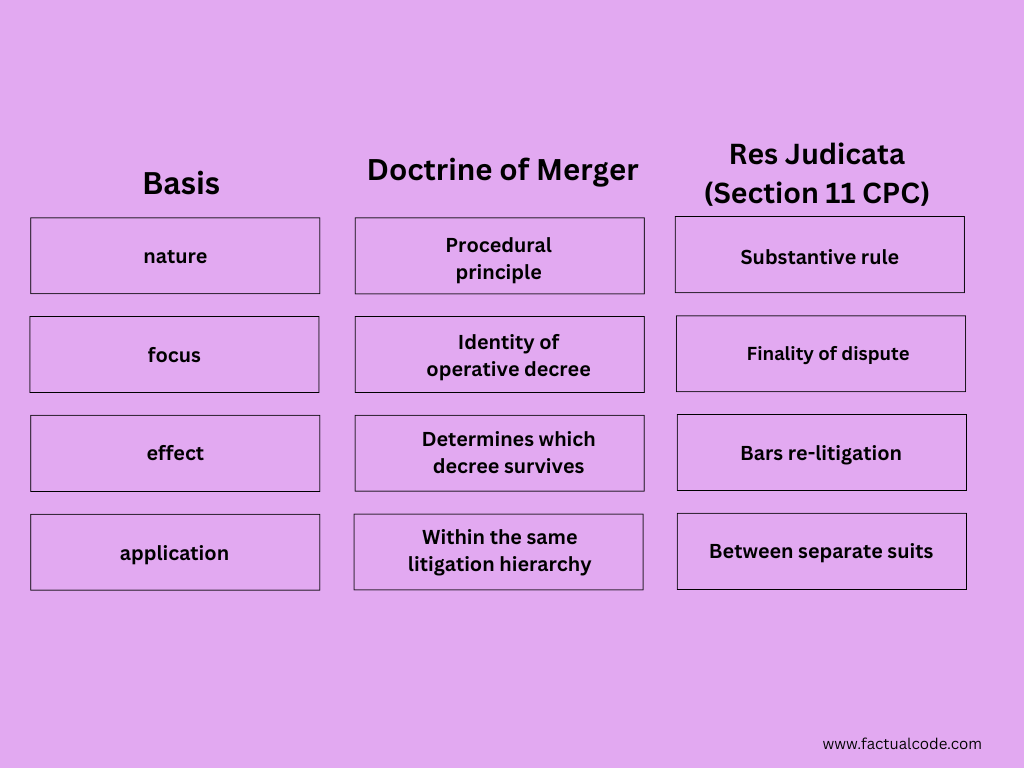
👉 Key Insight:
Merger determines which decree exists
Res Judicata determines whether the dispute can be reopened
11. Comparative Table (Quick Revision) 📘📘📘
| Scenario | Does Merger Occur? | Impact |
| Statutory Appeal (CPC) | Yes | Appellate decree replaces original |
| SLP Dismissed (No Reasons) | No | Lower court decree remains operative |
| SLP Dismissed (With Reasons) | No (Technically) | Law binding under Article 141 |
| Appeal Decided | Yes | Complete merger |
| Review Petition Dismissed | No | Original decree continues |
| Review Petition Allowed | Yes | Original decree is vacated |
| Revision (Sec. 115 CPC) | Yes | If decided on merits |
12. Conclusion ⚖️⚖️⚖️
The Doctrine of Merger ensures that only the final decision of the superior court prevails, thereby reinforcing judicial hierarchy and legal certainty. It is not a rigid technical rule but a principle of judicial propriety applied with reference to the nature of jurisdiction exercised. ⚖️⚖️⚖️
Ultimately, the doctrine ensures that the “last word” in the judicial hierarchy is the only word that remains enforceable, thereby bringing finality to litigation in the interest of justice. ⚖️⚖️⚖️