
📘 Start with the CPC Master Guide
Introduction ⚖️📖🧠
Execution is the final stage of a civil case. It is the stage at which the court’s decision, known as a decree, is actually enforced in practice. Practical difficulties may arise when the judgment-debtor (the person against whom the decree is passed) dies before or during execution proceedings. In such situations, the decree should not fail merely because of the death of the judgment-debtor. ⚖️📘🧩
To prevent such injustice, the Code of Civil Procedure, 1908 lays down specific rules for executing a decree against the legal representatives of a deceased judgment-debtor. These rules are mainly contained in Section 50 CPC and Order XXI CPC. The fundamental principle is that although personal liability comes to an end with death, the liability attached to the property (estate) of the deceased continues and can be enforced. ⚖️📚⚖️
Meaning of Legal Representative 👨⚖️📘🧠
The term legal representative is defined under Section 2(11) CPC. It refers to a person who in law represents the estate of a deceased person. It includes:
Heirs and legal successors,
Executors or administrators, and
Any person who deals with or takes possession of the deceased person’s property.
The definition is deliberately broad in nature. The law focuses on who represents the estate of the deceased, since execution proceedings are concerned only with enforcing the decree against the property left behind by the judgment-debtor. 📘⚖️🧩
Legal Basis for Execution against Legal Representatives 📜⚖️📚
The primary legal provision governing this subject is Section 50 CPC. It provides that:
If a judgment-debtor dies before the decree is fully satisfied,
The decree-holder may apply for execution against the legal representatives, and
Such execution can be carried out only against the property of the deceased that has come into their hands.
Section 50 CPC applies whether the decree was passed before or after the death of the judgment-debtor, so long as the liability relates to the estate. Order XXI CPC prescribes the detailed procedure for carrying out execution in such cases. ⚖️📘⚙️
Procedure under Order XXI CPC 🧾⚖️🔍
Execution against legal representatives follows a clear and structured judicial procedure: ⚖️📚🧭
Filing of Execution Application
The decree-holder must inform the court about the death of the judgment-debtor and clearly mention the legal representatives against whom execution is sought.Issue of Notice
The court issues notice to the legal representatives, giving them an opportunity to show cause as to why the decree should not be executed against them.Court Inquiry
The executing court may examine:Whether the persons named are legal representatives, and
The extent of the property of the deceased that has come into their possession.
Execution of Decree
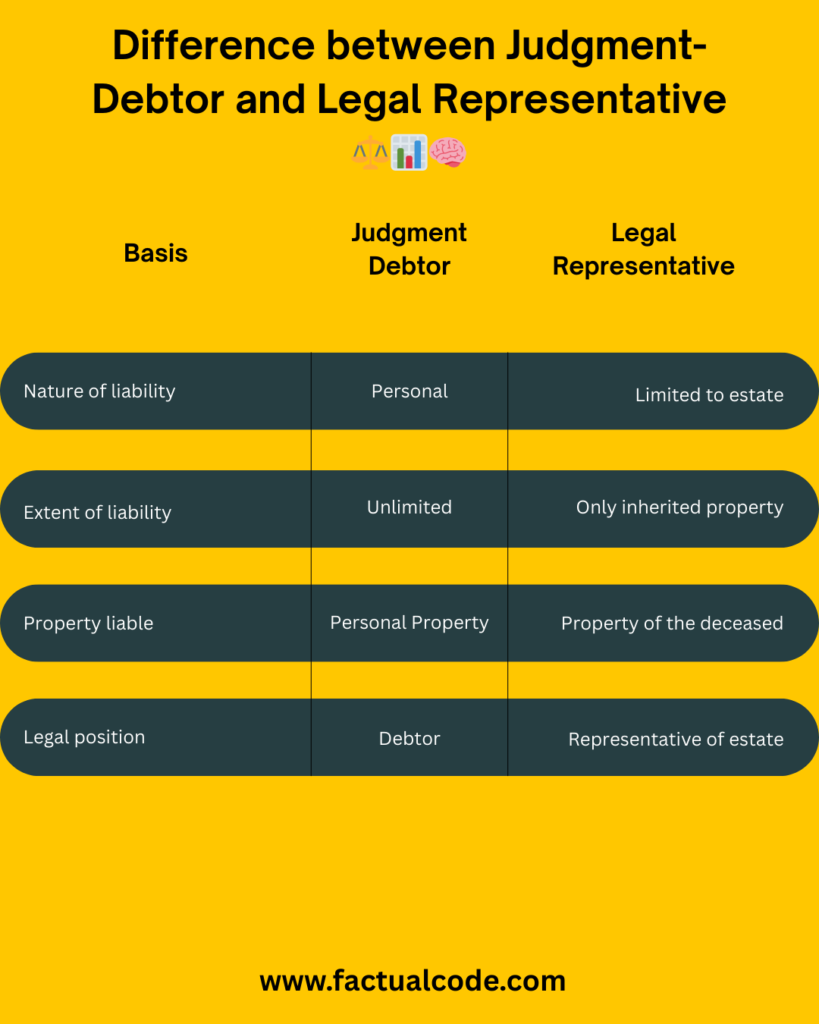
Execution is carried out only by attachment and sale of the property belonging to the deceased. The personal property of legal representatives cannot be proceeded against.
These procedural steps ensure fairness and protect the rights of heirs. ⚖️🛡️📘
Nature and Extent of Liability of Legal Representatives ⚖️📊🧠
The liability of legal representatives is limited and representative in nature, and not personal:
They are not personally responsible for satisfying the decree.
Their liability is restricted to the extent of the property inherited from the deceased.
If the inherited property has already been lawfully used, exhausted, or disposed of, no further liability arises.
The legal representative must establish the extent of the property received by them. This rule is based on the well-settled principle that heirs do not become personal debtors merely by inheriting property. ⚖️📘🧩
Objections Available to Legal Representatives 🧾⚖️🛑
Legal representatives are entitled to raise objections during execution proceedings, generally under Section 47 CPC, which deals with questions relating to execution, discharge, or satisfaction of a decree. Common objections include:
That the decree is not executable,
That no property of the deceased is in their possession,
That the inherited property has already been lawfully disposed of, or
That the decree is void due to lack of jurisdiction.
However, legal representatives cannot challenge the correctness or merits of the decree. The executing court is bound to execute the decree as it stands. ⚖️📘🚫
Important Case Laws 📚⚖️🏛️
The courts have clearly explained and settled the law on this subject: ⚖️📖🧠
Jugal Kishore Saraf v. Raw Cotton Co. Ltd.
The Supreme Court held that execution against legal representatives is permissible only against the property of the deceased and not against the personal assets of the legal representatives.- Topanmal Chhotamal v. Kundomal Gangaram (AIR 1960 SC 388)
The Supreme Court held that execution proceedings do not abate on the death of the judgment-debtor and may validly continue against the legal representatives, subject to the important limitation that execution can be carried out only against the estate of the deceased and not against the personal assets of the heirs. ⚖️🛡️📘
Death of Judgment-Debtor during Execution ⚰️⚖️📜
If the judgment-debtor dies after execution proceedings have already commenced:
The execution proceedings do not come to an end.
Legal representatives are brought on record as a procedural requirement.
Execution continues only against the estate of the deceased.
No fresh or personal liability is created against the legal representatives in such cases. ⚖️📘🧩
Conclusion ⚖️📘🧠
Execution against legal representatives under Order XXI CPC ensures that court decrees do not fail merely due to the death of a judgment-debtor. At the same time, it protects legal representatives from unjust personal liability. By limiting execution strictly to the estate of the deceased, Order XXI CPC maintains fairness and balance in civil procedure, ensuring effective enforcement of decrees while safeguarding the rights and interests of heirs. ⚖️🛡️📜