1. Introduction 📌📖✨
In civil litigation, the true value of a judgment lies in its execution. Even after a court finally determines the rights of the parties, those rights remain ineffective unless the decree is properly enforced. For this reason, execution is regarded as the final and most crucial stage of a civil suit. ⚖️📖✨
The Code of Civil Procedure, 1908 (CPC) lays down a comprehensive framework for the execution of decrees. In certain situations, both parties—either in the same suit or in different suits—may be entitled to recover money from each other. If such situations are not addressed carefully, they can result in multiple execution proceedings, delay, and unnecessary hardship. To prevent this, the CPC provides special provisions relating to cross-decrees and cross-claims, primarily contained in Order XXI Rules 18, 19, and 20. 📘⚖️✨
Although these provisions are not frequently invoked in routine cases, they play a vital role in ensuring that mutual monetary liabilities are adjusted fairly, efficiently, and without procedural complexity. 📚⚖️✨
2. Meaning of Decree and Its Importance in Execution 📜⚖️✨
Under Section 2(2) of the CPC, a decree means the formal expression of an adjudication by a court which conclusively determines the rights of the parties with regard to the matters in controversy. Execution proceedings can commence only after such a decree has been passed. 📘📖✨
The concepts of cross-decrees and cross-claims arise exclusively at the execution stage. They deal with situations where both parties have enforceable monetary rights against each other, requiring the executing court to adjust those rights before permitting actual recovery. ⚖️📚✨
3. Execution of Cross-Decrees 📌⚖️✨
(Order XXI Rule 18 CPC)
(a) Meaning of Cross-Decrees 🧾⚖️✨
Cross-decrees exist when:
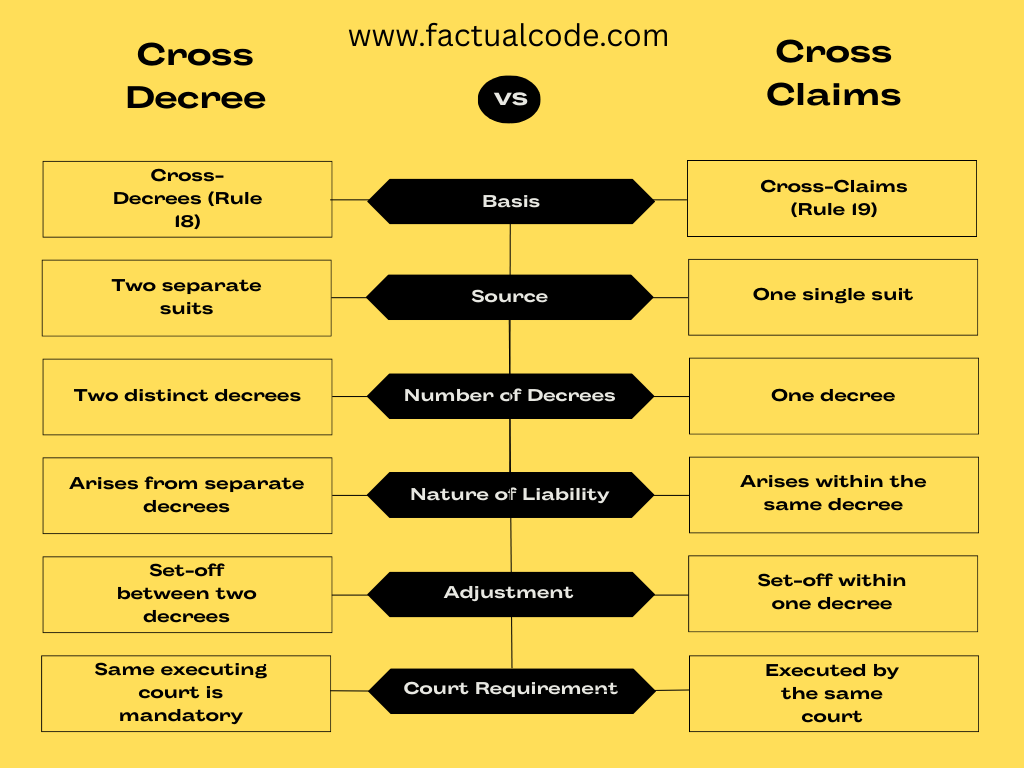
There are two separate decrees,
Passed in two different suits,
Between the same parties,
Each decree directs the payment of money, and
Both decrees are capable of execution at the same time by the same court.
Although the CPC does not expressly define the term “cross-decrees,” its scope and meaning are clearly derived from the provisions of Order XXI Rule 18. 📘⚖️✨
(b) Conditions for Applying Rule 18 📋⚖️✨
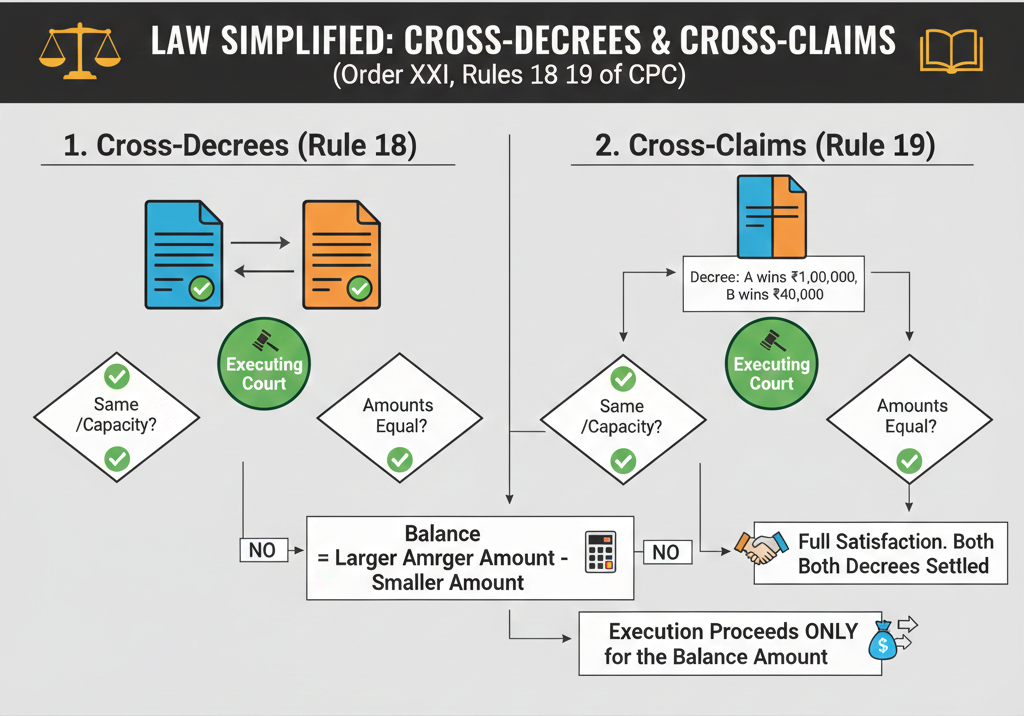
According to Order XXI Rule 18(3) CPC, adjustment of cross-decrees is permissible only when all the following conditions are fulfilled:
Each party must be a decree-holder in one suit and a judgment-debtor in the other.
The parties must litigate in the same legal capacity in both suits.
The sums due under both decrees must be definite, ascertained, and payable.
Both decrees must be executable by the same court at the same time.
Same Capacity – Simple Explanation 🔍⚖️✨
The requirement of same capacity is one of the most significant conditions under Rule 18. It means that a person must sue or be sued in the same legal role or character in both proceedings. 📘📖✨
Example: If A sues B in his personal capacity in one suit, but B sues A as an executor or trustee in another suit, Rule 18 cannot be applied. This is because A does not appear in the same legal capacity in both cases. ⚖️📚✨
(c) Mode of Execution of Cross-Decrees 🔄⚖️✨
Order XXI Rule 18 is based on the principle of set-off, which operates in the following manner:
Where the amounts under both decrees are equal, the court records satisfaction of both decrees.
Where the amounts are unequal, execution is permitted only in respect of the larger amount.
The smaller amount is adjusted against the larger one.
Execution proceeds only for the remaining balance.
This mechanism ensures that parties are not compelled to pay each other separately when their mutual liabilities can be justly adjusted by the court. ⚖️📘✨
(d) Joint and Several Liability 👥⚖️✨
Under Order XXI Rule 18(4) CPC, a decree passed jointly and severally against several persons may be treated as a cross-decree in relation to a decree passed against the decree-holder individually. This provision enables equitable adjustment even in cases involving multiple judgment-debtors or decree-holders. 📚⚖️✨
(e) Judicial View 🏛️⚖️✨
In Jugal Kishore v. Rao Cotton Co. Ltd. (AIR 1955 SC 376), the Supreme Court observed that Order XXI Rule 18 is intended to adjust mutual liabilities between parties and to prevent unnecessary and repetitive execution proceedings. The Court emphasized that procedural law should facilitate justice rather than defeat it through technical rigidity. ⚖️📘✨
4. Execution of Cross-Claims 📌⚖️✨
(a) Meaning of Cross-Claims 🧾⚖️✨
Cross-claims arise when:
There is a single decree, and
Both parties under that decree are entitled to recover sums of money from each other.
Unlike cross-decrees, cross-claims do not originate from separate suits. They exist within the framework of one decree passed in the same suit. 📘⚖️✨
(b) Mode of Execution 🔄⚖️✨
As provided under Order XXI Rule 19 CPC:
If the amounts recoverable by both parties are equal, satisfaction is entered in respect of both claims.
If the amounts are unequal, execution is allowed only for the excess amount remaining after adjustment.
(c) Example 🧠⚖️✨
If A is entitled to recover ₹10 lakhs from B under a decree, and B is entitled to recover ₹4 lakhs from A under the same decree, execution will be permitted only for ₹6 lakhs in favour of A after adjustment. 📘⚖️✨
6. Cross-Claims and Counter-Claims: Clear Difference
A counter-claim under Order VIII Rule 6A CPC is raised at the trial stage along with the written statement. It is treated as a cross-suit, requires a separate valuation and court fee, and results in a distinct decree.
In contrast, cross-claims under Order XXI Rule 19 CPC arise only at the execution stage and are intended solely for the adjustment of monetary amounts under an already existing decree.
7. Application in Mortgage Suits
(Order XXI Rule 20 CPC)
There was earlier uncertainty as to whether the provisions relating to cross-decrees and cross-claims applied only to simple money decrees. Order XXI Rule 20 CPC removes this doubt by expressly extending the application of Rules 18 and 19 to:
-
Mortgage decrees, and
-
Decrees for sale in enforcement of a mortgage or charge.
Accordingly, even in mortgage suits, the executing court is empowered to adjust mutual monetary claims between the parties.
8. Procedural Requirements
To seek adjustment under the provisions relating to cross-decrees or cross-claims:
-
An execution application must be pending before the court.
-
The party claiming adjustment must bring the cross-decree or cross-claim to the notice of the court.
-
Both decrees must be within the prescribed period of limitation.
-
Generally, courts do not apply these provisions suo motu; a specific request or application is required.
9. Conclusion
Order XXI Rules 18 to 20 of the CPC reflect the practical wisdom and balanced approach of procedural law. These provisions:
-
Prevent multiplicity of execution proceedings,
-
Avoid conflicting enforcement of decrees,
-
Ensure fair and equitable adjustment of mutual liabilities, and
-
Promote efficiency in the administration of civil justice.