
📘 Start with the CPC Master Guide
1. Introduction
Order 36 CPC, formally Order XXXVI of the Code of Civil Procedure, 1908, provides the procedure for determining a special case. It enables persons interested in a question of fact or law to agree in writing to submit that question to a competent civil court for decision. Section 90 CPC supplies the statutory foundation, while Order XXXVI Rules 1–6 prescribe the procedure.
The object is to secure a judicial determination of a specific question affecting the parties’ rights or obligations without commencing an ordinary contested suit in the usual way. It is not a mechanism for obtaining an abstract opinion: the agreement must connect the court’s finding with one of the consequences specified in Rule 1.
2. Meaning and Essential Requirements
A special case is a written statement of a question of fact or law agreed upon by interested parties and submitted to the court for adjudication. The agreement defines the question, records the relevant facts and documents, and states what consequence will follow from the court’s finding.
The essential requirements under Order XXXVI Rule 1 are:
Interested parties: The persons entering the agreement must claim an interest in the decision of the question.
Question of fact or law: The question submitted may be factual or legal; it need not be confined to a pure question of law.
Written agreement: The parties must agree in writing to state the question in the form of a case for the court’s opinion.
Specified consequence: The agreement must provide that, depending on the court’s finding, (a) a fixed or court-determined sum shall be paid by one party to another; (b) specified movable or immovable property shall be delivered by one party to another; or (c) one or more parties shall do, or refrain from doing, a particular act specified in the agreement.
Clear statement: Under Rule 1(2), the case must be divided into consecutively numbered paragraphs, concisely state the necessary facts and specify the documents required to decide the question.
Thus, the special case must present a real dispute or question with practical legal consequences. A merely hypothetical or academic question is insufficient.
3. Section 90 CPC and Order XXXVI
Section 90 CPC provides that where persons agree in writing to state a case for the court’s opinion, the court shall try and determine it in the prescribed manner. Order XXXVI implements Section 90 through six rules dealing with the agreement, valuation, filing, jurisdiction, hearing and appeal bar.
4. Valuation, Filing and Jurisdiction: Rules 2–4
Rule 2 – Valuation: If the agreement concerns delivery of property or doing or refraining from an act, it must state the estimated value of the property to be delivered or to which the act relates.
Rule 3 – Filing and registration: The agreement, if properly framed, may be filed with an application before the court that could entertain an ordinary suit involving the same amount or value. The application is numbered and registered as a suit; the presenting party or parties are shown as plaintiff(s), the others as defendant(s), and notice is given to the remaining parties to the agreement. Consent cannot confer jurisdiction: the court must be competent under the ordinary rules.
Rule 4 – Effect of filing: On filing, the parties become subject to the court’s jurisdiction and are bound by the statements in the agreement. Those statements define the case they have submitted and cannot simply be departed from during the proceeding.
5. Hearing and Disposal under Order 36 Rule 5 CPC
Rule 5(1) directs that the case be set down for hearing as a suit instituted in the ordinary manner. The provisions of the CPC apply so far as they are applicable.
Under Rule 5(2), the court must be satisfied, after examining the parties or taking such evidence as it thinks fit, that:
the agreement was duly executed by the parties;
the parties have a bona fide interest in the question stated; and
the question is fit to be decided.
If these conditions are met, the court pronounces judgment in the same manner as in an ordinary suit, and a decree follows.
The court is not required to give an advisory opinion merely because the parties have signed an agreement. It must independently examine the statutory conditions and decide whether the matter is suitable for adjudication. Where the question involves disputed facts, evidence may be necessary. In Minoo Kaikushru Belgamwala v. Maneck Marzban Kothawala, the Karnataka High Court explained that Rule 5 requires a hearing as an ordinary suit, so parties may lead evidence to prove their respective cases, subject to the statements in the agreement.
6. No Appeal under Order 36 Rule 6 CPC
Order XXXVI Rule 6 states: “No appeal shall lie from a decree passed under rule 5.” It therefore expressly bars an appeal from a decree made after adjudication of a special case. The ordinary appeal under Section 96 CPC is consequently unavailable against such a decree.
Legislative history: Rule 6 was inserted by Section 83 of the Code of Civil Procedure (Amendment) Act, 1976 (Act 104 of 1976), with effect from 1 February 1977. This matters when relying on older decisions: Minoo Kaikushru Belgamwala was decided in 1963, before Rule 6 was inserted, and its appeal cannot be treated as authority that a present-day Rule 5 decree is appealable.
The bar does not create an unrestricted alternative remedy. Review under Section 114 read with Order XLVII Rule 1 is possible only on recognised grounds, including discovery of important new evidence despite due diligence, an error apparent on the face of the record, or other sufficient reason; it is not a rehearing on merits. Revision under Section 115 may be considered only if its jurisdictional requirements are met. Article 227 supervisory jurisdiction is exceptional, not a routine substitute for appeal. In Radhey Shyam v. Chhabi Nath, (2015) 5 SCC 423, the Supreme Court held that judicial orders of civil courts are not amenable to Article 226 writ jurisdiction; Article 227 is distinct.
7. Important Case Law
Minoo Kaikushru Belgamwala v. Maneck Marzban Kothawala
Citation: AIR 1964 Mys 185; AIR 1964 Kant 185 (decided 11 April 1963).
The parties submitted a claim for ₹63,000 allegedly due from the estate of a deceased person. The trial court dismissed the special case, reasoning that the parties had to agree on all relevant facts and that disputed facts could not be investigated through evidence.
The High Court rejected that view. Rule 1 permits questions of fact as well as law; Rule 5(1) requires a hearing as an ordinary suit, allowing parties to prove their respective cases through evidence. Rule 4 binds parties to the statements in the agreement, but does not prevent them from proving those statements. The dismissal was set aside and the matter remanded.
Principle: A special case may involve disputed facts, and the court may receive evidence in accordance with the ordinary procedure, while remaining within the framework of the agreed case. The decision predates Rule 6 and should not be cited as authority on the present appeal bar.
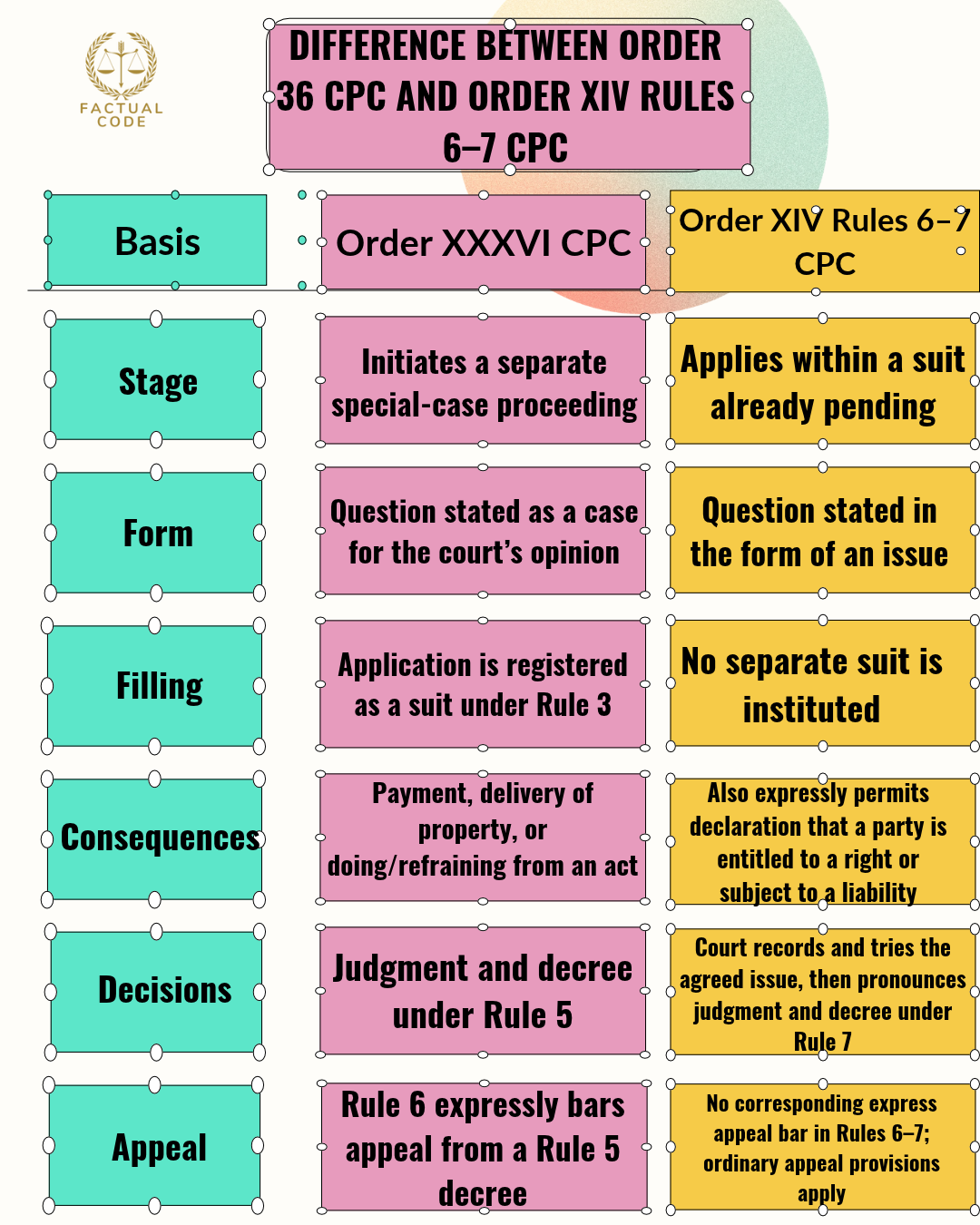
8. Difference between Order 36 CPC and Order XIV Rules 6–7 CPC
9. Illustration
A and B dispute whether a clause in their contract makes A liable to pay B ₹5 lakh. They enter into a written agreement submitting that question to a competent court and agree that payment will follow if the court finds the clause creates the liability. If the agreement satisfies Rule 1, it may be filed under Rule 3, registered as a suit and heard under Rule 5. The court examines the statutory conditions, determines the question and passes judgment followed by a decree. Rule 6 bars an appeal from that decree.
10. Conclusion
Order 36 CPC provides a specific procedure for judicial determination of a question of fact or law submitted by interested parties through a written agreement. Its requirements are substantive safeguards: the question must be genuine, the agreement must state a consequence recognised by Rule 1, the court must have jurisdiction, and the matter must be fit for adjudication. Rule 5 allows the court to hear the case as an ordinary suit and receive evidence where appropriate. Rule 6, inserted in 1976, bars an appeal from the resulting decree. The procedure is therefore a carefully regulated method of adjudication, not a device for securing an abstract legal opinion.
⚡ Quick Revision: Order XXXVI CPC (Special Case)
Section 90 & Order 36| Provision | Key Point |
|---|---|
| Section 90 | Statutory basis for stating a case for the court’s opinion |
| Rule 1 | Written agreement; question of fact or law; specified consequence |
| Rule 2 | Valuation for delivery of property or act-related agreement |
| Rule 3 | Filing with application; registration as suit |
| Rule 4 | Parties subject to jurisdiction and bound by agreed statements |
| Rule 5 | Hearing as an ordinary suit; judgment and decree |
| Rule 6 | No appeal from a decree under Rule 5 |