
📘 Start with the CPC Master Guide
1. Introduction
The Code of Civil Procedure, 1908 (CPC) does not require a litigant to appear personally at every stage of civil proceedings. To facilitate the conduct of litigation, it permits parties to appear and act through recognised agents or pleaders, subject to the court’s control.
The provisions relating to recognised agents and pleaders under CPC are primarily contained in Order III, Rules 1–6 of the First Schedule. These provisions balance procedural convenience with the need for proper legal representation and judicial supervision.
2. Meaning and Classes of Recognised Agents under CPC
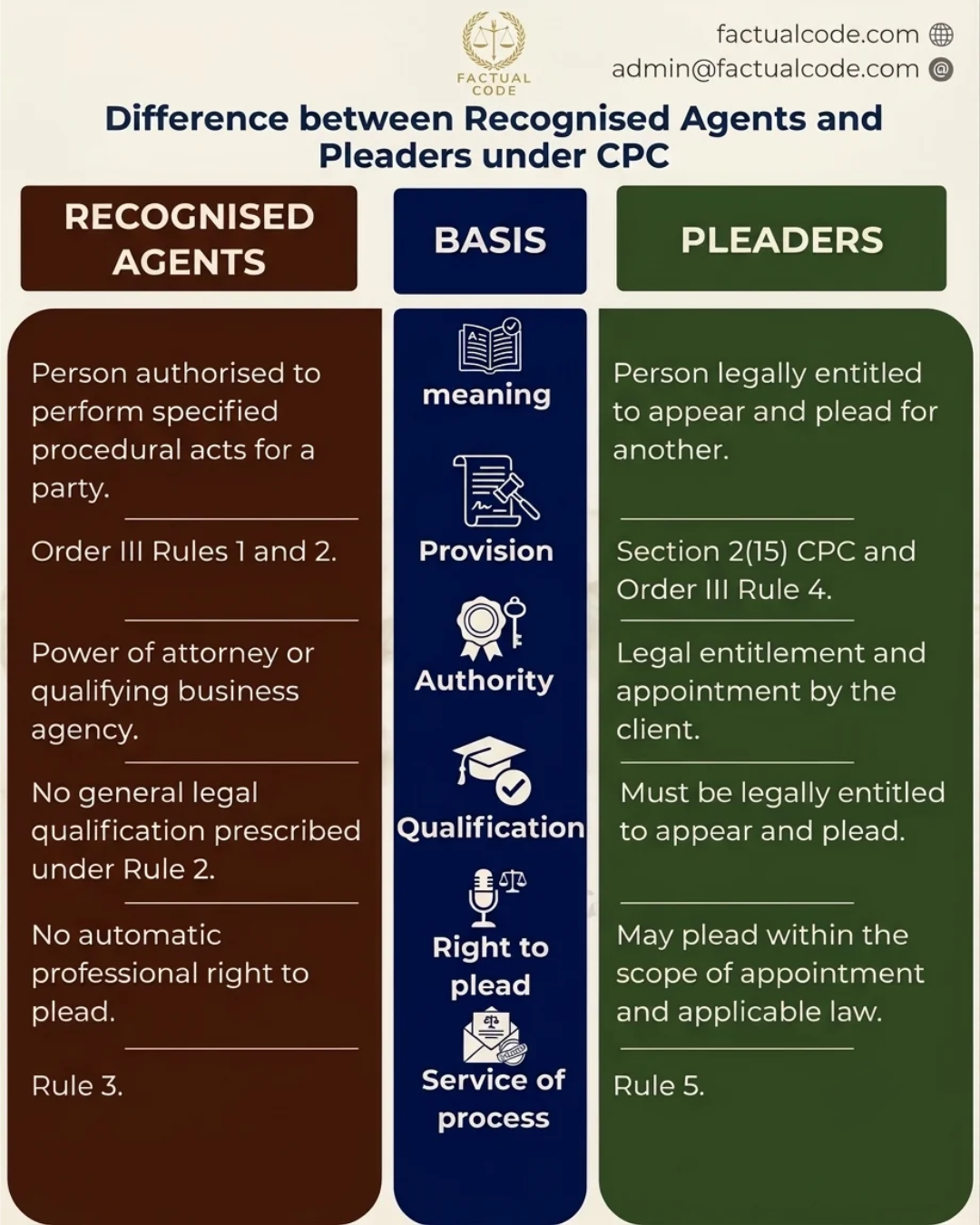
A recognised agent is a person authorised under Order III Rule 2 CPC to make appearances, applications and perform specified procedural acts on behalf of a party.
Rule 2 recognises two classes:
A. Power-of-Attorney Holders – Rule 2(a)
Under Rule 2(a), persons holding powers of attorney authorising them to make appearances, applications and acts on behalf of a party are recognised agents.
A Power of Attorney is an instrument by which one person (the principal) authorises another (the agent) to act on his behalf. It may be:
- General Power of Attorney: Authorises a range of acts within the scope of the instrument.
- Special Power of Attorney: Authorises specific acts or a particular transaction or proceeding.
Example: A person residing in Kolkata may authorise another person to undertake specified procedural acts in a civil suit concerning property in Murshidabad.
However, a power-of-attorney holder does not automatically acquire the professional right to plead before a court. His authority remains subject to the instrument and applicable law.
B. Trade or Business Agents – Rule 2(b)
Rule 2(b) recognises persons carrying on trade or business for and in the names of parties who do not reside within the local limits of the court’s jurisdiction.
The following conditions must be satisfied:
- The principal must not reside within the court’s local jurisdiction.
- The agent must carry on trade or business for and in the principal’s name.
- The appearance, application or act must relate to that trade or business.
- No other agent must have been expressly authorised to make or do such appearances, applications and acts.
Example: A businessman residing in Delhi conducts business through an agent in Kolkata. The agent may act in proceedings connected with that business if the statutory conditions are fulfilled.
3. Meaning of Pleader under CPC
Section 2(15) CPC defines a pleader as any person entitled to appear and plead for another in court. The expression includes:
- An advocate;
- A vakil; and
- An attorney of a High Court.
The professional entitlement of advocates is governed principally by the Advocates Act, 1961:
- Section 29: Recognises advocates as the only class of persons entitled to practise the profession of law, subject to the Act.
- Section 30: Confers the right to practise upon advocates whose names are entered in the State roll, subject to the Act.
- Section 33: Generally requires a person to be enrolled as an advocate to practise before courts and authorities, subject to statutory exceptions.
- Section 32: Empowers a court, authority or person to permit a non-advocate to appear in a particular case.
A pleader provides professional representation by appearing before the court, presenting legal arguments and conducting authorised procedural work. The legal entitlement to plead must, however, be distinguished from the procedural appointment required under Order III Rule 4 CPC.
4. Provisions Relating to Recognised Agents and Pleaders under Order III CPC
A. Rule 1 – Appearance in Person, through Recognised Agent or Pleader
Order III Rule 1 provides that an appearance, application or act required or authorised by law to be made by a party may generally be made:
- By the party personally;
- By his recognised agent; or
- By a pleader acting on his behalf.
This rule is subject to two qualifications:
- It does not override any contrary provision expressly made by another law.
- The court may direct the party to appear personally.
Thus, representation through an agent or pleader is subject to statutory requirements and judicial supervision.
B. Rule 2 – Recognised Agents
Rule 2 identifies the two classes of recognised agents: power-of-attorney holders and qualifying trade or business agents. Their authority is confined to the appearances, applications and acts permitted by the rule and the applicable authorisation.
C. Rule 3 – Service of Process on Recognised Agents
Under Rule 3, processes served on a recognised agent are ordinarily as effective as if served personally on the party, unless the court directs otherwise. The provisions relating to service upon a party also apply to service upon the recognised agent.
D. Rule 4 – Appointment of Pleader under CPC
Rule 4 governs the appointment and continuation of a pleader’s authority.
1. Written Appointment – Rule 4(1)
A pleader cannot act for a person in court unless appointed through a written document signed by:
- The person appointing him;
- His recognised agent; or
- Another person duly authorised by or under a power of attorney.
The document, commonly known as a Vakalatnama, must be filed in court.
2. Duration of Appointment – Rule 4(2)
The appointment remains in force until it is determined, with the leave of the court, by a written document signed by the client or pleader and filed in court; until the client or pleader dies; or until all proceedings in the suit end so far as the client is concerned.
3. Explanation to Rule 4(2)
The following are also treated as proceedings in the suit:
- An application for review of a decree or order;
- An application under Section 144 or Section 152 CPC;
- An appeal against a decree or order; and
- An application or act for obtaining copies, return of documents or refund of money deposited in court in connection with the suit.
Therefore, the appointment does not necessarily terminate upon the passing of the original decree.
4. Limitations – Rule 4(3)
The continuation of the appointment does not extend the duration of the professional engagement between the pleader and client. Further, it does not authorise service upon the pleader of a notice or document issued by another court unless the client has expressly agreed to such service in the written appointment.
5. Client Unable to Write – Rule 4(4)
The High Court may prescribe, by general order, the manner in which the mark of a person unable to write his name must be attested on the document appointing a pleader.
6. Pleader Engaged Only to Plead – Rule 4(5)
A pleader engaged only to plead must file a signed memorandum of appearance stating:
- The names of the parties;
- The party for whom he appears; and
- The person by whom he is authorised.
This requirement does not apply where he is engaged by another pleader already duly appointed to act for that party.
E. Rule 5 – Service of Process on Pleader
Under Rule 5, process served upon a pleader duly appointed to act for a party, or left at his office or ordinary residence, is presumed to have been communicated to that party. Unless the court directs otherwise, such service is as effective as personal service.
F. Rule 6 – Agent to Accept Service
Rule 6 provides for the appointment of an agent specifically to accept service of process.
- Rule 6(1): Any person residing within the court’s jurisdiction may be appointed to accept service, even if that person is not a recognised agent under Rule 2.
- Rule 6(2): The appointment must be made through a written instrument signed by the principal and filed in court. In the case of a general appointment, a certified copy may be filed.
- Rule 6(3): Where a party has neither a recognised agent residing within the court’s jurisdiction nor a pleader duly appointed to act for him, the court may direct him to appoint a local agent to accept service.
6. Powers and Limitations of Recognised Agents
The authority of recognised agents is subject to the following limitations:
- No automatic right to plead: Holding a power of attorney does not confer an independent professional right to practise law. Permission under Section 32 of the Advocates Act is discretionary and case-specific.
- Limited authority: An agent cannot exceed the authority granted by the principal or act contrary to law.
- Personal appearance: Under the proviso to Order III Rule 1, the court may require the party to appear personally.
- Giving evidence: A power-of-attorney holder cannot automatically depose in place of the principal regarding matters exclusively within the principal’s personal knowledge. He may testify about acts performed by him and matters within his own knowledge.
7. Important Case Laws on Recognised Agents and Pleaders
1. T.C. Mathai v. District & Sessions Judge, Thiruvananthapuram (1999)
The Supreme Court considered whether a power-of-attorney holder could claim an automatic right to appear and plead for another person before a criminal court. It held that Section 32 of the Advocates Act permits a court to allow a non-advocate to appear in a particular case, but a power of attorney by itself does not confer such a right.
Principle: Authority as a recognised agent is distinct from the professional right to plead before a court.
2. Janki Vashdeo Bhojwani v. Indusind Bank Ltd. (2004)
The Supreme Court held that a power-of-attorney holder may give evidence concerning acts performed by him under the authority granted and matters within his personal knowledge. However, he cannot substitute himself for the principal regarding acts performed by the principal or matters exclusively within the principal’s personal knowledge.
Principle: Authority to act on behalf of a principal does not automatically confer the right to testify in place of that principal.
3. Bar of Indian Lawyers v. D.K. Gandhi PS National Institute of Communicable Diseases (2024)
This decision primarily concerned whether advocates could be treated as service providers under consumer protection legislation. It discussed the professional status and duties of advocates and the advocate-client relationship.
Relevance: It may be mentioned as supplementary reading on the professional status of advocates, but it is not a principal authority on recognised agents under Order III CPC.
8. Importance of Order III CPC
Order III serves several important purposes:
- Procedural convenience: Enables litigants to participate through authorised representatives without personal attendance at every stage.
- Effective representation: Facilitates professional assistance by legally entitled persons.
- Commercial convenience: Allows qualifying business agents to act for non-resident principals in connected matters.
- Effective service: Rules 3, 5 and 6 provide mechanisms for service through recognised agents, pleaders and appointed service agents.
- Judicial supervision: Preserves the court’s power to require personal appearance and regulate representation.
9. Conclusion
Order III CPC provides the procedural framework for representation of parties through recognised agents and pleaders. Rules 1 and 2 govern modes of appearance and recognised agents; Rules 3 and 5 regulate service of process; Rule 4 deals with the appointment of pleaders; and Rule 6 provides for agents appointed to accept service.
The essential distinction is that a recognised agent may perform authorised procedural acts but does not automatically possess the professional right to plead. A pleader, on the other hand, is legally entitled to appear and plead, subject to proper appointment and applicable law. Thus, Order III balances procedural convenience, effective representation and judicial control.
10. Important Provisions & Case Laws for Revision
| Provision / Case Law | Type | Key Legal Subject / Core Ratio |
|---|---|---|
| Section 2(15), CPC | Statute | Definition of Pleader. |
| Order III Rules 1–2 | Statute | Modes of appearance and recognised agents. |
| Order III Rule 3 | Statute | Service of process on recognised agents. |
| Order III Rule 4 | Statute | Appointment, scope, and continuation of pleader's authority. |
| Order III Rule 5 | Statute | Service of process on pleaders. |
| Order III Rule 6 | Statute | Appointment of agents to accept service. |
| Sections 29, 30, 32 & 33, Advocates Act, 1961 | Statute | Professional entitlement to practise and court permission for non-advocates. |
| T.C. Mathai (1999) | Precedent | No automatic right to plead through a power-of-attorney holder without court permission. |
| Janki Vashdeo Bhojwani (2005) | Precedent | Evidentiary limitations: POA holder cannot depose on facts exclusively within principal's personal knowledge. |
| Bar of Indian Lawyers (2024) | Precedent | Professional status of advocates and procedural requirement of Vakalatnama under Rule 4. |