Introduction ⚖️📖✨
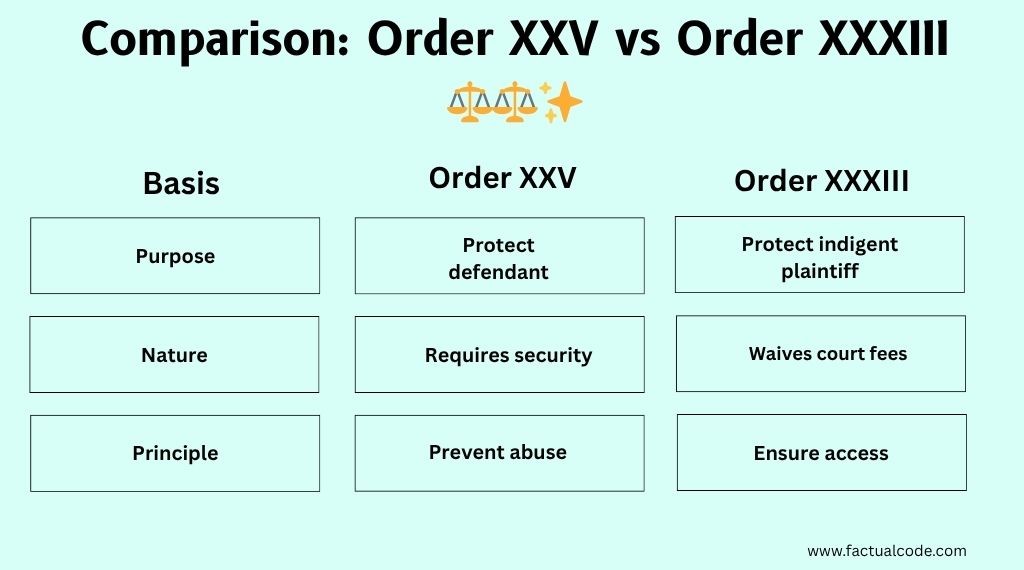
Order XXV of the Code of Civil Procedure, 1908 deals with Security for Costs, empowering courts to direct the plaintiff to furnish security to ensure that the defendant can recover litigation costs if the suit fails. ⚖️📖✨
It is a procedural safeguard aimed at preventing abuse of process while maintaining fairness in civil litigation. ⚖️📖✨
Object and Purpose ⚖️🎯✨
Protect the defendant from unrecoverable costs
Prevent frivolous or vexatious litigation
Ensure bona fide claims
Maintain a balance between access to justice and judicial discipline
Core Idea: Prevent misuse without creating barriers to genuine litigation ⚖️🎯✨
Statutory Framework (Order XXV Rule 1 CPC) ⚖️📜✨
Suo Motu Clarification ⚖️📜✨
The court may act independently where:
However, this power must be exercised sparingly, cautiously, and judicially. ⚖️📜✨
Grounds for Ordering Security ⚖️📌✨
(a) Plaintiff Residing Outside India ⚖️🌍✨
Security may be ordered where:
Refined Property Rule ⚖️🏠✨
The property must be:
Disputed property cannot be treated as valid security. ⚖️🏠✨
(b) Multiple Plaintiffs Rule ⚖️👥✨
If there are multiple plaintiffs and even one of them resides in India with sufficient property, the court generally cannot invoke the proviso against the others. ⚖️👥✨
(c) Plaintiff Lacks Means ⚖️💰✨
Security may be ordered where the plaintiff is unlikely to pay costs if the suit fails. ⚖️💰✨
(d) Vexatious or Speculative Litigation ⚖️⚠️✨
Case: Vinod Seth v. Devinder Bajaj (2010) – Security should be ordered only in clear cases of abuse; otherwise, it becomes a “toll on litigation.” ⚖️⚠️✨
(e) Corporate Plaintiffs ⚖️🏢✨
Case: Sir Lindsay Parkinson & Co. Ltd. v. Triplan Ltd. – Security is justified where a company is likely unable to pay costs. ⚖️🏢✨
Nature of Court’s Discretion ⚖️🧠✨
Cases:
Timing of Application ⚖️⏳✨
Although the law permits action at any stage, applications should be made at the earliest possible stage. ⚖️⏳✨
Delay may result in rejection due to the doctrine of laches. ⚖️⏳✨
Procedure for Furnishing Security ⚖️📂✨
The court determines:
Forms of Security:
Cash deposit
Bank guarantee
Surety bond
Link with Costs under Section 35 CPC ⚖️📊✨
Order XXV operates as a safeguard for costs awarded under:
The amount of security is generally calculated based on probable costs under these provisions. ⚖️📊✨
Failure to furnish security within the prescribed time may result in dismissal of the suit. ⚖️❌✨
Such dismissal is procedural and not on merits. ⚖️❌✨
Restoration of Suit (Order XXV Rule 2(2)) ⚖️🔄✨
The plaintiff may apply to set aside the dismissal. ⚖️🔄✨
Conditions:
Limitation: Generally within 30 days under the Limitation Act. ⚖️🔄✨
Appeal and Revision ⚖️📚✨
(a) Order to furnish security:
(b) Dismissal for default:
(c) Refusal to restore:
Additional Principle ⚖️📖✨
Case: M/s. Alka Gupta v. Narender Kumar Gupta – Procedural law must advance justice, not obstruct it. ⚖️📖✨