📘 Start with the CPC Master Guide
Introduction ⚖️📖🧾
Order XXIX of the Code of Civil Procedure, 1908 deals with suits by or against corporations. A corporation is an artificial legal person, distinct from its members, and therefore cannot act or appear in court in its own physical capacity. The law accordingly provides a procedural mechanism through which a corporation can sue and be sued through human agency. ⚖️📖🧾
The provisions under this Order are enabling in nature and are designed to ensure procedural convenience while preserving the substantive rights and liabilities of the corporation. These rules must be read harmoniously with the general principles of pleadings under Order VI CPC and the jurisdictional provisions under Section 20 CPC. ⚖️📖🧾
Who May Sign and Verify Pleadings (Rule 1) 🖊️📑🏢
Rule 1 of Order XXIX provides that in suits by or against a corporation, the plaint or written statement may be signed and verified on behalf of the corporation by the Secretary, Director, or any other Principal Officer of the corporation. 🖊️📑🏢
The term “Principal Officer” has a wide and practical connotation:
A. It includes formally designated high-ranking officials.
B. It also includes officers specifically authorized by the corporation.
C. It extends to officers who are well acquainted with the facts of the case.
Thus, officers such as Branch Managers or General Managers may validly sign and verify pleadings if they possess personal knowledge of the transaction in question. 🖊️📑🏢
Further compliance with Order VI, Rule 15 CPC requires:
a. Clear distinction between statements based on personal knowledge.
b. Statements based on information and belief.
Order XXIX, Rule 1 operates as an enabling provision allowing corporations to comply with Order VI, Rules 14 and 15. 🖊️📑🏢
Service of Summons on Corporation (Rule 2) 📬📮🏢
Rule 2 lays down the mode of service of summons on a corporation:
A. Delivery or leaving summons at the registered office.
B. Delivery at the principal place of business.
An important procedural nuance:
a. Service may also be effected through registered post.
b. Refusal to accept summons amounts to valid service.
This prevents corporations from evading legal proceedings. 📬📮🏢
Place of Suing (Section 20 CPC – Explanation) 📍🏛️📘
The place of suing in matters involving corporations is governed by Section 20 CPC, particularly its Explanation:
A. A corporation is deemed to carry on business at its principal office.
B. It is also deemed to carry on business at a subordinate office where cause of action arises.
This ensures jurisdictional flexibility and prevents evasion of liability. 📍🏛️📘
Interplay with General Rules of Pleadings ⚖️📚🧩
Order XXIX operates as a special provision and must be read with Order VI CPC:
A. Order VI requires pleadings to be signed by parties.
B. Order XXIX allows corporations to act through officers.
Thus, Order XXIX supplements and adapts general procedural rules. ⚖️📚🧩
Judicial Approach and Doctrines ⚖️🏛️📖
The courts have adopted a liberal and pragmatic approach:
A. Emphasis is on substantive justice over technicalities.
Key judicial principles:
a. United Bank of India v. Naresh Kumar
- Procedural defects are curable.
- Subsequent ratification validates the act.
b. State Bank of Travancore v. Kingston Computers (2011)
- Complete lack of authority leads to dismissal.
c. De Facto Doctrine
- Acts of officers with defective authority may still be valid if done in good faith.
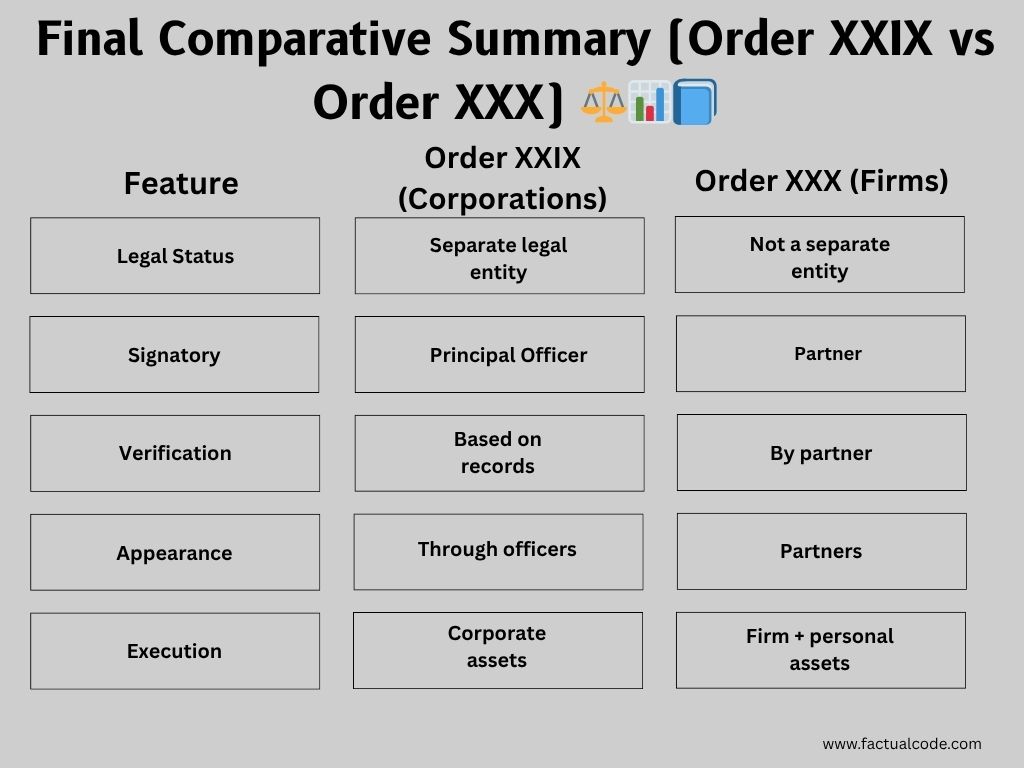
Comparison with Suits by Firms (Order XXX CPC) ⚖️📊🏢
Key distinctions:
A. Order XXIX applies to corporations.
B. Order XXX applies to firms.
Further differences:
a. Firms require disclosure of partners.
b. Corporations have separate legal identity.
Model Verification Clause (Illustration) 🖊️📄⚖️
“I, A.B., the Manager of the Plaintiff Company, do hereby verify that the contents of paragraphs 1 to 5 of the plaint are true to my personal knowledge, and paragraphs 6 to 10 are based on information received and believed to be true.” 🖊️📄⚖️
Procedural Flow of a Corporate Suit 🔄⚖️📘
A. Institution of Suit – Filed and verified by authorized officer.
B. Scrutiny – Court checks compliance.
C. Issue of Summons – Under Rule 2.
D. Service – At office or via registered post.
E. Appearance – Through authorized representative.
F. Written Statement – Verified by Principal Officer.
G. Trial and Evidence – As per CPC.
H. Judgment and Decree – Passed by court.
I. Execution – Against corporate assets.
Enhanced Model Verification Clause 🖊️📄⚖️
“I, [Name], the Principal Officer/Director of [Company Name], do hereby verify that the contents of paragraphs 1 to 10 are true to my personal knowledge derived from official records of the company, and the contents of paragraphs 11 to 15 are based on legal advice and information received, which I believe to be true.
Verified at [Place] on this [Date].
(Signature)
Deponent”
Exam Tip: Doctrine of Ratification 


In problem-based questions:
A. Identify defect in authorization.
B. Apply doctrine of ratification.
C. Argue retrospective validation.
However:
a. Works only if ratification exists.
b. Fails in cases of complete lack of authority.
Conclusion 
Order XXIX CPC provides a practical framework for corporate litigation. It balances procedural flexibility with legal accountability.
Judicial interpretation ensures that technical defects do not defeat substantive justice, while still requiring proper authority.