
Introduction
In civil procedure, the decision of a court is formally expressed through either a decree or an order. A decree represents the formal and conclusive determination of the rights of the parties with respect to the matters in controversy in a civil suit.
The term “decree” is defined under Section 2(2) of the Code of Civil Procedure, 1908 (CPC). According to this provision, a decree means the formal expression of an adjudication that conclusively determines the rights of the parties regarding all or any of the matters in controversy in a suit.
The CPC classifies decrees into different categories depending on the stage of the suit and the nature of the adjudication. This classification is significant because it determines when an appeal can be filed, when execution may begin, and how the rights of the parties are ultimately enforced.
Essential Elements of a Decree
For an adjudication to qualify as a decree under Section 2(2) CPC, the following essential conditions must be satisfied:
There must be an adjudication by a court of law.
The adjudication must arise in a civil suit.
It must determine the rights of the parties regarding matters in controversy.
The determination must be conclusive in nature.
The adjudication must be formally expressed by the court.
When these conditions are fulfilled, the decision becomes a decree capable of appeal and execution.
Types of Decrees under CPC
The Code of Civil Procedure recognizes the following principal types of decrees:
Preliminary Decree
Final Decree
Partly Preliminary and Partly Final Decree
Deemed Decree
Each category plays a specific role within the procedural framework of civil litigation and helps courts resolve disputes in a systematic and stage‑wise manner.
Preliminary Decree
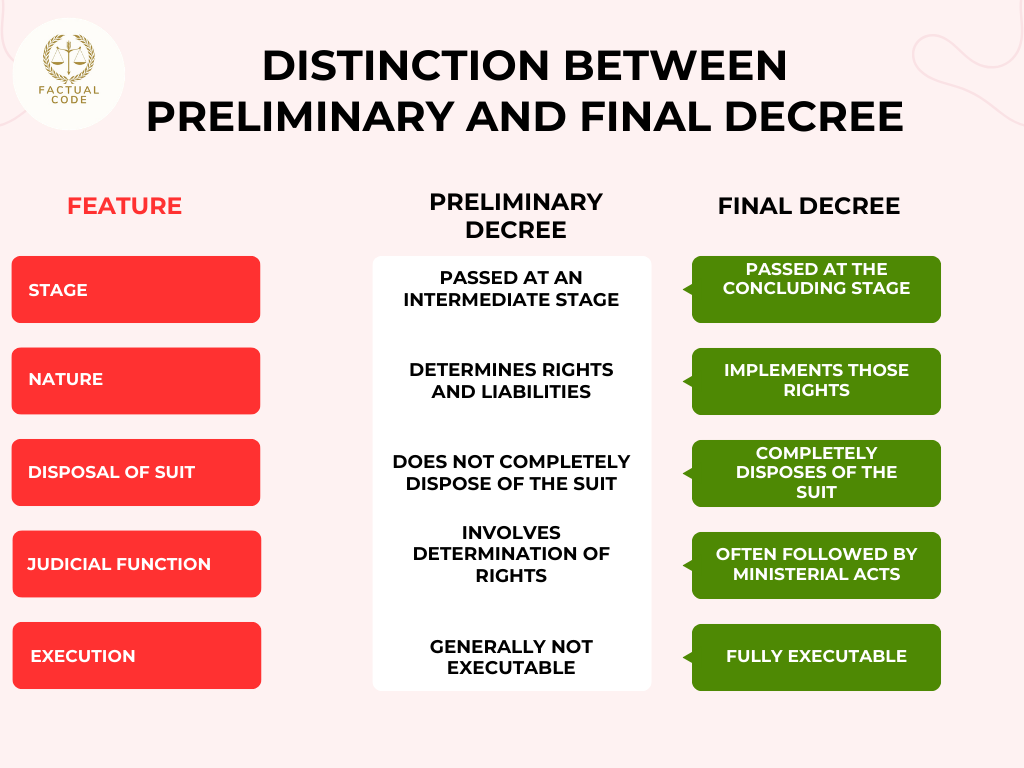
A preliminary decree is a decree that determines the rights and liabilities of the parties, but does not completely dispose of the suit. Further proceedings are required before the court can grant complete relief.
Preliminary decrees are commonly passed in cases where additional inquiries, accounting, or division of property must be undertaken before the dispute can be finally resolved.
Statutory Provisions Involving Preliminary Decrees
| Nature of Suit | Relevant CPC Provision |
|---|---|
| Administration suits | Order XX Rule 13 CPC |
| Dissolution of partnership | Order XX Rule 15 CPC |
| Partition suits | Order XX Rule 18 CPC |
| Mortgage suits (foreclosure or sale) | Order XXXIV Rules 2–4 CPC |
Example
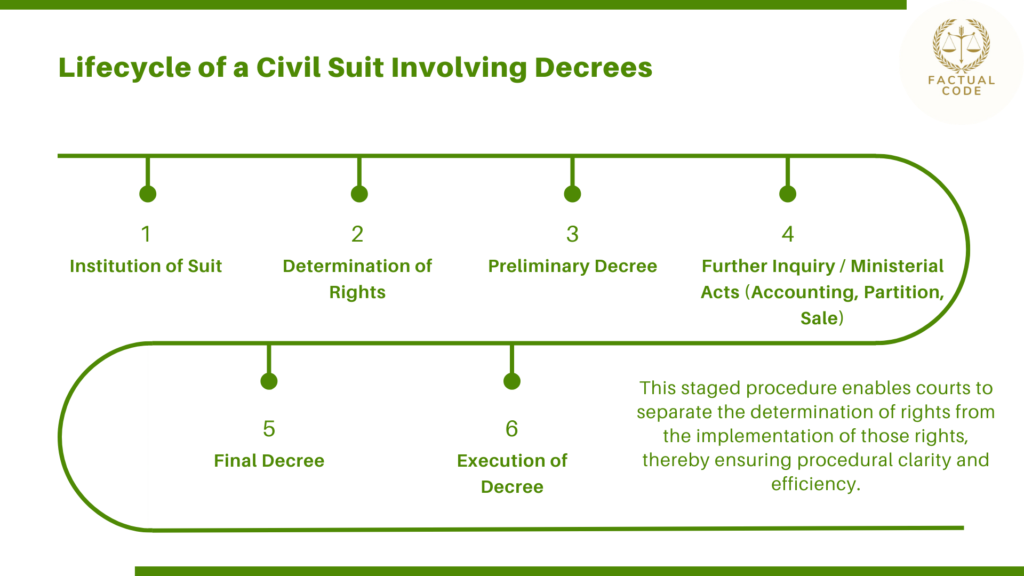
In a partition suit, the court first determines the shares of the parties through a preliminary decree. The actual division of the property takes place later through a final decree.
Thus, the preliminary decree establishes the legal rights of the parties, which form the foundation for further proceedings in the suit.
Effect of Preliminary Decree – Section 97 CPC
A crucial rule relating to preliminary decrees is contained in Section 97 CPC.
According to this provision, if a party does not file an appeal against a preliminary decree, that party cannot later challenge its correctness in an appeal against the final decree.
Practical Significance
This rule means that the determination of rights in the preliminary decree becomes final and binding if no appeal is filed at that stage.
In suits such as partition suits or mortgage suits, failure to appeal the preliminary decree may result in waiving the right to challenge the determination of shares or liabilities at a later stage.
Final Decree
A final decree is the decree that completely disposes of the suit and leaves nothing further for the court to determine.
A decree is regarded as final not merely because it is the last document issued, but because it leaves nothing further for the judicial mind to decide.
The stage between the preliminary decree and the final decree often involves ministerial acts, such as:
Accounting of profits
Physical division of property
Sale of mortgaged property
For instance, in a partition suit, the court may appoint a Commissioner to divide the property according to the shares determined in the preliminary decree. This process is largely ministerial because it implements the judicial determination already made.
After the completion of these procedures, the court issues the final decree confirming the rights and distribution of the property.
Partly Preliminary and Partly Final Decree
In certain situations, a decree may be partly preliminary and partly final.
This occurs when the court conclusively decides certain issues while leaving other matters to be determined through further inquiry.
Example
In a suit for possession of immovable property and mesne profits under Order XX Rule 12 CPC:
The decree is final regarding the delivery of possession, as the ownership rights have been conclusively determined.
The decree is preliminary concerning mesne profits, since the exact amount payable must be determined through further inquiry.
Thus, the decree possesses both preliminary and final characteristics.
Deemed Decree
A deemed decree refers to an adjudication that does not strictly fulfill all the elements of Section 2(2) CPC, but is treated as a decree by statutory legal fiction.
Significance
This legal fiction allows the affected party to file an appeal as if the decision were a regular decree, thereby providing a stronger procedural remedy.
Important Examples
Rejection of a plaint under Order VII Rule 11 CPC
Orders relating to restitution under Section 144 CPC
For example, rejection of a plaint terminates the suit at the threshold, even though the merits of the case are not examined. Therefore, the law treats it as a decree so that the aggrieved party may file an appeal against the decision.
Decisions Which Are Not Decrees
Section 2(2) CPC also clarifies certain decisions that do not constitute decrees.
The following are excluded:
Any adjudication from which an appeal lies as an appeal from an order.
Dismissal of a suit for default.
Such decisions are governed by separate procedural provisions and cannot be executed as decrees.
Judicial Interpretation
Indian courts have clarified the nature and scope of decrees through several important judicial decisions.
In Phoolchand v. Gopal Lal (AIR 1967 SC 1470), the Supreme Court held that more than one preliminary decree may be passed in a partition suit if circumstances require modification of the shares before the final decree is issued.
Similarly, in Shankar Balwant Lokhande v. Chandrakant Shankar Lokhande (1995), the Court explained that the final decree completes the process initiated by the preliminary decree in partition suits.
Limitation for Appeals
The Limitation Act, 1963 governs appeals against decrees.
The limitation period for filing an appeal generally begins from the date of the decree, not from the date when the decree is formally drawn up or signed.
However, the time required for obtaining a certified copy of the decree or judgment is excluded when calculating the limitation period.
Conclusion
The classification of decrees under the Code of Civil Procedure, 1908 plays a vital role in the administration of civil justice. By distinguishing between preliminary, final, partly preliminary, and deemed decrees, the CPC provides a structured procedural framework for resolving civil disputes.
This mechanism enables courts to first determine the legal rights of the parties and subsequently ensure their effective enforcement through execution. As a result, the system of decrees promotes clarity, procedural efficiency, and fairness in civil litigation.