
1. Introduction
The examination of parties under the Code of Civil Procedure, 1908 (CPC) is an important procedural mechanism that helps civil courts identify the actual disputes between litigating parties. Order X CPC deals with the examination of parties, ascertainment of admissions and denials, and clarification of matters in controversy. It also facilitates the consideration of alternative dispute resolution under Section 89 CPC.
Alongside Order X, Order XV CPC provides for the disposal of suits at the first hearing in specified circumstances. These provisions enable courts to identify undisputed matters, avoid unnecessary trials and promote the speedy administration of civil justice.
This article explains Order X Rules 1–4, the first hearing of a suit, the provisions of Order XV, and the relevant Supreme Court decisions.
2. Meaning and Importance of the First Hearing under CPC
The first hearing is an important stage in a civil suit because the court examines the pleadings, clarifies disputed matters and determines the appropriate course of proceedings.
However, the expression “first hearing” does not necessarily mean the first date on which the parties appear before the court. Its precise meaning depends upon the procedural context.
In Ved Prakash Wadhwa v. Vishwa Mohan, (1981) 3 SCC 667, the Supreme Court, while considering a rent-control dispute, referred to the stages contemplated under Order X Rule 1, Order XIV Rule 1(5) and Order XV Rule 1 CPC. The decision emphasises the importance of the stage at which the court examines the pleadings and identifies the matters requiring adjudication. Its observations should be understood in the context of the statute involved.
Importance of the First Hearing
The first hearing is significant because it enables the court to:
- Ascertain the admissions and denials of the parties.
- Clarify the matters actually in controversy.
- Consider whether the dispute is suitable for alternative dispute resolution.
- Determine whether issues need to be framed.
- Examine whether the suit can be disposed of without a full trial.
3. Examination of Parties under Order X CPC
Order X CPC deals specifically with the examination of parties by the court. Its principal purpose is to clarify the matters in controversy and identify the actual disputes between the parties.
The provisions of Order X are explained below.
A. Order X Rule 1 – Ascertainment of Admissions and Denials
Under Order X Rule 1, at the first hearing of the suit, the court must ascertain from each party or their pleader whether the party admits or denies the allegations of fact made in the plaint or written statement, which are not expressly or by necessary implication admitted or denied by the other party.
The court is also required to record such admissions and denials.
The use of the word “shall” makes the ascertainment and recording of admissions and denials a mandatory procedural duty of the court.
This provision helps the court identify the facts that are genuinely disputed and those that do not require further proof. It also assists in determining the questions on which issues may be framed.
B. Order X Rules 1A–1C – Reference to Alternative Dispute Resolution
Order X Rules 1A, 1B and 1C were introduced through the CPC amendment effective from 1 July 2002 to facilitate the use of alternative dispute resolution (ADR).
After recording admissions and denials, the court may consider whether the dispute is suitable for settlement outside the court.
Under Rule 1A, the court directs the parties to opt for one of the modes of settlement referred to in Section 89 CPC. The parties are required to appear before the appropriate forum or authority for the selected process.
Rule 1B provides for the appearance of the parties before the forum or authority for conciliation, judicial settlement or another appropriate ADR process. Rule 1C deals with the return of the matter to the court where the process fails to produce a settlement.
Modes of Alternative Dispute Resolution under Section 89 CPC
Section 89 CPC recognises the following statutory modes of settlement:
- Arbitration;
- Conciliation;
- Judicial settlement, including settlement through Lok Adalat; and
- Mediation.
In Afcons Infrastructure Ltd. v. Cherian Varkey Construction Co. (P) Ltd., (2010) 8 SCC 24, the Supreme Court explained the scope and application of Section 89 CPC. The Court indicated that the appropriate stage for considering ADR is ordinarily after the completion of pleadings and before the framing of issues, when the court conducts the preliminary examination contemplated under Order X.
The Court also clarified that arbitration cannot be imposed upon parties without an arbitration agreement or their consent. The court must consider the nature of the dispute and the suitability of the particular ADR process.
C. Order X Rule 2 – Oral Examination of Parties
Order X Rule 2 empowers the court, at the first hearing or at any subsequent hearing, to examine orally any party or any person accompanying a party or their pleader who is able to answer material questions relating to the suit.
The purpose of such examination is to elucidate matters in controversy. It enables the court to obtain clarification regarding the disputed facts and the respective positions of the parties.
This examination is not the recording of formal evidence. It is a procedural mechanism intended to clarify the dispute and assist the court in understanding the real issues involved.
In Kapil Corepacks Pvt. Ltd. v. Harbans Lal, (2010) 8 SCC 452, the Supreme Court considered the purpose of examination under Order X Rule 2 and explained that it is intended to clarify matters in controversy rather than to conduct a formal evidentiary examination.
It is also important to distinguish Order X Rule 2 from Section 168 of the Bharatiya Sakshya Adhiniyam, 2023 (BSA), corresponding to Section 165 of the repealed Indian Evidence Act, 1872. Section 168 gives the judge a broader power to put questions to witnesses or parties at any time and to order the production of documents or things for the purpose of discovering or obtaining proper proof of relevant facts, subject to the statutory safeguards.
D. Order X Rule 3 – Substance of Examination to Be Recorded
Under Order X Rule 3, the substance of the examination conducted under Rule 2 must be reduced to writing by the judge and must form part of the record.
This ensures that the clarification obtained from the parties is properly documented and can be considered during the subsequent proceedings.
E. Order X Rule 4 – Consequences of Refusal or Inability to Answer
Order X Rule 4 deals with a situation where a pleader or a person accompanying a party refuses or is unable to answer a material question which the party ought to answer personally and which the party is likely to be able to answer.
In such circumstances, the court may postpone the hearing and direct the party to appear personally on a date not later than seven days from the first hearing.
If the party fails to appear without lawful excuse, the court may pronounce judgment against that party or make such other order in relation to the suit as it considers appropriate.
The provision discourages evasive conduct and ensures that parties cooperate with the court in clarifying the matters in dispute.
4. Disposal of Suits at the First Hearing under Order XV CPC
Order XV CPC deals with the disposal of suits at the first hearing. It provides circumstances in which a court may dispose of a suit without proceeding through a full trial.
The objective is to avoid unnecessary litigation where the dispute does not require a lengthy adjudication.
A. Order XV Rule 1 – Parties Not at Issue
Under Rule 1, where at the first hearing of a suit it appears that the parties are not at issue on any question of law or fact, the court may pronounce judgment.
The provision applies where there is no genuine dispute requiring adjudication between the parties.
For example, if the defendant admits the material allegations and no legal question remains for determination, the court may proceed to pronounce judgment instead of conducting an unnecessary trial.
B. Order XV Rule 2 – One of Several Defendants Not at Issue
Rule 2 applies where there are several defendants and the court finds that one or more of them are not at issue with the plaintiff on any question of law or fact.
In such circumstances, the court may pronounce judgment for or against those defendants and the suit may continue against the remaining defendants.
This provision enables the court to dispose of the uncontested part of a dispute without delaying the proceedings against other defendants.
C. Order XV Rule 3 – Parties at Issue
Rule 3 deals with a situation where the parties are at issue on questions of law or fact.
Where issues have been framed and the court is satisfied that no further argument or evidence is required from the parties on those issues, it may determine the issues and, if its findings are sufficient for the decision of the suit, pronounce judgment.
However, the court must ensure that no injustice is likely to result from deciding the suit in this manner.
If further evidence or argument is necessary, the court must adjourn the matter and fix a date for the further proceedings.
D. Order XV Rule 4 – Failure to Produce Evidence
Rule 4 applies where summons has been issued for the final disposal of the suit and either party, without sufficient cause, fails to produce the evidence on which that party relies.
In such a situation, the court may:
- Pronounce judgment; or
- If it considers that the interests of justice require further proceedings, frame and record the issues and adjourn the suit for the production of evidence or for further argument.
The provision prevents unnecessary delay caused by a party’s failure to produce evidence at the appropriate stage.
5. Difference between Order XV and Order XIII-A CPC
Order XV and Order XIII-A CPC serve different purposes and should not be confused.
Order XV provides for disposal of suits at the first hearing in circumstances specified under its rules. Order XIII-A, however, introduces a separate mechanism of summary judgment in commercial disputes of specified value.
The Commercial Courts Act, 2015 introduced Order XIII-A and Order XV-A into the CPC for commercial disputes of specified value and made corresponding amendments to the application of certain procedural provisions, including the omission of Order XV from the Schedule applicable to such commercial disputes.
Conditions for Summary Judgment under Order XIII-A Rule 3
Under Order XIII-A Rule 3, the court may grant summary judgment where it is satisfied that:
- The plaintiff has no real prospect of succeeding on the claim; or
- The defendant has no real prospect of successfully defending the claim; and
- There is no other compelling reason why the claim should not be disposed of before recording oral evidence.
An application for summary judgment may be made after service of summons but before the issues are framed.
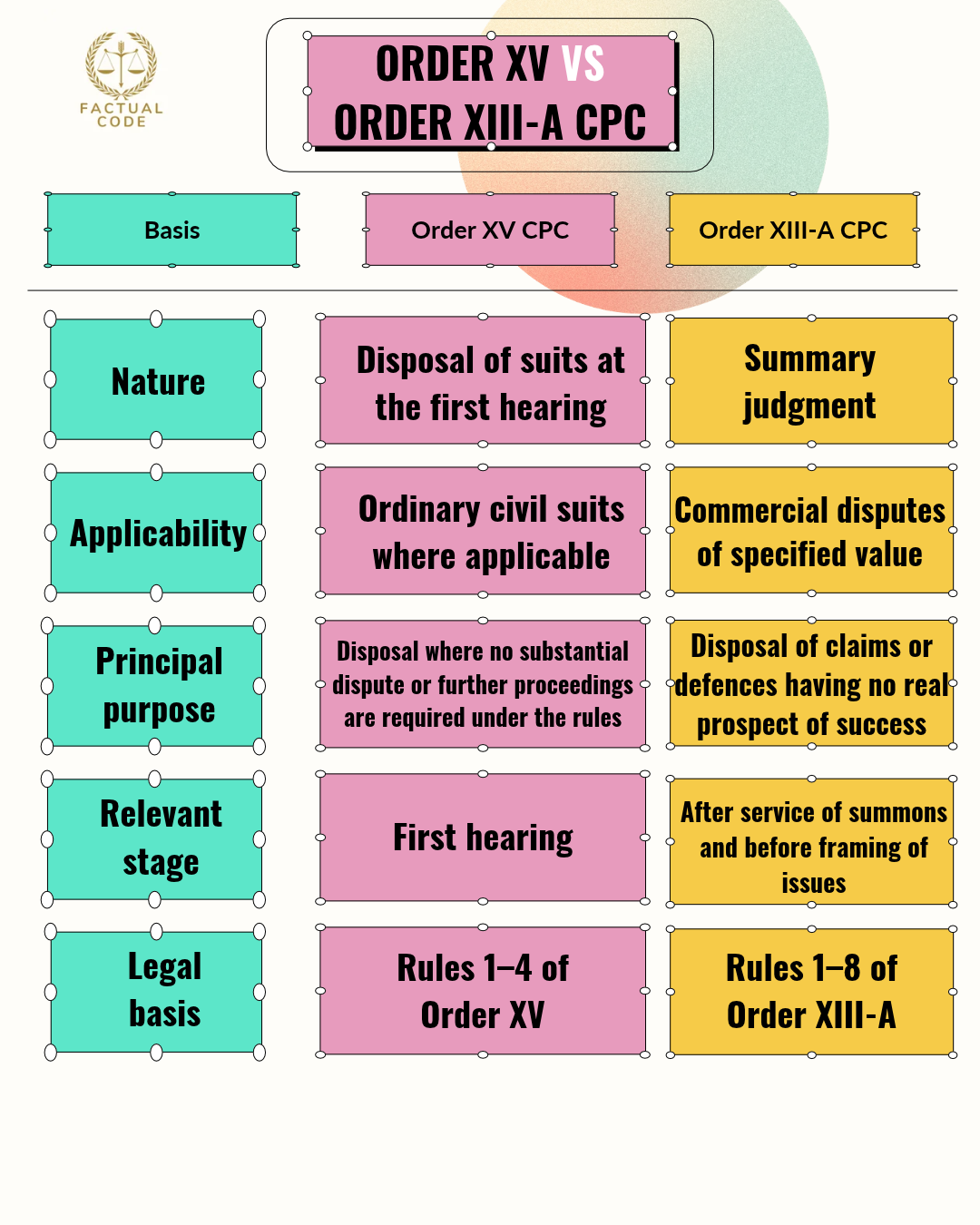
Thus, Order XV deals with disposal at the first hearing, whereas Order XIII-A provides a distinct summary judgment procedure for specified commercial disputes.
6. Important Case Laws on Examination of Parties and First Hearing
1. Afcons Infrastructure Ltd. v. Cherian Varkey Construction Co. (P) Ltd., (2010) 8 SCC 24
The Supreme Court explained the scope of Section 89 CPC and the role of courts in referring suitable disputes to alternative dispute resolution. It clarified the appropriate stage for considering ADR and the need for consent where arbitration is proposed.
2. Kapil Corepacks Pvt. Ltd. v. Harbans Lal, (2010) 8 SCC 452
The Supreme Court explained the purpose of examination under Order X Rule 2. Such examination is intended to clarify matters in controversy and is not a substitute for formal evidence.
3. A. Shanmugam v. Ariya K.R.K.M.N.P. Sangam, (2012) 6 SCC 430
The Supreme Court emphasised the importance of proper pleadings, specific admissions and denials, discovery, production of documents and effective case management. The judgment highlights the responsibility of courts to identify the real controversy and prevent unnecessary litigation.
4. Ved Prakash Wadhwa v. Vishwa Mohan, (1981) 3 SCC 667
The Supreme Court discussed the significance of the first hearing in the context of rent-control proceedings and referred to the stages contemplated under Orders X, XIV and XV CPC. The decision is relevant to understanding why the first hearing is not necessarily the first date of appearance.
7. Importance of Examination of Parties and Early Disposal of Suits
Order X and Order XV are complementary provisions that promote the efficient disposal of civil suits.
Order X helps the court understand the actual controversy by ascertaining admissions and denials and examining parties where clarification is necessary. It also facilitates consideration of alternative dispute resolution under Section 89 CPC.
After the controversy has been clarified, Order XV enables the court to determine whether the suit can be disposed of at the first hearing under the circumstances specified in its rules.
Together, these provisions:
- Reduce unnecessary disputes over admitted facts.
- Help identify the real questions requiring adjudication.
- Encourage settlement through ADR.
- Prevent avoidable trials and procedural delays.
- Promote judicial efficiency and the timely administration of justice.
8. Conclusion
The examination of parties under Order X and the disposal of suits at the first hearing under Order XV are important procedural mechanisms under the Code of Civil Procedure, 1908. Order X assists the court in clarifying the dispute and identifying admissions and denials, while Order XV enables early disposal where the statutory conditions are satisfied.
These provisions reflect the broader objective of civil procedure: ensuring that disputes are adjudicated fairly, efficiently and without unnecessary delay. Their proper application helps courts save judicial time while protecting the rights of litigating parties.
Frequently Asked Questions (FAQs)
1. What is the examination of parties under CPC?
The examination of parties under CPC is governed by Order X. It enables the court to ascertain admissions and denials, clarify matters in controversy and examine parties orally where necessary.
2. What is the purpose of Order X Rule 1 CPC?
Order X Rule 1 requires the court to ascertain and record admissions and denials of the parties at the first hearing in respect of allegations of fact that have not otherwise been admitted or denied.
3. What is the purpose of Order X Rule 2 CPC?
Order X Rule 2 empowers the court to examine parties or persons accompanying them orally to clarify matters in controversy. The examination is not formal evidence.
4. What is the first hearing of a suit under CPC?
The first hearing is the stage at which the court examines the pleadings and identifies the matters requiring adjudication. It does not necessarily mean the first date of appearance of the parties.
5. What is the purpose of Order XV CPC?
Order XV provides for the disposal of suits at the first hearing in specified circumstances, including cases where the parties are not at issue or where further evidence or argument is unnecessary.
6. What is the difference between Order XV and Order XIII-A CPC?
Order XV deals with disposal of suits at the first hearing, whereas Order XIII-A provides a summary judgment procedure for commercial disputes of specified value where the statutory conditions are satisfied.
7. Which case explains Section 89 CPC and alternative dispute resolution?
The Supreme Court explained the scope and application of Section 89 CPC in Afcons Infrastructure Ltd. v. Cherian Varkey Construction Co. (P) Ltd., (2010) 8 SCC 24.
CPC Quick Revision
Code of Civil Procedure — Key Provisions Summary
| Provision | Subject |
|---|---|
| Order X Rule 1 | Ascertainment and recording of admissions and denials |
| Order X Rules 1A–1C | Reference to alternative dispute resolution |
| Order X Rule 2 | Oral examination of parties |
| Order X Rule 3 | Recording the substance of examination |
| Order X Rule 4 | Refusal or inability to answer material questions |
| Order XV Rule 1 | Judgment where parties are not at issue |
| Order XV Rule 2 | Judgment against or in favour of one or more defendants not at issue |
| Order XV Rule 3 | Decision where parties are at issue but further evidence or argument is unnecessary |
| Order XV Rule 4 | Failure to produce evidence |
| Order XIII-A | Summary judgment in specified commercial disputes |