
1. Introduction
The examination of witnesses is an essential part of civil proceedings. A civil court determines disputes by considering the pleadings, documentary evidence and oral testimony presented by the parties. However, a party may not always be able to secure voluntarily the attendance of a person whose evidence is necessary for establishing its case. A witness may be unwilling to appear or may possess important documents relevant to the dispute.
To address these situations, the Code of Civil Procedure, 1908 (CPC) provides a detailed procedure for summoning and securing the attendance of witnesses. The principal provisions are contained in Order XVI, Rules 1–21. They regulate witness lists, applications for summons, payment of expenses, service of summons, production of documents and consequences of non-compliance. Order XVI-A separately deals with witnesses confined or detained in prisons.
The primary objective of these provisions is to ensure that relevant evidence is available to the Court while maintaining procedural discipline, protecting witnesses from unnecessary hardship and facilitating the fair administration of justice.
2. Meaning and Object of Summoning Witnesses
A witness is a person possessing relevant information, knowledge or documents concerning a matter in dispute, whose evidence may assist the Court in determining the issues.
Summoning of witnesses refers to the formal process by which the Court requires a person to attend at a specified time and place to give evidence, produce documents, or both.
The principal objectives are:
To enable parties to obtain relevant oral and documentary evidence.
To provide both parties with a fair opportunity to establish their respective cases.
To prevent suppression of material evidence.
To avoid unnecessary delay through procedural discipline.
To protect witnesses by providing for reasonable attendance and travelling expenses.
To empower the Court to obtain evidence necessary for a just decision.
3. Statutory Provisions under Order XVI CPC
A. List of Witnesses and Summons – Rule 1
Rule 1(1): Every party must present a list of witnesses whom it proposes to call to give evidence or produce documents. The list must be filed on or before the date appointed by the Court and, in any event, not later than fifteen days after settlement of issues.
Rule 1(2): A party seeking a Court-issued summons must apply to the Court, stating the purpose for which the witness is required.
Rule 1(3): The Court may, for reasons recorded, permit a party to call a witness whose name was omitted from the list, whether by Court summons or otherwise, provided sufficient cause for the omission is shown.
The Court exercises judicial discretion while considering the explanation for the omission, relevance of the proposed evidence, stage of proceedings and possible prejudice or delay.
Rule 1(4): An application for summons must ordinarily be made within five days of presenting the witness list under Rule 1(1).
B. Production of Witnesses Without Summons – Rule 1A
Rule 1A permits any party, subject to Rule 1(3), to bring a witness to Court to give evidence or produce documents without applying for a summons.
For example, a party may bring a neighbour who has voluntarily agreed to testify regarding possession of disputed property.
Distinction between Rules 1(3) and 1A: Rule 1(3) empowers the Court to permit the calling of an omitted witness, either through summons or otherwise, upon sufficient cause being shown. Rule 1A enables a party to produce a witness independently without obtaining a Court-issued summons.
In Mange Ram v. Brij Mohan, (1983) 4 SCC 36, the Supreme Court explained that the two provisions operate in different situations. In Vidhyadhar v. Manikrao, (1999) 3 SCC 573, the Court observed that Rule 1A is subject to Rule 1(3), and leave of the Court may be necessary before examining a witness brought by a party. Thus, Rule 1A is not an unrestricted right to examine every omitted witness without judicial control.
C. Expenses of Witnesses – Rules 2–4
Rule 2: Before a summons is granted, the applicant must deposit sufficient money into Court to cover the witness’s travelling expenses and one day’s attendance expenses. The deposit must be made within the period fixed by the Court, not later than seven days from the application under Rule 1(4).
Where an expert is summoned, the Court may allow reasonable remuneration for the time occupied in giving evidence and necessary expert work. Rule 2(3) requires regard to the applicable High Court rules when determining the scale of expenses. Where the party directly serves the summons, expenses must be paid directly to the witness.
Rule 3: The amount deposited in Court must be tendered to the witness at the time of service, where personal service is possible.
Rule 4: If the amount deposited is insufficient, the Court may direct an additional deposit. On default, it may order recovery by attachment and sale of the applicant’s movable property, discharge the witness without examination, or adopt both measures. Rule 4(2) also provides for additional expenses where a witness has to remain in attendance for more than one day.
These provisions ensure that witnesses do not unfairly bear the financial burden of attending Court.
D. Contents and Production of Documents – Rules 5–7
Rule 5: A summons must specify the time, place and purpose of attendance. Where a document is required, it must be described with reasonable accuracy.
Rule 6: A person may be summoned merely to produce a document without being required to give oral evidence. Such a person is deemed to have complied if the document is caused to be produced without personal attendance.
Rule 7: The Court may require any person already present before it to give evidence or produce a document then and there in that person’s possession or power.
E. Service of Summons – Rules 7A–9
Rule 7A: The Court may deliver a summons to a party for personal service upon the witness. The summons must bear the Court’s seal and the required signature. Order V Rules 16 and 18 apply to such service. If service cannot be effected, the party may apply for re-issuance through the Court. No service fee is payable for service by the party under this rule. This procedure is commonly known as dasti service.
Rule 8: Other summonses must be served, as nearly as possible, in the same manner as summonses to defendants. The provisions of Order V relating to proof of service apply.
Rule 9: Summons must be served sufficiently before the date fixed for attendance, allowing the witness reasonable time to comply.
F. Failure to Comply with Summons – Rules 10–13
Rule 10: Where a person fails to attend or produce a document, the Court follows the prescribed procedure for verifying service. It must examine the serving officer or the party or agent who effected service on oath where the certificate of service has not been verified by affidavit or service was effected by a party or agent. Where the certificate has been verified by affidavit, the Court may examine the serving officer.
If the Court has reason to believe that the evidence or document is material and the person has failed to comply without lawful excuse or intentionally avoided service, it may issue a proclamation requiring attendance or production. It may also issue an arrest warrant, with or without bail, and order attachment of property, subject to the statutory limits.
Rule 11: Attachment may be withdrawn where the person appears and satisfies the Court that the failure was without intentional default or lawful excuse, or that timely notice of the proclamation was not received.
Rule 12: The Court may impose a fine not exceeding ₹500 under the central text, considering the person’s condition in life and circumstances. It may also order attachment and sale of property to recover the costs and fine. Under Rule 12(2), a fine may be imposed after notice to show cause even without the earlier measures under Rule 10.
Rule 13: The provisions relating to attachment and sale in execution of decrees apply, so far as applicable, to attachment under this Order.
G. Court’s Power to Summon Witnesses – Rule 14
Rule 14 empowers the Court to summon, on its own motion, any person, including a party, who has not been called by either side, if the Court considers that person’s evidence or production of documents necessary for a just decision.
For example, the Court may summon a government survey officer whose evidence is necessary to clarify disputed property boundaries.
This power must be exercised judicially and fairly, without assuming the role of either party’s advocate.
H. Duties and Attendance of Witnesses – Rules 15–19
Rule 15: A summoned person must attend at the specified time and place or cause the required document to be produced.
Rule 16: A witness must ordinarily continue attending each hearing until disposal of the suit. The Court may require security for future attendance, and failure to furnish it may result in detention in civil prison.
Rule 17: Rules 10–13 apply, so far as applicable, where a witness leaves without lawful excuse in violation of Rule 16.
Rule 18: Where an arrested witness cannot give evidence because a party is absent, the Court may require bail or security for subsequent attendance; failing this, the witness may be detained in civil prison.
Rule 19: Personal attendance may ordinarily be required only within the local jurisdiction of the Court, within 100 kilometres outside it, or within 500 kilometres where railway, steamer or another established public conveyance is available for five-sixths of the distance. The proviso permits personal attendance beyond these limits where air transport is available and the air fare is paid.
I. Refusal by a Party and Application of Witness Rules – Rules 20–21
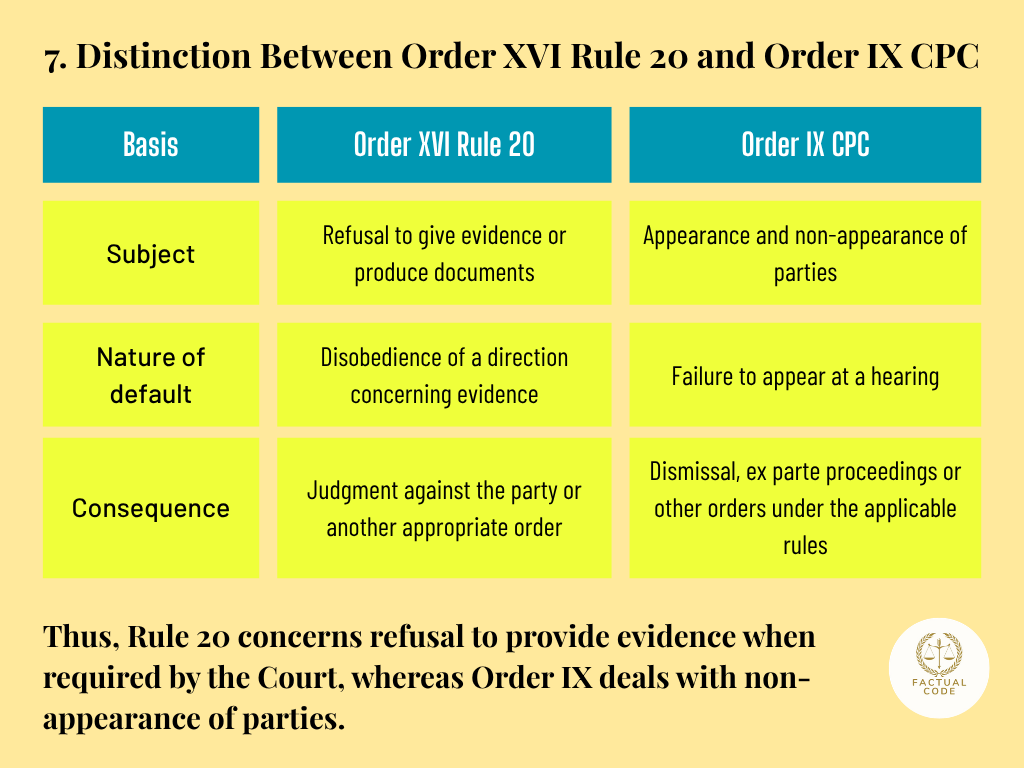
Rule 20: Where a party present in Court refuses, without lawful excuse, to give evidence or produce a document then and there in that party’s possession or power when required by the Court, the Court may pronounce judgment against that party or make such other order as it considers appropriate. Judgment is not automatic.
Rule 21: The provisions relating to witnesses apply, so far as applicable, to parties required to give evidence or produce documents.
4. Order XVI-A: Attendance of Witnesses Confined or Detained in Prisons
Order XVI-A deals specifically with witnesses who are confined or detained in prisons.
Its important provisions include:
Rule 1: Defines expressions such as prison and detained.
Rule 2: Empowers the Court, subject to statutory conditions, to require the production of a prisoner whose evidence is material to the suit. Where the prison is more than 25 kilometres from the Court-house, such an order cannot ordinarily be made unless examination on commission would be inadequate.
Rule 3: Requires the applicant to deposit sufficient expenses for executing the order, including escort expenses.
Rule 4: Permits the State Government to exclude specified persons or classes from removal from prison in the public interest.
Rule 5: Specifies circumstances in which the prison officer may abstain from carrying out the order, including medical unfitness and specified detention-related circumstances.
Rule 6: Provides for bringing the prisoner before the Court in custody where the order can be carried out.
Rule 7: Empowers the Court to issue a commission for examination of a prisoner where attendance cannot be secured under the preceding provisions.
These provisions ensure that relevant evidence is not unavailable merely because a witness is imprisoned or detained.
5. Commercial Disputes: Order XV-A CPC
The Commercial Courts Act, 2015 introduced Order XV-A, which provides for case-management hearings in commercial disputes of specified value.
During case management, the Court may frame issues, list witnesses, fix dates for affidavits of evidence and recording of testimony, and determine the timetable for written and oral arguments.
Order XV-A also provides that arguments must be closed not later than six months from the first case-management hearing and that evidence should, as far as possible, be recorded day-to-day until cross-examination of all witnesses is complete.
Order XV-A provides the case-management framework, whereas Order XVI governs the summoning, attendance and production of witnesses. Both operate together in commercial proceedings.
6. Important Judicial Decisions
A. Mange Ram v. Brij Mohan
(1983) 4 SCC 36; AIR 1983 SC 925
The Supreme Court considered the scope of Order XVI Rules 1 and 1A in the context of an election petition under the Representation of the People Act, 1951. It explained that Rule 1(3) and Rule 1A operate in different situations. Rule 1A permits independent production of a witness without summons, whereas Rule 1(3) enables the Court to permit the calling of an omitted witness, including through Court assistance, upon sufficient cause being shown.
Principle: Rules 1(3) and 1A are complementary provisions addressing different procedural situations.
B. Vidhyadhar v. Manikrao
(1999) 3 SCC 573; AIR 1999 SC 1441
The Supreme Court considered the relationship between Rule 1A and Rule 1(3). It recognised the right to bring a witness without summons under Rule 1A but observed that, because the provision is subject to Rule 1(3), leave of the Court may be necessary before examination.
Principle: Omission of a witness’s name from the list does not, by itself, invalidate examination under Rule 1A, subject to the Court’s control under Rule 1(3).
C. Smt. Surinder Kaur v. S. Rajdev Singh
2023:DHC:8634, decided on 23 November 2023
The Delhi High Court considered the examination of a witness omitted from the original list and discussed the distinction between independent production under Rule 1A and obtaining Court assistance under Rule 1(3).
Principle: The requirements governing an application for Court assistance under Rule 1(3) must be distinguished from independent production of a witness under Rule 1A.
8. Conclusion
Order XVI and Order XVI-A of the CPC establish a comprehensive framework for securing the attendance of witnesses and obtaining relevant evidence in civil proceedings. They regulate witness lists, summons, expenses, service, production of documents, non-compliance and the Court’s power to summon witnesses independently.
The provisions also protect witnesses from unnecessary hardship and ensure that parties cooperate with the judicial process. Judicial decisions such as Mange Ram v. Brij Mohan and Vidhyadhar v. Manikrao clarify the distinction between independent production of witnesses and obtaining the Court’s assistance.
Ultimately, these provisions seek to ensure that civil disputes are decided on the basis of relevant evidence through a fair, orderly and effective judicial process.
9. Quick Table
High-yield summary of Order XVI (Summoning & Attendance) & Order XVI-A (Attendance of Prisoners) under CPC, 1908.
| Provision | Subject | Priority |
|---|---|---|
| Order XVI Rule 1 | List of witnesses and summons Mandatory filing within 15 days of settlement of issues. | High |
| Rule 1A | Production without summons Key distinction vs. Rule 1(3) (Mange Ram case). | High |
| Rules 2–4 | Witness expenses Payment into court, scale of expenses & direct payment. | High |
| Rules 5–7 | Contents of summons, documents and persons present in Court | Standard |
| Rules 7A–9 | Service and timing of summons Summons handed to party for service (Rule 7A). | Standard |
| Rules 10–13 | Non-compliance, proclamation, fine and attachment Consequences of failure to comply with summons. | High |
| Rule 14 | Court's power to summon witnesses Sua sponte power of Court to summon any person. | High |
| Rules 15–19 | Attendance, security and personal attendance limits Focus on Rule 19: Distance exemption thresholds. | High |
| Rules 20–21 | Refusal by parties and application of witness rules | High |
| Order XVI-A | Attendance of prisoners as witnesses Special procedure for examining confined persons (Rules 1–7). | Special |
Landmark Precedents to Cite
Mange Ram v. Brij Mohan (1983)
SCRule 1(3) vs Rule 1A: Omission of a witness's name in the Rule 1 list does not bar a party from producing that witness under Rule 1A without summons, provided court's permission is sought showing cogent reasons.
Vidhyadhar v. Manikrao (1999)
SCNon-Appearance Effect: If a party does not enter the witness box to state their case on oath and face cross-examination, the court can draw an adverse inference under Section 114(g) of Evidence Act.
Examination Tip
For a 15-mark answer, explain Rules 1, 1A, 2–4, 10–14 and 19–21 in greater detail.
- Case Law Comparison: Discuss Mange Ram and Vidhyadhar to demonstrate the distinction between Rules 1(3) and 1A.
- Comprehensive Coverage: Briefly cover Order XVI-A (Prisoner witness rules) and Order XV-A (Case Management Hearing) to make the answer comprehensive.
15-Marker Answer Blueprint
Order XV-A Touchpoint
Don't forget to connect Order XVI with Order XV-A (Commercial Disputes) regarding Case Management Hearings, where deadlines for witness statements and summons lists are strictly enforced by courts.