1. Introduction
Pleadings form the foundation of civil proceedings by stating the respective claims and defences of the parties. Under the Code of Civil Procedure, 1908 (CPC), pleadings ordinarily consist of a plaint and a written statement.
However, parties may sometimes include unnecessary, scandalous, frivolous or vexatious allegations in their pleadings. Such statements may distract from the real controversy, prejudice the opposite party or delay the trial.
To prevent these problems, Order VI Rule 16 CPC empowers the court to strike out or amend improper matter in pleadings. This discretionary power must be exercised judicially and only when the statutory grounds are satisfied.
2. Meaning and Importance of Pleadings under CPC
Under Order VI Rule 1 CPC, pleading means a plaint or written statement. Order VI Rule 2 requires pleadings to contain a concise statement of material facts on which a party relies, not the evidence by which those facts are to be proved.
Pleadings serve the following purposes:
Informing each party about the case of the opposite party.
Identifying the real questions in controversy.
Assisting the court in framing issues.
Preventing unnecessary evidence and procedural complications.
Promoting fairness during trial.
Order VI Rule 16 supports these objectives by allowing the removal of improper matter from pleadings.
3. Statutory Provision: Order VI Rule 16 CPC
Order VI Rule 16 deals with striking out or amending improper matter in pleadings.
Order VI Rule 16 – Striking out pleadings
The Court may at any stage of the proceedings order to be struck out or amended any matter in any pleading—
(a) which may be unnecessary, scandalous, frivolous or vexatious; or
(b) which may tend to prejudice, embarrass or delay the fair trial of the suit; or
(c) which is otherwise an abuse of the process of the Court.
The provision authorises the court to remove or amend particular matter in a pleading. It does not ordinarily result in rejection of the entire plaint.
The expression “at any stage of the proceedings” indicates that the court may exercise this power whenever the statutory requirements are satisfied.
Relationship with Section 151 CPC
Section 151 preserves the inherent powers of the court to secure the ends of justice and prevent abuse of its process. However, inherent powers cannot override an express statutory provision.
Where the removal of improper matter is concerned, Order VI Rule 16 is the specific provision ordinarily applicable. Section 151 cannot be used to bypass its statutory requirements.
Quick Revision
Purpose: Removal or amendment of improper matter in pleadings.
Grounds: Three grounds under Rule 16(a), (b) and (c).
Stage: At any stage of proceedings.
Scope: Particular matter in a pleading.
Nature: Discretionary judicial power.
Leading case: Abdul Razak v. Mangesh Rajaram Wagle, (2010) 1 SCC 49.
4. Grounds for Striking Out Improper Pleadings
Order VI Rule 16 provides three statutory grounds.
A. Unnecessary, Scandalous, Frivolous or Vexatious Matter
Under clause (a), the court may strike out matter that is unnecessary, scandalous, frivolous or vexatious.
Unnecessary matter: Information having no meaningful connection with the dispute.
Scandalous matter: Irrelevant and offensive allegations that serve no legitimate purpose.
Frivolous matter: Statements lacking a serious factual or legal foundation.
Vexatious matter: Allegations introduced primarily to harass or unnecessarily burden the opposite party.
An allegation does not become improper merely because it is disputed or damaging. Its relevance and necessity must be examined in the context of the entire pleading.
B. Matter Prejudicing, Embarrassing or Delaying a Fair Trial
Clause (b) protects the fair conduct of civil proceedings.
Matter may prejudice a party by unfairly affecting their ability to present or answer the case. It may embarrass the trial by obscuring the real controversy or introducing unnecessary complications. Similarly, irrelevant allegations may delay proceedings by creating collateral disputes.
The court must determine whether the impugned matter is likely to interfere with the fair trial of the suit.
C. Matter Amounting to Abuse of the Process of the Court
Clause (c) applies where matter in a pleading amounts to an improper use of judicial proceedings.
For example, allegations introduced primarily to harass the opposite party or pursue an improper collateral purpose may attract this provision.
However, a mere disagreement or denial by the opposite party does not establish abuse of process.
5. Judicial Principles Governing the Exercise of Power
The power under Order VI Rule 16 is discretionary but not arbitrary. The court should consider the following principles:
Identification: The particular statement or portion challenged should be identified.
Statutory grounds: At least one ground under Rule 16 must be established.
Context: The impugned matter should be examined in the context of the entire pleading.
Relevance: Disputed allegations should not be removed merely because the opposite party denies them.
Caution: The court must avoid excluding legitimate claims or defences.
Appropriate remedy: The court should determine whether striking out or amendment is justified.
6. Important Judicial Decisions
A. Abdul Razak v. Mangesh Rajaram Wagle, (2010) 1 SCC 49
The Supreme Court discussed the scope of Order VI Rule 16 CPC and emphasised that the power to strike out matter in pleadings is discretionary and must be exercised with great care and circumspection.
The court must be satisfied that the challenged matter falls within at least one of the statutory grounds.
Principle: The power under Order VI Rule 16 cannot be exercised casually or arbitrarily.
B. K.K. Modi v. K.N. Modi, (1998) 3 SCC 573
The Supreme Court explained the concept of abuse of the process of the court. Judicial proceedings should not be used for improper, oppressive or collateral purposes.
Principle: Courts must prevent misuse of judicial proceedings.
C. T. Arivandandam v. T.V. Satyapal, (1977) 4 SCC 467
The Supreme Court emphasised that courts should examine the substance of a plaint and prevent vexatious litigation. This decision primarily concerns Order VII Rule 11 CPC and is a supporting authority on preventing meritless litigation, rather than a direct interpretation of Order VI Rule 16.
Principle: Courts should examine the substance of pleadings rather than merely their formal presentation.
D. Sopan Sukhdeo Sable v. Assistant Charity Commissioner, (2004) 3 SCC 137
The Supreme Court discussed the principles governing rejection of plaints under Order VII Rule 11 CPC. It emphasised that the plaint must be examined as a whole.
Principle: Rejection of a plaint under Order VII Rule 11 must be distinguished from striking out particular matter under Order VI Rule 16.
7. Procedure for Striking Out Improper Pleadings
The court may exercise its power under Order VI Rule 16 either on an application by a party or on its own initiative.
Generally, the following steps may be involved:
Identifying the particular matter challenged.
Determining the applicable statutory ground.
Giving the affected party an opportunity to respond, consistent with procedural fairness.
Examining the pleading and the relevance of the challenged matter.
Passing an appropriate order for striking out or amending the matter, if justified.
The court must exercise its discretion judicially and should not use this provision to decide disputed facts prematurely.
8. Consequences of Striking Out Improper Pleadings
An order under Order VI Rule 16 may have the following consequences:
Improper or irrelevant matter is removed or amended.
The remaining portions of the pleading ordinarily continue to operate.
The real controversy becomes clearer.
Unnecessary complications and delays may be reduced.
The suit may proceed on the basis of the remaining pleadings.
Striking out particular matter does not automatically terminate the entire suit.
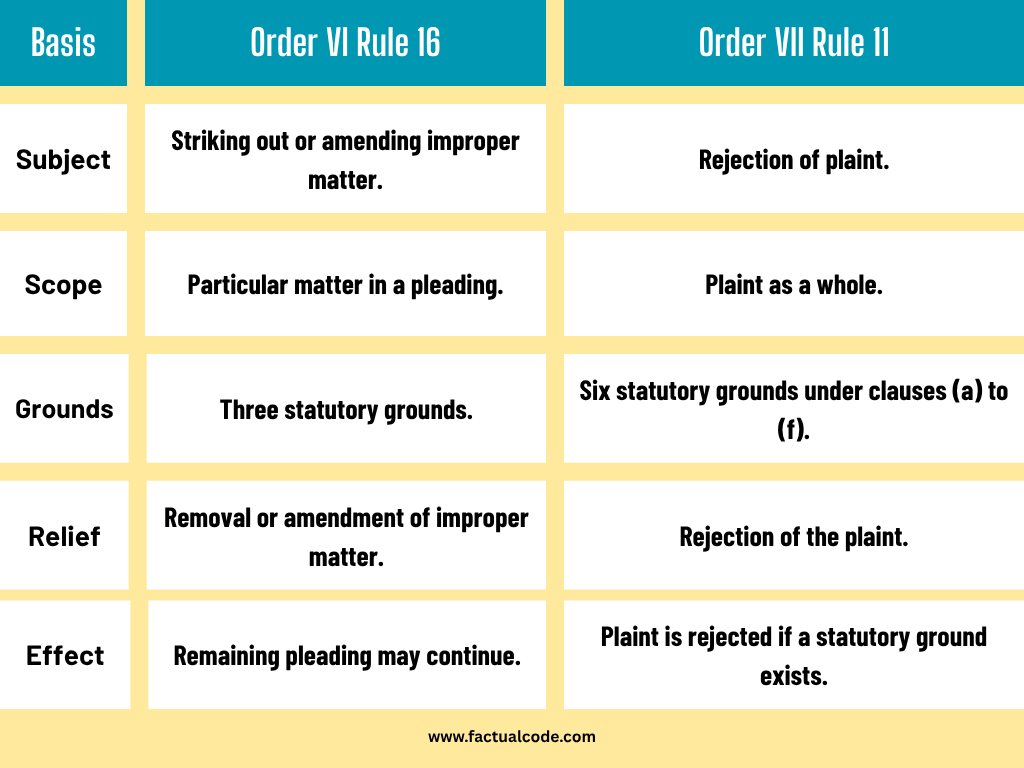
9. Difference Between Order VI Rule 16 and Order VII Rule 11 CPC
Both provisions serve different procedural purposes.
Examination Memory Aid: Surgical Scalpel and Guillotine
Order VI Rule 16 may be remembered as a surgical scalpel, as it targets particular improper matter within a pleading.
Order VII Rule 11 may be remembered as a guillotine, as it results in rejection of the plaint as a whole.
This is merely a memory aid; the actual distinction depends on the statutory provisions.
Difference Between Order VI Rule 16 and Order VI Rule 17
Order VI Rule 17 deals with amendment of pleadings to determine the real questions in controversy. After commencement of trial, amendment is subject to the due diligence requirement under its proviso.
Order VI Rule 16 primarily concerns removal or amendment of improper matter, whereas Rule 17 concerns amendments necessary for determining the real controversy.
10. Illustrations of Order VI Rule 16 CPC
Illustration 1: Unrelated personal allegations
A files a money recovery suit against B but includes irrelevant allegations concerning B’s family. If these allegations are unnecessary or scandalous, the court may consider striking them out under clause (a).
Illustration 2: Unnecessary complications
A party introduces irrelevant allegations requiring evidence on collateral matters and unnecessarily complicating the trial. Clause (b) may apply if the matter tends to prejudice, embarrass or delay the fair trial.
Illustration 3: Abuse of process
A party introduces allegations primarily to harass the opposite party or pursue an improper collateral purpose. Clause (c) may apply if the matter amounts to abuse of the court’s process.
These illustrations are hypothetical. Their applicability depends on the facts and circumstances of each case.
11. Limitations on the Power of the Court
The court must observe certain limitations while exercising its power:
At least one statutory ground must be established.
Relevant allegations cannot be removed merely because they are disputed.
The power must be exercised carefully and judicially.
The challenged matter must be examined in context.
The affected party should ordinarily receive an opportunity to respond.
Legitimate claims and defences must not be unfairly excluded.
12. Conclusion
Order VI Rule 16 CPC is an important procedural safeguard against improper pleadings. It empowers the court to strike out or amend matter that is unnecessary, scandalous, frivolous, vexatious, prejudicial, embarrassing, likely to delay a fair trial or otherwise amounts to an abuse of the court’s process.
As emphasised in Abdul Razak v. Mangesh Rajaram Wagle, the power must be exercised with care and circumspection. The court must identify the challenged matter and establish at least one statutory ground before passing an appropriate order.
In short, Order VI Rule 16 enables courts to remove improper matter from pleadings while preserving the remaining legitimate claims and defences.