
Introduction
A decree declares the parties’ rights, but the successful party may still need execution to obtain the relief. Disputes may arise about payment, settlement or whether anything remains due.
The Code of Civil Procedure, 1908 (CPC) deals with these matters through Order XXI Rules 1 and 2 and Section 47. The provisions have connected but different functions:
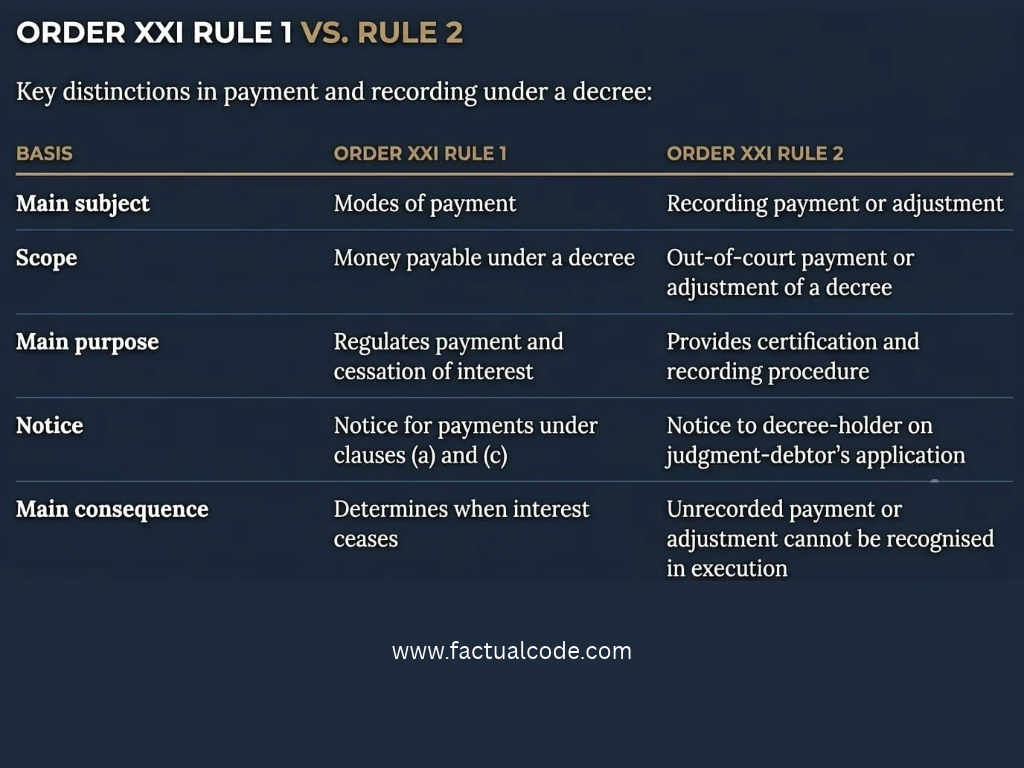
Order XXI Rule 1 explains how money payable under a decree must be paid and when interest stops running.
Order XXI Rule 2 explains how an out-of-court payment or adjustment must be certified or recorded.
Section 47 requires the executing court to decide questions relating to execution, discharge or satisfaction of the decree.
This distinction is central to the topic.
1. Meaning of Payment, Adjustment and Satisfaction
Payment means paying all or part of the money due under a decree.
Adjustment means an arrangement between the decree-holder and judgment-debtor that reduces or extinguishes the decree, wholly or partly, such as accepting property or a reduced amount in settlement.
Satisfaction means that the decree-holder’s claim under the decree has been discharged wholly or partly. A mere promise or proposal to settle does not establish satisfaction.
2. Order XXI Rule 1: How Must Money Under a Decree Be Paid?
Rule 1(1) recognises three modes of payment:
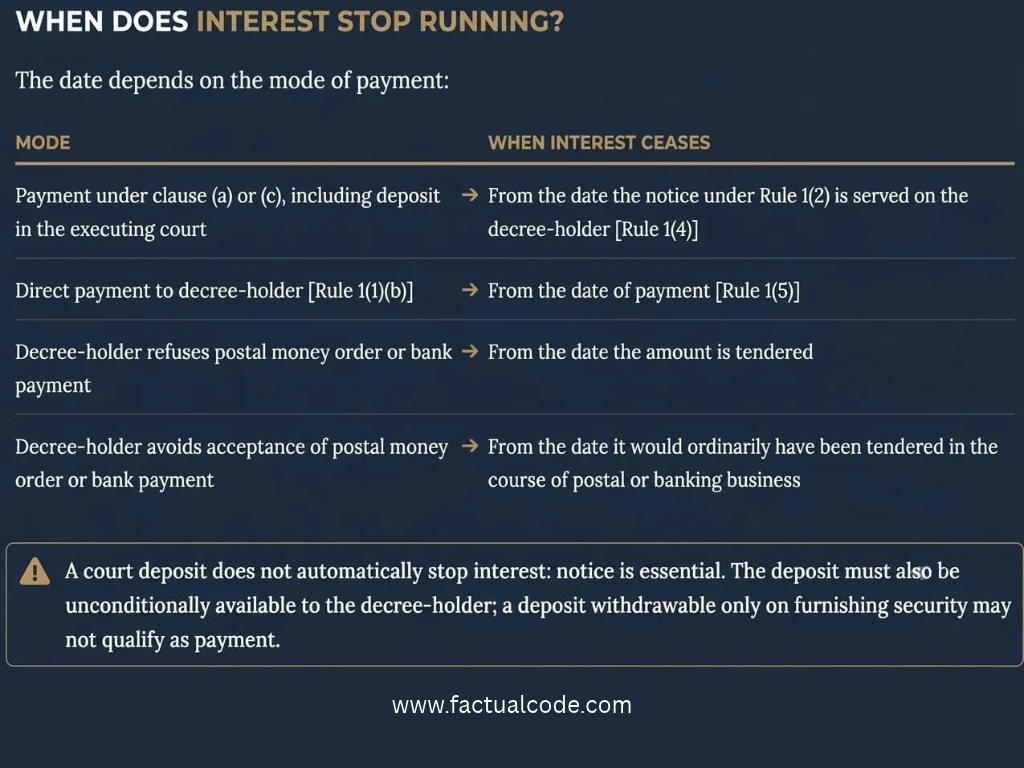
Deposit in the executing court — Rule 1(1)(a): The judgment-debtor may deposit the money in the court whose duty it is to execute the decree, or send it to that court by postal money order or through a bank. Depending on the proceedings, this may be the court which passed the decree or the court to which it has been transferred for execution under Sections 38–42 CPC.
Direct payment to the decree-holder — Rule 1(1)(b): Payment may be made outside court to the decree-holder by postal money order, through a bank, or by another mode in which payment is evidenced in writing.
Other court-directed mode — Rule 1(1)(c): Payment may be made in another manner directed by the court which passed the decree.
These modes provide verifiable proof of payment.
Notice and particulars of payment
Where payment is made under clause (a) or clause (c), the judgment-debtor must give notice to the decree-holder, either through the court or directly by speed post with registration and proof of delivery. This is the current wording of Rule 1(2), substituted by the Repealing and Amending Act, 2025. It replaced the earlier reference to registered post, acknowledgment due.
For postal or bank remittances under clause (a) or (b), Rule 1(3) requires the original suit number, parties’ names, appropriation (principal, interest or costs), execution-case number if pending, and payer’s name and address.
3. Order XXI Rule 2: How Is an Out-of-Court Payment or Adjustment Recorded?
Rule 2 deals with payment outside court or an arrangement adjusting a decree. It requires a formal record before the executing court treats the decree as satisfied.
The procedure is as follows:
Step 1 — Certification by the decree-holder [Rule 2(1)]. If money payable under a decree is paid outside court, or the decree is otherwise adjusted wholly or partly to the decree-holder’s satisfaction, the decree-holder must certify the payment or adjustment to the court whose duty it is to execute the decree. The court then records it.
Step 2 — Application by the judgment-debtor or surety [Rule 2(2)]. If the decree-holder does not certify it, the judgment-debtor or surety may inform the court and apply for notice requiring the decree-holder to show cause. If the decree-holder fails to show cause after service, the court shall record the payment or adjustment.
Step 3 — Proof required [Rule 2(2A)]. At the instance of the judgment-debtor, the court cannot record the payment or adjustment unless at least one of these conditions is satisfied:
the payment was made in the manner prescribed by Rule 1;
the payment or adjustment is proved by documentary evidence; or
the decree-holder admits it in the reply to the notice or before the court.
Effect of failure to certify or record
Rule 2(3) provides that a payment or adjustment which has not been certified or recorded in accordance with the Rule shall not be recognised by any court executing the decree. A private payment or settlement does not automatically stop execution; it must be recorded under Rule 2.
Limitation
Article 125 of the Limitation Act, 1963 prescribes 30 days from the date on which the payment or adjustment is made for an application to record adjustment or satisfaction. A judgment-debtor or surety relying on Rule 2(2) should act within this period. Section 5 of the Limitation Act expressly excludes applications under Order XXI, so delay in an Order XXI application cannot be condoned under that provision.
4. Section 47 CPC: Which Court Decides Disputes About Satisfaction?
Section 47(1) provides that all questions arising between the parties to the suit, or their representatives, and relating to the execution, discharge or satisfaction of the decree must be decided by the court executing the decree, not by a separate suit.
This avoids a separate suit: the executing court is the proper forum to decide whether the decree has been carried out or remains enforceable.
Under Section 47(3), the executing court decides whether a person is a representative of a party. Explanation I treats a plaintiff whose suit has been dismissed and a defendant against whom the suit has been dismissed as parties. Explanation II treats an execution-sale purchaser as a party; questions relating to delivery of possession to that purchaser or the purchaser’s representative are treated as questions of execution, discharge or satisfaction. Sub-section (2) has been omitted.
The executing court generally cannot reopen the merits of the decree, except where it is a nullity for want of inherent jurisdiction.
5. How Do Rule 2 and Section 47 Work Together?
Section 47 gives the executing court jurisdiction to decide questions about satisfaction. Rule 2 lays down the specific procedure for recognising out-of-court payments and adjustments. Therefore, Section 47 cannot ordinarily be used to bypass Rule 2(3).
In Sultana Begum v. Prem Chand Jain, (1997) 1 SCC 373, the Supreme Court held that Section 47 confers jurisdiction, while Rule 2 prescribes how an out-of-court payment or adjustment must be recorded. An uncertified adjustment cannot be recognised merely by raising a Section 47 objection.
In Padma Ben Banushali v. Yogendra Rathore, (2006) 12 SCC 138, an agreement not to execute the decree depended on execution of a sale deed. As the deed was not executed and the adjustment was not certified, the decree remained enforceable.
In Gurpreet Singh v. Union of India, (2006) 8 SCC 457, a Constitution Bench considered appropriation of payments and cessation of interest. The mode of payment, notice, decree terms and applicable statutory scheme must be considered; no single formula applies to every decree.
In National Seeds Corporation Ltd. v. National Agro Seed Corporation (India), 2026 INSC 1017, the Supreme Court held that a court deposit must be unconditional and freely withdrawable to qualify under Rule 1. A deposit conditional on furnishing security did not stop interest on the facts. The case concerned enforcement of an arbitral award.
6. Difference between Order XXI Rule 1 and Rule 2
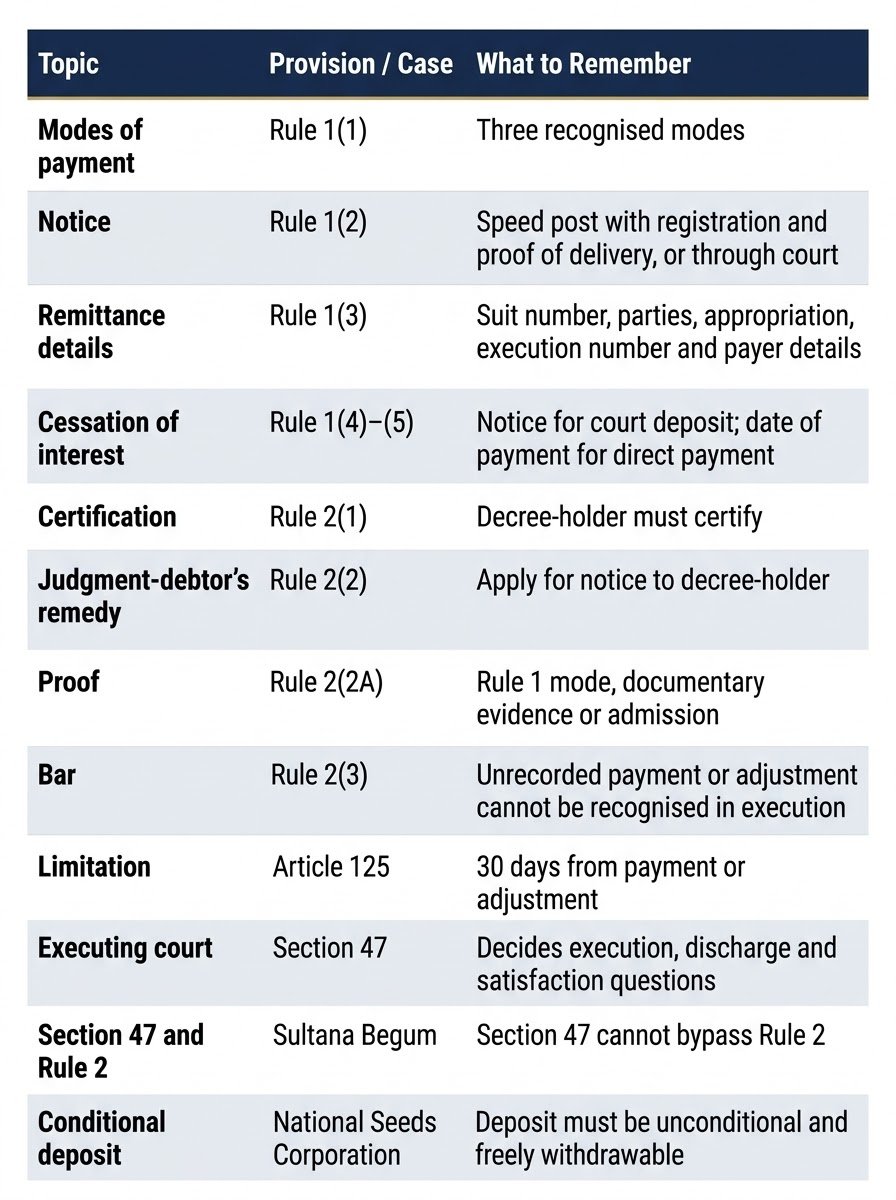
7. Important Points for Last-Minute Examination Revision
Conclusion
Order XXI Rule 1 prescribes how money under a decree is to be paid and when interest ceases. Rule 2 ensures that out-of-court payments and adjustments are formally recorded. Section 47 gives the executing court jurisdiction to decide questions relating to execution, discharge and satisfaction. Together, these provisions protect the decree-holder while allowing genuine satisfaction of a decree to be recognised.
References- www.indiacode.nic.in indiankanoon.org www.writinglaw.com