
📘 Start with the CPC Master Guide
1. Introduction
Execution gives effect to a decree. A possession decree may be resisted by the judgment-debtor or a third party. Order XXI Rules 97–106 CPC provide the mechanism for resolving such obstruction.
Order 21 Rule 97 CPC applies where resistance occurs before delivery of possession is completed. Rule 99 provides a remedy where a person other than the judgment-debtor has already been dispossessed. Rules 98–104 govern adjudication and its consequences.
2. Statutory Scheme
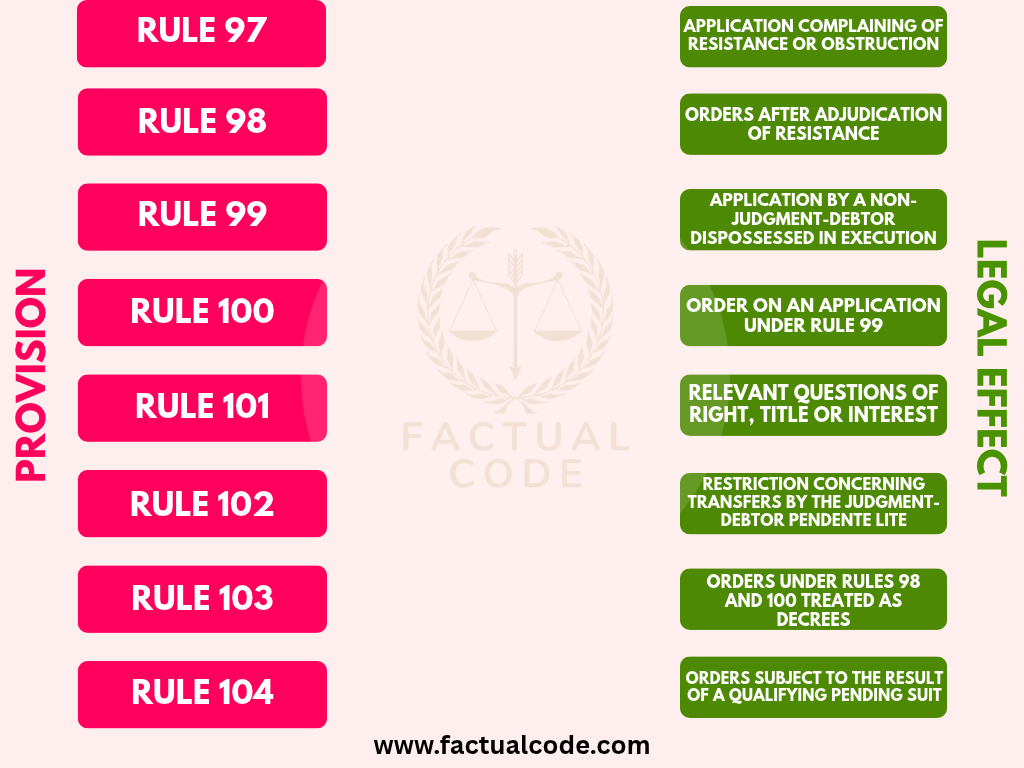
Rules 35 and 36 govern ordinary delivery. Rule 35 permits actual delivery and removal of a person bound by the decree who refuses to vacate. Rule 36 provides symbolic delivery where the property is occupied by a tenant or another person entitled to occupy it and not bound by the decree. Rules 97–106 deal with resistance to delivery.
3. Order 21 Rule 97 CPC: Resistance or Obstruction
Under Rule 97(1), where the holder of a possession decree or the purchaser of property sold in execution is resisted or obstructed by any person, the decree-holder or purchaser may apply to the executing court. Rule 97(2) requires the court to adjudicate the application under the following rules.
A bailiff’s or amin’s report may evidence obstruction, but does not necessarily replace the Rule 97 application.
A third party claiming an independent right should object before dispossession. Brahmdeo Chaudhary v. Rishikesh Prasad Jaiswal, (1997) 3 SCC 694, and Shreenath v. Rajesh, (1998) 4 SCC 543, recognised pre-dispossession protection for such claimants. Periyammal (2025 INSC 329) also described Rule 97 as a remedy for a stranger resisting delivery; Danesh Singh, however, later noted that the precise standing question remains unresolved.
There is an important qualification. In Sriram Housing Finance and Investment Ltd. v. Omesh Misra Memorial Charitable Trust, (2022) 15 SCC 176, the Supreme Court read Rule 97 literally as permitting a formal application by the decree-holder or auction-purchaser. The apparent conflict with Brahmdeo Chaudhary was noticed in P. Sumathi v. K. Krishna Gounder, SLP(C) No. 14092 of 2025, order dated 16 May 2025. Danesh Singh v. Har Pyari, 2025 INSC 1434, acknowledged the differing views but left the question open. A third party’s right to object must therefore be distinguished from the unresolved question of independent formal standing under Rule 97.
Article 129 of the Limitation Act, 1963 prescribes 30 days for an application to obtain possession after removing resistance or obstruction, calculated from the date of resistance or obstruction.
4. Procedural Flowchart / Decision Matrix
Procedural Flowchart & Decision Matrix
Obstruction During Execution
Resistance or obstruction is encountered while delivering possession of immovable property in execution of a decree.
Bailiff / Amin Reports Incident
The executing officer (bailiff or amin) formally reports the resistance or obstruction to the executing court.
Rule 97 Application by Decree-Holder or Auction-Purchaser
Application complaining of resistance or obstruction filed within 30 days from the date of obstruction under Article 129 of the Limitation Act, 1963.
Is the objector a person to whom the judgment-debtor transferred the property after institution of the suit in which the decree was passed?
Determine that status through a limited inquiry. Once established, Rules 98 and 100 do not confer relief on that transferee.
Determine all legally arising and relevant questions of right, title, or interest between the parties directly within execution under Rule 101.
Outcomes Based on Adjudication
1. Obstructionist's Claim Fails
Allow the Rule 97 application and direct delivery of possession under Rule 98(1); apply Rule 98(2) (detention/compensation) if its specific conditions are met.
2. Independent Claim Succeeds
Dismiss the Rule 97 application under Rule 98(1) and protect the objector's lawful possession.
3. Non-JD Already Dispossessed
Consider an application by the dispossessed third party and order restoration of possession under Rules 99–100.
Deemed Decree & Bar of Separate Suit
An order adjudicating an application under Rule 98 or Rule 100 is a deemed decree under Rule 103 and is ordinarily appealable. Rule 101 bars a separate suit to re-agitate matters that must be decided in execution, subject to Rule 104 (pending suit) and the limited pre-proceeding situation explained in Danesh Singh.
5. Rule 98: Orders After Adjudication
After determining the relevant questions under Rule 101, Rule 98(1) permits the court to allow the application and direct possession, dismiss it, or pass another appropriate order.
Rule 98(2) applies where obstruction without just cause is caused by the judgment-debtor, a person acting at the judgment-debtor’s instigation or on their behalf, or a transferee where the transfer was made during the pendency of the suit or execution proceeding. The court must direct delivery of possession. If resistance continues, it may, at the applicant’s request, order the judgment-debtor or a person acting at their instigation or on their behalf to be detained in civil prison for up to thirty days. This power does not extend indiscriminately to every obstructionist or transferee.
Rule 98(2) is distinct from Rule 102. The former provides consequences for obstruction without just cause in specified circumstances; the latter restricts relief to a particular class of transferees from the judgment-debtor. In Maharashtra, the Bombay amendments effective from 1 October 1983, recorded in Alka Shrirang Chavan, omit central Rule 102 and modify Rules 98(2) and 100; those State-specific changes must not be applied to the unamended central CPC.
6. Order 21 Rule 99 CPC: Remedy After Dispossession
Rule 99 allows a person other than the judgment-debtor who is dispossessed by the decree-holder or execution-sale purchaser to apply to the executing court. The applicant must establish prior possession and dispossession in the course of execution; a mere threat of dispossession is insufficient.
Under Rule 100, after determining the relevant questions under Rule 101, the court may restore possession, dismiss the application or pass another appropriate order. Thus, Rule 97 concerns resistance before delivery is completed, while Order 21 Rule 99 CPC concerns dispossession that has already occurred.
Article 128 of the Limitation Act prescribes 30 days from dispossession for a Rule 99 application. In Danesh Singh, the Supreme Court held that a dispossessed person cannot ordinarily bypass the specific Rule 99 remedy and its limitation period by filing a separate suit for the same relief after the statutory period has expired.
7. Order 21 Rule 101 CPC: Questions to Be Determined
Order 21 Rule 101 CPC is the central adjudicatory provision. The executing court must determine all questions, including right, title or interest, which arise between parties to a Rule 97 or Rule 99 proceeding or their representatives and are relevant to the application. Such questions must be decided in execution, not by a separate suit.
In Silverline Forum Pvt. Ltd. v. Rajiv Trust, (1998) 3 SCC 723, the Supreme Court held that the court must determine questions which have legally arisen between the parties and are relevant to adjudication. It need not conduct an unlimited inquiry into every assertion made by the obstructionist.
In Alka Shrirang Chavan v. Hemchandra Rajaram Bhonsale, 2026 INSC 52, the Supreme Court reiterated that only legally arising and relevant questions require determination. The court may decide them on admitted facts or pleadings, or record evidence where necessary. It may also determine whether the obstructionist is bound by the decree for Rule 35. In Rahul S. Shah v. Jinendra Kumar Gandhi, (2021) 6 SCC 418, the Supreme Court directed executing courts to dispose of execution proceedings within six months from filing, extendable only by recording written reasons. It also directed courts to deal strictly with third-party objections, limit evidence to exceptional cases and provide police assistance where execution cannot be effected without it.
Section 47 CPC generally governs execution, discharge or satisfaction questions between parties to the suit; Rules 97 and 101 specifically concern resistance to possession and relevant third-party rights. In Periyammal (Dead) through LRs v. V. Rajamani, 2025 INSC 329, the Supreme Court held that an application labelled under Section 47 may, in substance, be treated as one under Rule 97 where it complains of resistance to delivery. The executing court cannot, however, go behind the decree or reopen matters concluded in the original suit.
8. Rule 102: Transferee Pendente Lite
Rule 102 provides that Rules 98 and 100 do not apply where resistance, obstruction or a claim following dispossession is made by a person to whom the judgment-debtor transferred the property after institution of the suit in which the decree was passed. It reflects the doctrine of lis pendens under Section 52 of the Transfer of Property Act, 1882.
The court must first determine whether the objector is a transferee from the judgment-debtor within Rule 102. In Silverline Forum, the Supreme Court held that, if the transfer is established, the inquiry is confined to that question and the transferee cannot resist execution by claiming relief under Rules 98 or 100. Tahir V. Isani v. Madan Waman Chodankar, 2025 INSC 1044, clarified that Rule 102 does not apply where the objector derives title from someone other than the judgment-debtor, even if the transfer occurred during litigation.
The reference in Rule 98(2) to a transfer during the pendency of the suit or execution proceeding must be kept distinct from Rule 102, which specifically addresses a transfer by the judgment-debtor after institution of the suit in which the decree was passed.
9. Rules 103 and 104: Appeal and Pending Suit
Under Rule 103, an order adjudicating an application under Rule 98 or Rule 100 has the force of a decree. A first appeal ordinarily lies under Section 96 CPC; a second appeal under Section 100 requires a substantial question of law. Revision under Section 115 is generally unavailable where an appeal lies.
Not every procedural order in execution is a deemed decree. In Sameer Singh v. Abdul Rab, (2015) 1 SCC 379, the Supreme Court held that where the executing court declines to adjudicate because it considers itself without jurisdiction, the order does not acquire the status of a decree under Rule 103. In an appropriate case, the High Court’s supervisory jurisdiction under Article 227 may be invoked.
Rule 104 makes an order under Rule 101 or Rule 103 subject to the result of a suit already pending when the Rule 97 or Rule 99 proceeding commenced, provided the party against whom the order is made had claimed in that suit a right to present possession. In Danesh Singh, the Supreme Court recognised a limited opportunity, in the context of an execution sale, for a third party in possession to sue before a cause of action under Rule 97 or 99 arises. Once that execution remedy becomes available, a separate suit cannot ordinarily replace it.
10. Hearing Procedure and Limitation
Rules 105 and 106 supplement the procedure. Under Rule 105, the court fixes a hearing and may dismiss the application if the applicant is absent, or proceed ex parte if the opposite party does not appear despite notice. Rule 106 permits specified dismissal or ex parte orders to be set aside for sufficient cause, ordinarily within 30 days from the order or, where notice was not duly served, from knowledge of the order.
The principal limitation periods are: Article 129—30 days from resistance or obstruction for an application under Rule 97; and Article 128—30 days from dispossession for an application under Rule 99. Section 5 of the Limitation Act excludes applications under Order XXI from its general power to condone delay. Section 14 may apply only where its requirements, including due diligence and good faith in pursuing a proceeding before a court unable to entertain it, are established.
West Bengal practice note: A request for police assistance should not automatically be treated as a Rule 97 application. In Tapas Kumar Maity (AD 14) v. Pradip Kumar Chatterjee, CO 3044 of 2026, decided on 10 September 2026, the Calcutta High Court distinguished an application for police help under Rule 208 of the Civil Rules and Orders from an application under Order XXI Rule 97 CPC. Police assistance may be sought under the local procedural rule where facts justify it, including an apprehension of breach of peace; Article 129 does not automatically govern that distinct request.
11. Illustrative Example
A obtains a possession decree against B. During execution, C claims an independent tenancy and resists the bailiff. The court must consider the objection under Rule 101, subject to the unsettled standing issue under Rule 97. If C is dispossessed, C may seek restoration under Rule 99 within limitation. If C derives title from B through a post-suit transfer, Rule 102 may bar relief under Rules 98 and 100.
12. Conclusion
Order 21 Rule 97 CPC is the procedural starting point for resistance to delivery of possession. Rules 98 and 101 empower the executing court to adjudicate relevant claims, while Order 21 Rule 99 CPC provides relief to a qualifying person already dispossessed. Rule 102 prevents a judgment-debtor from defeating execution through a pendente lite transfer, and Rules 103–104 regulate appeals and qualifying pending suits. Together, these provisions balance effective execution with protection of genuine third-party rights.
References- www.indiacode.nic.in indiankanoon.org lawrato.com