1. Introduction and Jurisprudential Basis 


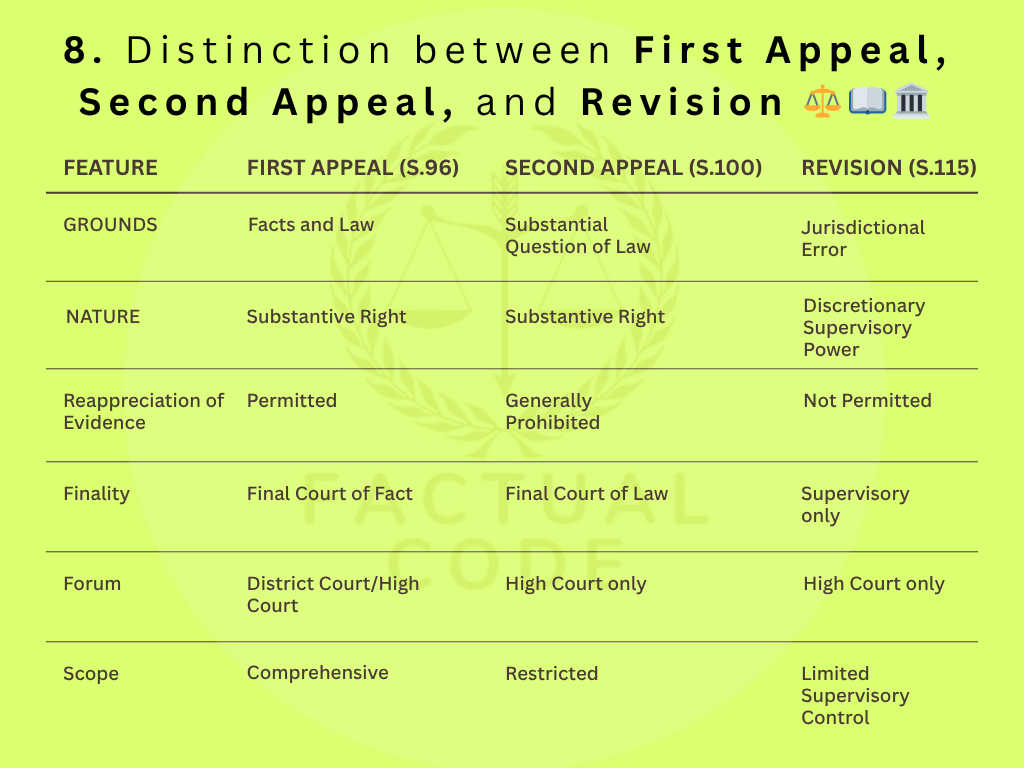
A First Appeal is a substantive statutory remedy available to a party aggrieved by the decree of a subordinate court. It constitutes the primary stage of appellate scrutiny and authorizes a superior court to undertake a comprehensive de novo examination involving both questions of fact and questions of law. 

The law relating to first appeals is principally governed by Sections 96 to 99A and Order XLI of the Code of Civil Procedure, 1908. 

The doctrine of appellate jurisdiction is founded upon the recognition of judicial fallibility.
Since a trial court may commit errors in appreciation of evidence, interpretation of law, or procedural application, the legal system provides an opportunity for reconsideration before a superior forum.
In Lachmeshwar Prasad Shukul v. Keshwar Lal Chaudhuri, it was observed that an appeal is a “continuation of the suit.” Consequently, the entire matter remains open before the appellate court unless expressly restricted by statute.
Thus, the remedy of first appeal ensures that the finality of litigation rests upon correctness, fairness, and judicial accountability.
The emphasis is therefore placed on substantive justice rather than mere technical conclusiveness.
2. Nature and Characteristics of First Appeal
The first appeal possesses the following essential characteristics:
It is a substantive right created by statute.
It is a vested right accruing on the date of institution of the suit.
It permits reconsideration of both:
facts, and
law.
The appellate court functions as the:
final court of facts, and
an appellate court of law.
The proceeding is treated as a continuation of the original suit.
Unlike a second appeal under Section 100 CPC, the jurisdiction of the first appellate court is extremely wide and comprehensive.
3. Statutory Framework: Dual Structure of Appellate Law
The CPC divides appellate law into two distinct components:
| Component | Provisions | Nature |
|---|---|---|
| Substantive Law | Sections 96–99A CPC | Creates and recognizes the right of appeal |
| Procedural Law | Order XLI CPC | Prescribes the procedure and machinery for exercising that right |
Thus, Section 96 confers the legal entitlement to appeal, whereas Order XLI regulates the procedural mechanism governing the filing, hearing, and adjudication of appeals.
4. Analysis of Section 96 CPC
(A) Section 96(1): General Right of Appeal
Section 96(1) provides that an appeal shall lie from every decree passed by a court exercising original jurisdiction unless expressly barred by law.
This provision establishes the general principle that every original decree is appealable.
(B) Section 96(2): Appeal against Ex Parte Decree
An appeal may also lie against an ex parte decree.
The defendant may:
file an application under Order IX Rule 13 CPC for setting aside the decree, or
directly prefer a first appeal.
Both remedies are independent in nature.
(C) Section 96(3): Bar on Appeal from Consent Decree
No appeal shall lie from a decree passed with the consent of parties.
This principle is based on the doctrine of estoppel, since a person cannot ordinarily challenge a decree voluntarily accepted by him.
(D) Section 96(4): Petty Suits
In suits cognizable by Courts of Small Causes involving small monetary value, no appeal lies except on questions of law.
The object is to discourage unnecessary prolongation of minor litigation.
5. Scope of First Appeal
The scope of first appeal is extremely wide.
The appellate court may:
reappreciate oral and documentary evidence,
examine findings of fact,
interpret legal provisions,
consider procedural irregularities,
and arrive at independent conclusions.
The first appellate court is therefore regarded as the last court on facts.
In Santosh Hazari v. Purushottam Tiwari (2001), the Supreme Court emphasized the duties of the first appellate court.
The appellate court must:
independently assess all issues,
examine the entire evidence on record,
provide cogent reasons for findings,
and particularly record reasons while reversing the judgment of the trial court.
Similarly, in Madhukar v. Sangram (2001), it was held that the first appellate court cannot dispose of an appeal casually without proper discussion of evidence.
The appellate judgment must also comply with Order XLI Rule 31 CPC, which requires:
points for determination,
decision thereon,
reasons for decision,
and relief granted.
6. Powers of the Appellate Court (Section 107 CPC)
The appellate court possesses extensive powers to ensure complete justice.
(A) Power to Determine Questions of Fact and Law
The appellate court may fully reconsider both factual and legal aspects of the case.
(B) Power to Remand
Under Order XLI Rules 23 and 23A CPC, the court may remand the matter where:
the suit was disposed of on a preliminary issue, or
retrial becomes necessary in the interests of justice.
(C) Power to Frame Issues
Under Order XLI Rule 25, omitted or improperly framed issues may be framed and referred to the trial court for findings.
(D) Power to Take Additional Evidence
Order XLI Rule 27 permits additional evidence only in exceptional circumstances.
Additional evidence may be admitted where:
the trial court wrongly refused admissible evidence,
the evidence was unavailable despite due diligence, or
the appellate court requires such evidence to pronounce judgment.
The rule does not permit parties to fill lacunae negligently left during trial.
(E) Power to Modify, Reverse, or Confirm Decree
The appellate court may:
affirm the decree,
reverse it,
vary or modify it, or
pass any decree which ought to have been passed by the trial court.
7. Procedural Requirements under Order XLI CPC
The procedural framework under Order XLI CPC regulates the manner in which a first appeal is instituted, presented, heard, and adjudicated.
Compliance with these procedural requirements is essential for the proper exercise of appellate jurisdiction. Compliance with these procedural requirements is essential for the proper exercise of appellate jurisdiction.
(A) Memorandum of Appeal
A first appeal must be filed in the form of a Memorandum of Appeal.
It must:
be signed by the appellant or pleader,
contain concise grounds of objection,
avoid argumentative narration, and
ordinarily be accompanied by certified copies of the decree and judgment.
In certain jurisdictions and under modern procedural practices, some courts permit the filing of an appeal with a plain copy of the judgment where the certified copy has already been applied for but has not yet been received. This practice helps preserve the limitation period and prevents procedural hardship to litigants.
(B) Limitation Period
Under the Limitation Act, 1963:
appeals to District Courts generally lie within 30 days,
appeals to High Courts generally lie within 90 days.
Delay may be condoned upon showing sufficient cause.
(C) Cross-Objections under Order XLI Rule 22
Order XLI Rule 22 CPC enables the respondent in an appeal to file cross-objections against any part of the decree, even where the respondent has not independently filed an appeal.
The provision expands the scope of appellate adjudication and avoids unnecessary multiplicity of proceedings.
The provision prevents multiplicity of proceedings and ensures comprehensive adjudication of all connected grievances within the same appellate proceeding.
Cross-objections are treated substantially like a cross-appeal and, in certain circumstances, may survive even if the original appeal is withdrawn or dismissed.
(D) Caveat under Section 148A CPC
Under Section 148A CPC, a person anticipating an application in appeal—particularly an application for interim stay—may lodge a caveat before the appellate court.
The object of a caveat is to ensure that no adverse ex parte order is passed without providing an opportunity of hearing to the caveator.
This provision strengthens procedural fairness and adherence to the principles of natural justice.
(E) Stay of Execution (Order XLI Rule 5)
A common misconception is that filing an appeal automatically stays the execution of the decree. No such automatic stay exists.
Stay may be granted only where:
substantial loss may result to the appellant,
the application is filed without unreasonable delay, and
security is furnished for due performance of the decree.
The underlying principle seeks to balance:
the appellant’s right to challenge the decree, and
the decree-holder’s right to enjoy the fruits of litigation.