
📘 Start with the CPC Master Guide
1. Introduction
Order 23 of the Code of Civil Procedure, 1908 (CPC) deals with the withdrawal and adjustment of suits. It lays down the procedure through which a plaintiff may withdraw a suit or abandon a part of the claim, and the conditions under which parties may settle their disputes through a lawful compromise.
The main object of Order 23 CPC is to prevent unnecessary litigation, encourage amicable settlement and ensure that a plaintiff does not misuse the right to withdraw a suit to defeat the rights of the defendant. It also protects the interests of minors and persons under disability and provides safeguards in representative suits.
The important provisions of Order 23 are contained in Rules 1, 1-A, 2, 3, 3-A, 3-B and 4.
2. Withdrawal and Abandonment of Suits – Order 23 Rule 1 CPC
Order 23 Rule 1 CPC deals with the withdrawal of suits and abandonment of claims. It recognises the plaintiff’s right to discontinue litigation, subject to certain statutory restrictions.
A. Withdrawal or Abandonment as of Right
Under Rule 1(1), a plaintiff may, at any time after the institution of a suit, abandon the suit or abandon a part of the claim against all or any of the defendants.
Ordinarily, the plaintiff does not require the permission of the court to withdraw a suit unconditionally. However, this right is subject to the provisions of Order 23 and cannot be exercised to defeat an accrued legal right of the defendant.
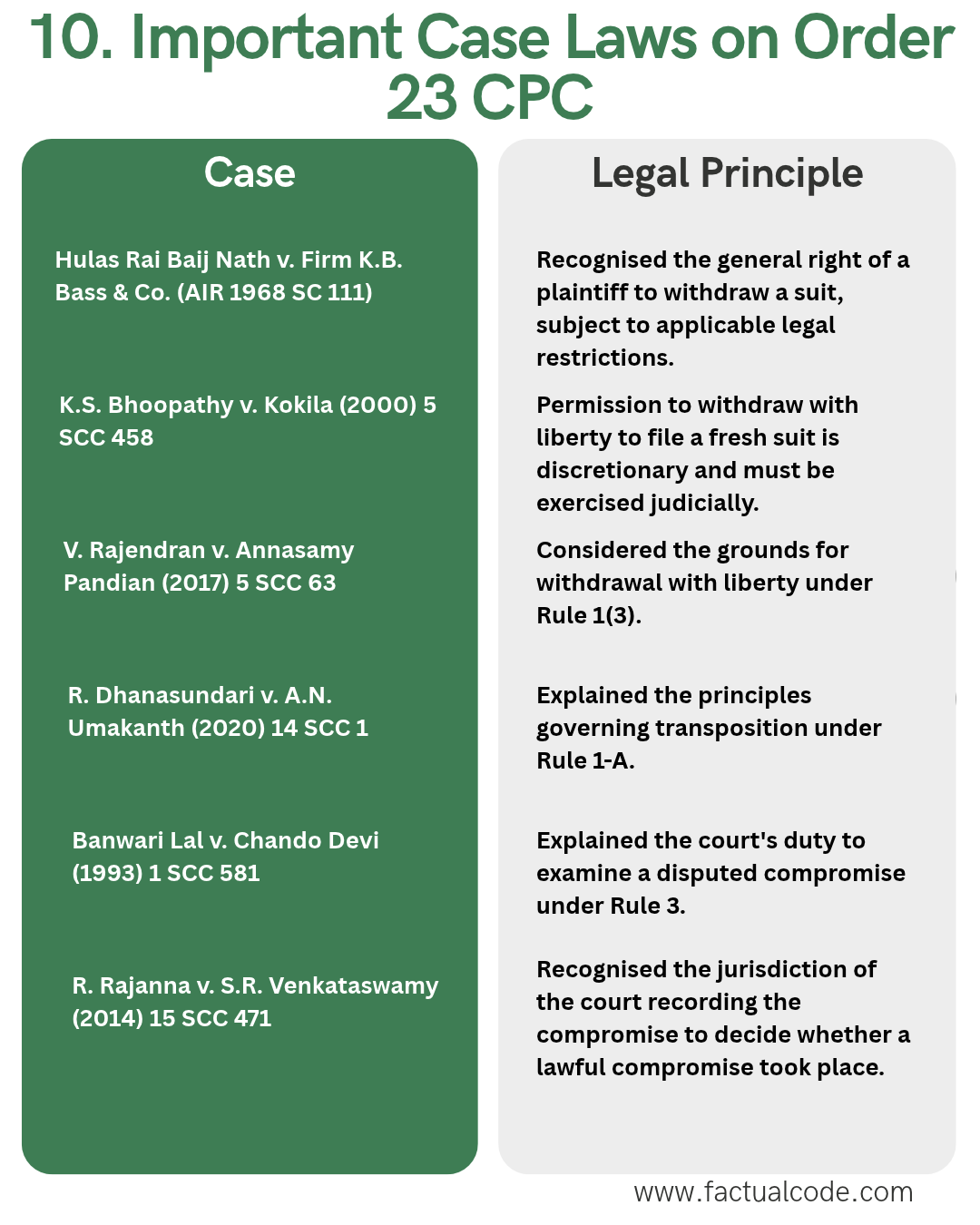
In Hulas Rai Baij Nath v. Firm K.B. Bass & Co. (AIR 1968 SC 111), the Supreme Court recognised the plaintiff’s general right to withdraw a suit. However, the exercise of this right may be restricted where legal consequences or rights of the opposite party are involved.
B. Withdrawal with Permission of the Court
Rule 1(3) provides that where the court is satisfied that:
The suit must fail by reason of some formal defect; or
There are other sufficient grounds for allowing the plaintiff to institute a fresh suit for the subject matter of the suit or part of the claim,
the court may grant permission to withdraw the suit or abandon a part of the claim, with liberty to institute a fresh suit.
Examples of formal defects may include certain defects relating to jurisdiction, valuation, court fees or the description of the subject matter, depending on the circumstances of the case.
The expression “other sufficient grounds” gives the court discretion to consider circumstances beyond formal defects. However, such permission is not automatic and must be supported by adequate reasons.
In V. Rajendran v. Annasamy Pandian (2017) 5 SCC 63, the Supreme Court considered the scope of Rule 1(3). The Court discussed the grounds for permitting withdrawal with liberty to institute a fresh suit and emphasised that the discretion must be exercised judicially.
In K.S. Bhoopathy v. Kokila (2000) 5 SCC 458, the Supreme Court held that permission to withdraw a suit with liberty to file a fresh suit is not a matter of right. The court must consider the circumstances and ensure that the plaintiff does not use the provision to prejudice the defendant or circumvent the law.
C. Withdrawal by a Minor or Person under Disability
Rule 1(2) provides special protection where the plaintiff is a minor or a person under disability.
In such cases, the suit or claim cannot be abandoned without the permission of the court. An application for such permission must be supported by an affidavit of the next friend and, where the minor or person under disability is represented by a pleader, a certificate from the pleader stating that the proposed abandonment is, in the pleader’s opinion, for the benefit of the person concerned.
This provision prevents the misuse of the right of withdrawal against the interests of persons who cannot adequately protect their own legal rights.
D. Consequences of Withdrawal Without Permission
Rule 1(4) provides that where a plaintiff withdraws a suit or abandons a part of the claim without obtaining permission under Rule 1(3), the plaintiff:
Shall be liable for such costs as the court may award; and
Shall be precluded from instituting a fresh suit in respect of the same subject matter or the part of the claim abandoned.
Thus, a plaintiff who wishes to preserve the right to bring a fresh suit must obtain the court’s permission under Rule 1(3).
E. Withdrawal Where There Are Several Plaintiffs
Under Rule 1(5), where there are several plaintiffs, one or more of them cannot abandon a suit or part of a claim without the consent of the other plaintiffs.
This requirement protects the interests of co-plaintiffs whose rights may be affected by the proposed withdrawal.
F. Effect on Set-off and Counterclaim
The withdrawal of a suit does not necessarily bring all connected proceedings to an end. Order VIII Rule 6-D CPC expressly provides that where a suit is stayed, discontinued or dismissed, a counterclaim may nevertheless proceed.
A counterclaim is treated substantially as a cross-suit and may survive independently of the plaintiff’s claim. The position of a statutory set-off must be considered separately in accordance with the applicable provisions.
3. Transposition of Defendants as Plaintiffs – Order 23 Rule 1-A CPC
Order 23 Rule 1-A CPC provides for the transposition of a defendant as a plaintiff where the plaintiff withdraws or abandons the suit.
The provision applies where:
A suit is withdrawn or abandoned by the plaintiff; and
A defendant applies to be transposed as a plaintiff.
The court may consider whether the defendant has a substantial question to be decided against any remaining defendant. If the court finds that the defendant has a legitimate interest in continuing the proceedings, it may permit transposition, subject to the provisions of Order I Rule 10 CPC.
The object is to prevent the withdrawal of a suit from defeating a genuine claim or controversy that can appropriately be decided in the same proceedings.
In R. Dhanasundari @ R. Rajeswari v. A.N. Umakanth (2020) 14 SCC 1, the Supreme Court considered the scope of transposition under Order 23 Rule 1-A and the principles governing the court’s discretion in permitting a defendant to continue the proceedings as a plaintiff.
4. Limitation – Order 23 Rule 2 CPC
Rule 2 provides that where the court grants permission to withdraw a suit with liberty to institute a fresh suit, the plaintiff remains subject to the law of limitation.
In other words, the grant of permission under Order 23 Rule 1(3) does not automatically extend the limitation period or create a fresh period of limitation.
However, depending on the facts and applicable legal requirements, the plaintiff may seek the benefit of Section 14 of the Limitation Act, 1963, where its conditions are satisfied.
5. Compromise of Suits – Order 23 Rule 3 CPC
Order 23 Rule 3 CPC deals with the adjustment or satisfaction of a suit through a lawful agreement, compromise or other recognised arrangement between the parties.
Under Rule 3, where the court is satisfied that:
A suit has been adjusted wholly or partly by a lawful agreement or compromise in writing and signed by the parties; or
The defendant has satisfied the plaintiff in respect of the whole or any part of the subject matter of the suit,
the court shall record the agreement, compromise or satisfaction and pass a decree in accordance with it, so far as it relates to the parties to the suit.
A. Requirements of a Valid Compromise
For a compromise under the first part of Rule 3 to be recorded, the following requirements must be fulfilled:
There must be an agreement or compromise between the parties.
It must be lawful.
It must be in writing.
It must be signed by the parties.
The court must be satisfied that the suit has been adjusted wholly or partly.
The requirement that the compromise must be in writing and signed by the parties was introduced by the Code of Civil Procedure (Amendment) Act, 1976. The amendment was intended to prevent disputes and fraudulent claims concerning alleged oral compromises.
The second part of Rule 3 separately recognises a situation where the defendant satisfies the plaintiff in respect of the subject matter of the suit. The statutory requirements applicable to a compromise agreement should not automatically be treated as identical to this separate mode of satisfaction.
B. Meaning of Lawful Compromise
The Explanation to Rule 3 clarifies that an agreement or compromise which is void or voidable under the Indian Contract Act, 1872 shall not be treated as lawful for the purpose of this rule.
Therefore, a compromise obtained through fraud, coercion, undue influence or other legally recognised grounds of invalidity cannot be treated as a lawful compromise merely because it has been presented before the court.
C. Court’s Duty to Examine the Compromise
The proviso to Rule 3 requires the court to decide the question where one party alleges and the other denies that an adjustment or satisfaction has taken place.
Consequently, the court must examine the validity and genuineness of the alleged compromise where a dispute arises. It should not mechanically record a compromise without satisfying itself that the statutory requirements have been fulfilled.
In Banwari Lal v. Chando Devi (1993) 1 SCC 581, the Supreme Court explained the importance of the court’s duty to examine a disputed compromise and recognised the statutory procedure for challenging the recording of an alleged unlawful or invalid compromise.
In R. Rajanna v. S.R. Venkataswamy (2014) 15 SCC 471, the Supreme Court reiterated that the court dealing with the compromise has jurisdiction to decide whether a lawful compromise or adjustment has actually taken place.
6. Bar on Separate Suit – Order 23 Rule 3-A CPC
Rule 3-A provides that no suit shall lie to set aside a decree on the ground that the compromise on which the decree is based was not lawful.
The object of this provision is to prevent parties from initiating separate proceedings to challenge a compromise decree. Instead, the challenge must ordinarily be raised before the court which recorded the compromise, in accordance with the proviso to Rule 3.
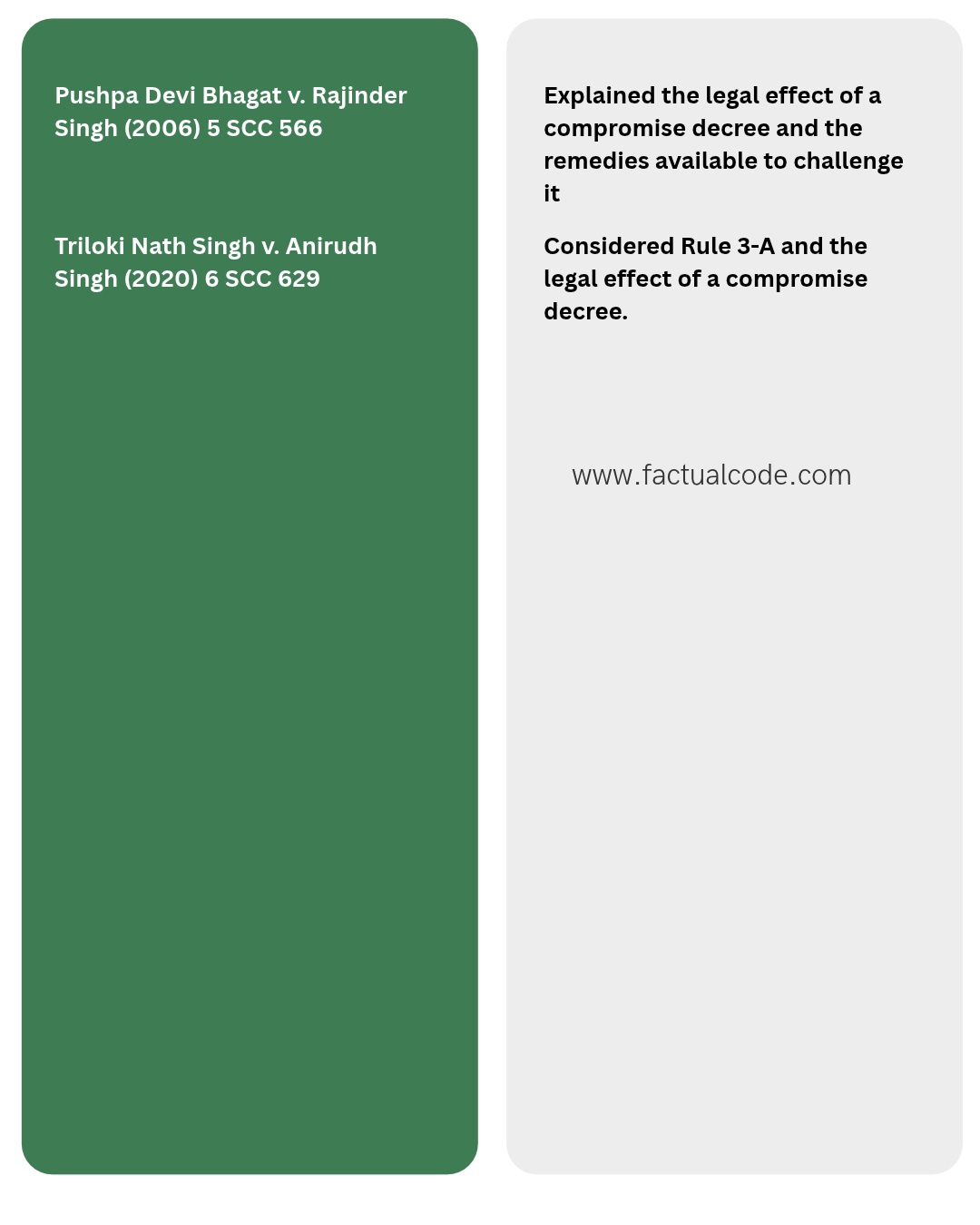
In Pushpa Devi Bhagat v. Rajinder Singh (2006) 5 SCC 566, the Supreme Court explained that a consent decree is not appealable under Section 96(3) CPC. The Court also clarified the remedies available to a party disputing the validity of a compromise decree.
In Triloki Nath Singh v. Anirudh Singh (2020) 6 SCC 629, the Supreme Court considered the scope of Rule 3-A and the legal consequences of a compromise decree, including the position of persons who were not parties to the compromise proceedings.
Appeal Against a Compromise Decree
Section 96(3) CPC provides that no appeal shall lie from a decree passed by the court with the consent of the parties.
However, Order XLIII Rule 1-A(2) permits a party appealing against a decree to contend that a compromise should or should not have been recorded by the court. This provision must be read with the statutory bar under Section 96(3) and the principles governing challenges to compromise decrees.
Where the dispute concerns the existence or lawfulness of the compromise, the statutory remedy before the court which recorded it is ordinarily the appropriate course. The supervisory jurisdiction under Article 227 of the Constitution may be invoked only in exceptional cases where its requirements are satisfied; it is not an ordinary substitute for the remedy under Order 23 Rule 3.
7. Compromise in Representative Suits – Order 23 Rule 3-B CPC
Rule 3-B imposes special restrictions on compromises in representative suits.
Where a suit is instituted in a representative capacity, or where the decree may affect persons who are not individually named as parties, a compromise cannot be recorded without the leave of the court.
The provision applies to specified categories, including suits under Sections 91 and 92 CPC, suits instituted under Order I Rule 8, and certain proceedings involving managers of undivided Hindu families or other persons representing the interests of others.
The purpose is to protect the interests of persons who may be bound by the decree even though they are not individually before the court. The court must ensure that the compromise is fair and does not prejudice the interests of the persons represented.
8. Compromise on Behalf of a Minor – Order XXXII Rule 7 CPC
Order XXXII Rule 7 CPC provides an additional safeguard where a compromise is entered into on behalf of a minor or a person under disability.
Under this provision, no next friend or guardian for the suit shall enter into an agreement or compromise on behalf of the minor or person under disability without the leave of the court, expressly recorded in the proceedings.
An application for such leave must be supported by an affidavit of the next friend or guardian and, where the minor or person under disability is represented by a pleader, a certificate from the pleader stating that the proposed compromise is for the benefit of the person concerned.
A compromise entered into without obtaining the required leave is voidable against all parties other than the minor or person under disability. It is therefore important not to describe every such compromise as an absolute nullity against all parties.
Rule 7 Order XXXII protects the interests of minors in ordinary proceedings, whereas Order 23 Rule 3-B deals with safeguards in specified representative suits. The two provisions serve distinct purposes.
9. Application of Order 23 to Execution Proceedings – Rule 4
Order 23 Rule 4 clarifies that the provisions of Order 23 do not apply to execution proceedings. Therefore, the rules governing withdrawal and compromise of suits under Order 23 cannot automatically be applied to proceedings for execution of decrees.
Questions concerning adjustment or satisfaction of a decree during execution are generally governed by Section 47 and Order XXI Rule 2 CPC, as applicable.
11. Conclusion
Order 23 CPC plays an important role in regulating the withdrawal, abandonment and compromise of civil suits. Rule 1 permits withdrawal and abandonment subject to statutory safeguards, while Rule 1-A enables the transposition of a defendant as a plaintiff in appropriate cases. Rule 2 preserves the operation of limitation law, and Rule 3 provides the procedure for recording lawful compromises.
Rules 3-A and 3-B prevent separate challenges to compromise decrees and protect the interests of persons represented in certain suits. Order XXXII Rule 7 further safeguards minors and persons under disability. Thus, Order 23 CPC balances the plaintiff’s freedom to discontinue litigation with the need to protect defendants, represented persons and the proper administration of justice.