
Quick Reference: Order XXXI CPC
www.factualcode.com| Rule | Subject | Main Principle |
|---|---|---|
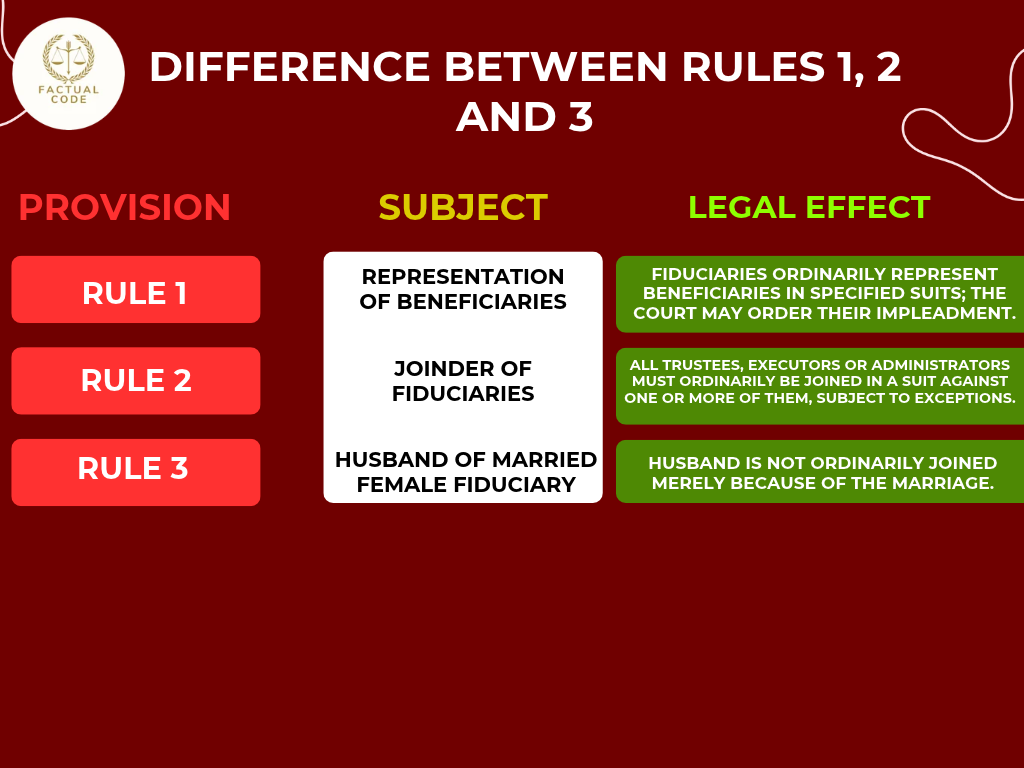
| Rule 1 | Representation of beneficiaries | A fiduciary ordinarily represents persons beneficially interested in the property. |
| Rule 2 | Joinder of fiduciaries | All trustees, executors or administrators must generally be joined in a suit against one or more of them, subject to exceptions. |
| Rule 3 | Husband of married female fiduciary | The husband is not ordinarily joined merely because of the marriage. |
1. Introduction
Order XXXI of the Code of Civil Procedure, 1908 (CPC) deals with suits by or against trustees, executors and administrators. These persons hold or manage property in a representative or fiduciary capacity for the benefit of others. Consequently, litigation concerning such property may affect several beneficiaries even when they are not individually named as parties.
Order XXXI provides rules for representing beneficiaries, determining when multiple fiduciaries must be joined and avoiding unnecessary parties. It contains three rules.
2. Meaning of Trustee, Executor and Administrator
Trustee: Section 3 of the Indian Trusts Act, 1882 defines a trust as an obligation attached to the ownership of property, arising from confidence reposed in and accepted by the owner, for the benefit of another or another and the owner. The person accepting that confidence is called the trustee, while the person for whose benefit it is accepted is the beneficiary.
The Indian Trusts Act, 1882 primarily deals with private trusts. Section 1 excludes public or private religious or charitable endowments and certain other matters from its application. However, this exclusion does not by itself determine whether Order XXXI CPC applies to a particular dispute. The nature of the proceeding and the applicable legal framework must be considered.
Executor: Under Section 2(c) of the Indian Succession Act, 1925, an executor is a person appointed by the testator to carry out the provisions of the deceased person’s last will.
Administrator: Section 2(a) of the Indian Succession Act, 1925 defines an administrator as a person appointed by a competent authority to administer the estate of a deceased person where there is no executor. Section 211 generally recognises an executor or administrator as the deceased person’s legal representative and provides for vesting of the deceased’s property in that person, subject to the statutory exception in subsection (2).
3. Objects of Order XXXI CPC
The principal objectives of Order XXXI are to:
Ensure proper representation of persons beneficially interested in property.
Prescribe when trustees, executors and administrators must be joined as parties.
Avoid unnecessary impleadment of every beneficiary.
Facilitate effective adjudication of disputes involving trust or estate property.
4. Rule 1 – Representation of Beneficiaries
Statutory provision – Order XXXI Rule 1 CPC
In all suits concerning property vested in a trustee, executor or administrator, where the contention is between the persons beneficially interested in such property and a third person, the trustee, executor or administrator shall represent the persons so interested, and it shall not ordinarily be necessary to make them parties to the suit. But the Court may, if it thinks fit, order them or any of them to be made parties.
Explanation
Rule 1 establishes the principle of representative litigation. Where a dispute concerning property vested in a trustee, executor or administrator arises between the persons beneficially interested and a third person, the fiduciary ordinarily represents those interested persons.
Therefore, it is not generally necessary to implead every beneficiary individually. However, the rule does not create an absolute bar against adding beneficiaries. The court retains discretion to direct their impleadment where their presence is necessary for effective adjudication.
For example, a beneficiary may seek impleadment where the trustee has failed to protect the trust property, a conflict of interest or collusion is alleged, or the beneficiary’s participation is otherwise necessary. The court may also exercise its power under Order I Rule 10(2) CPC.
Illustration: A trustee holds land for several beneficiaries. A neighbour disputes the boundary and claims a portion of the land. The trustee may ordinarily represent the beneficiaries in the suit. However, the court may direct a beneficiary to be added if the circumstances require it.
Importance: Rule 1 prevents unnecessary multiplicity of parties while preserving the court’s power to ensure that the interests of beneficiaries are adequately protected.
5. Rule 2 – Joinder of Trustees, Executors and Administrators
Statutory provision – Order XXXI Rule 2 CPC
Where there are several trustees, executors or administrators, they shall all be made parties to a suit against one or more of them:
Provided that the executors who have not proved their testator’s will, and trustees, executors and administrators outside India, need not be made parties.
Explanation
Rule 2 deals with the joinder of multiple fiduciaries. Where several trustees, executors or administrators exist, all must ordinarily be made parties to a suit brought against one or more of them in that capacity.
The rule contains two express exceptions:
Executors who have not proved the will: An executor who has not proved the testator’s will need not be joined.
Fiduciaries outside India: Trustees, executors and administrators outside India need not be made parties.
The second exception may have practical significance where service of court process and participation in proceedings across borders present difficulties. However, the statutory provision merely dispenses with compulsory joinder; it does not declare that Indian courts lack jurisdiction over every person outside India.
Illustration: A, B and C are trustees of a trust. A suit is instituted against A and B concerning the administration of the trust. C must ordinarily be joined. However, if C is outside India, the statutory exception may apply.
Importance: Rule 2 promotes complete adjudication by requiring the relevant fiduciaries to be before the court, while recognising the specific exceptions provided by law.
6. Rule 3 – Husband of Married Female Trustee, Administratrix or Executrix
Statutory provision – Order XXXI Rule 3 CPC
Unless the Court directs otherwise, the husband of a married trustee, administratrix or executrix shall not as such be a party to a suit by or against her.
Explanation
Rule 3 recognises the independent representative capacity of a married woman acting as a trustee, administratrix or executrix. Her husband is not required to be joined merely because of the marital relationship.
The expression “shall not as such” means that the husband is not a party merely by virtue of being her husband in the representative proceedings. The court may direct otherwise where his presence is necessary in the circumstances.
Illustration: A married woman is appointed executrix under a will. When a suit is instituted against her in that representative capacity, her husband need not ordinarily be joined.
Importance: Rule 3 prevents unnecessary joinder and recognises the independent legal capacity of a married female fiduciary.
7. Important Case Laws
1. Dr. Debajit Das and Another v. Williamson Magor Education Trust and Others (2020)
Citation: AIRONLINE 2020 GAU 319
Court: Gauhati High Court
Decision: 8 June 2020
Case Number: RFA No. 47 of 2018
The case arose from a claim for compensation following the death of a minor student due to electrocution at a residential school managed by a trust. The defendants argued that all trustees should have been impleaded under Order XXXI Rule 2 CPC.
The Gauhati High Court distinguished between Rules 1 and 2. It held that the suit was essentially a claim for damages arising from the alleged negligence of the school authority and did not concern the legal ownership of property vested in the trustees. Consequently, all trustees were not necessary parties. The Chairman of the Board of Trustees, who was also a trustee, was considered sufficient for representation in the circumstances.
Legal principle: The mere involvement of a trust does not automatically require all its trustees to be impleaded. The nature of the suit and the capacity in which the trustees are sued must be examined.
2. Randhir Singh Bhutoria and Another v. Food Corporation of India (2015)
Court: Calcutta High Court
Decision: 2 February 2015
Case Number: C.S. No. 261 of 1999
The plaintiffs were trustees of Chandmal Religious Trust and instituted a suit against the Food Corporation of India for recovery of arrears of rent and related amounts arising from lease arrangements concerning godowns constructed on trust land. The defendant objected that the trust itself had not been made a party.
The Calcutta High Court considered the representative capacity of the plaintiffs and referred to Order XXXI Rule 1 CPC. It recognised that a trust is not a separate legal entity in the same manner as a corporation and that the trustees are the persons holding the relevant legal title. Since the plaintiffs established that they were trustees and had instituted the suit in that capacity, the objection was rejected. The Court observed that payment to the plaintiffs under the decree would constitute payment to the trust.
Legal principle: The case illustrates the importance of correctly describing and establishing the representative capacity of trustees instituting proceedings. It does not establish that one trustee can invariably institute every suit without the others.
3. Baluram v. P. Chellathangam and Others (2014)
Citation: (2015) 13 SCC 579; AIR 2015 SC 1264
Court: Supreme Court of India
Decision: 10 December 2014
Case Number: Civil Appeal Nos. 10940–10941 of 2014
The case concerned a suit for specific performance of an agreement to sell trust property. A beneficiary of the trust sought impleadment because he apprehended that the property would be sold at an undervalued price, thereby prejudicing the interests of the beneficiaries.
The Supreme Court held that the beneficiary could not be treated as a stranger to the trust property. He was a proper party and could be impleaded under Order I Rule 10(2) CPC to enable effective adjudication and avoid multiplicity of proceedings.
Legal principle: A beneficiary may be impleaded as a proper party where the proposed transaction concerning trust property may affect the beneficiary’s interests. The decision is primarily an interpretation of Order I Rule 10(2), rather than a direct interpretation of Order XXXI Rule 1.
8. Relationship with Other CPC Provisions
Order I Rule 9 – Misjoinder and Non-joinder: A suit is not ordinarily defeated by misjoinder or non-joinder of parties, except where a necessary party is absent. This general principle must be read alongside the specific joinder requirements under Order XXXI.
Order I Rule 10(2) – Addition of Parties: The court may add a necessary or proper party at any stage of the proceedings to enable complete and effective adjudication. This provision is particularly relevant where a beneficiary seeks to participate in litigation concerning trust property.
Section 92 CPC – Public Charities: Section 92 provides a special procedure for suits concerning an alleged breach of an express or constructive trust created for public charitable or religious purposes, or where court directions are necessary for its administration. Such proceedings must satisfy the statutory requirements, including institution by the Advocate-General or by two or more persons interested in the trust with the leave of the court. Section 92 does not govern every dispute involving a public trust and should not be treated as automatically replacing Order XXXI in all trust-related proceedings.
10. Conclusion
Order XXXI CPC provides an important procedural framework for suits by or against trustees, executors and administrators. Rule 1 enables fiduciaries to represent beneficiaries in specified disputes, while allowing the court to add beneficiaries where necessary. Rule 2 generally requires the joinder of all relevant fiduciaries in suits against one or more of them, subject to statutory exceptions. Rule 3 clarifies that the husband of a married female fiduciary is not ordinarily a necessary party merely because of the marriage.
Together, these provisions promote proper representation, effective adjudication and procedural economy in civil proceedings.