
1. Introduction
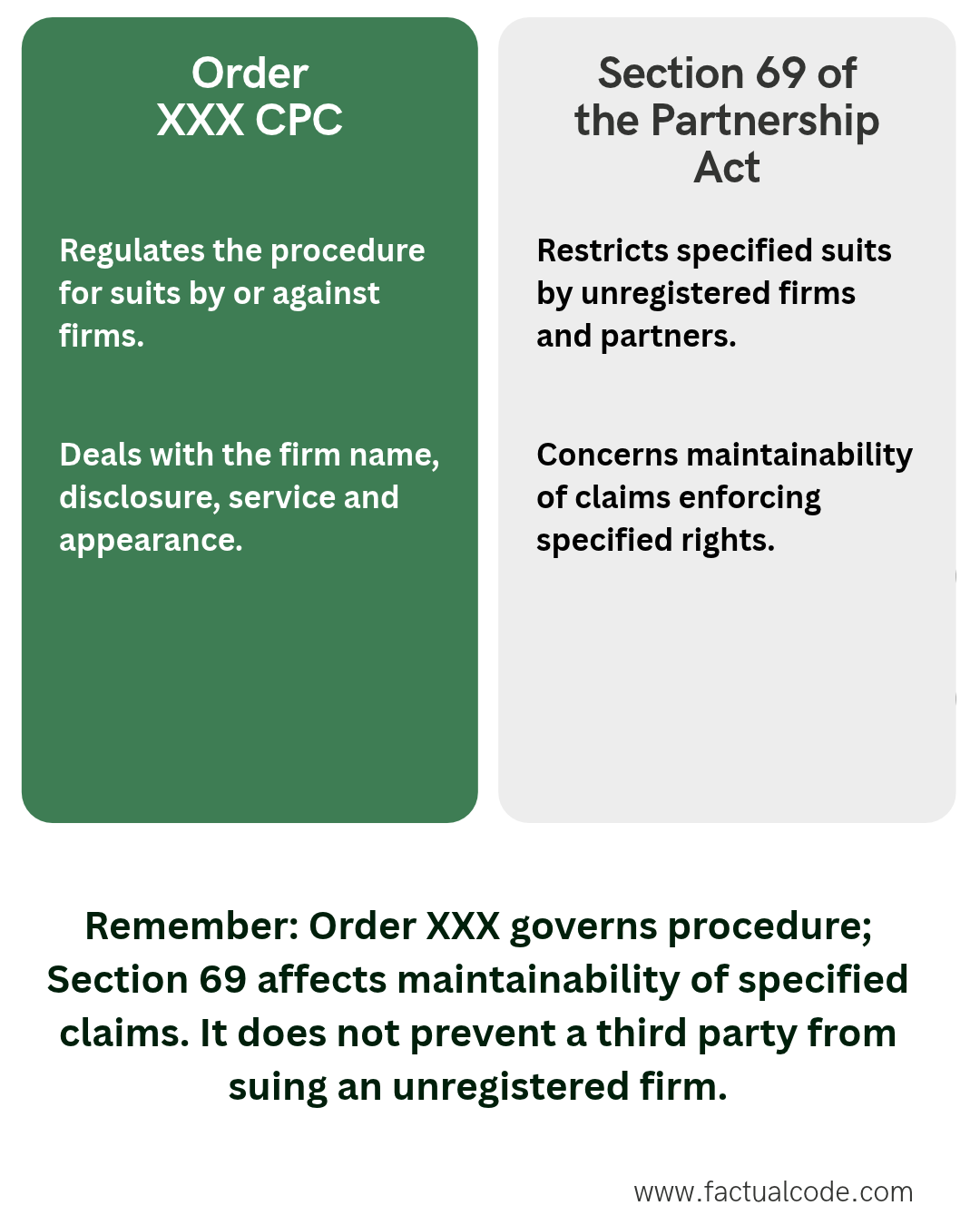
Order XXX, Rules 1–10 Code Of Civil Procedure, 1908 provides a special procedure for suits by or against partnership firms and persons carrying on business under other names. It permits litigation in the firm name and regulates disclosure, service, appearance under protest and inter-partner suits. It must be read with Section 69 of the Indian Partnership Act, 1932, which restricts specified claims by unregistered firms and partners.
2. Legal Nature of a Partnership Firm
Section 4 of the Partnership Act defines partnership as the relationship between persons who agree to share business profits, with the business carried on by all or any acting for all. An ordinary firm is not a separate legal person like a company; its name collectively describes its partners. Under Section 18, a partner is the firm’s agent, and Section 25 makes partners jointly and severally liable for acts of the firm done while they are partners. Order XXX permits proceedings in the firm name as a procedural convenience.
The procedural treatment of partnership firms differs from that of corporations. While Order XXX CPC regulates suits involving partnership firms, Order XXIX CPC provides the corresponding procedural framework for suits by or against corporations.
3. Order XXX CPC and Section 69 of the Partnership Act
4. Suing or Being Sued in the Firm Name – Rule 1
Rule 1(1) permits two or more persons claiming or liable as partners and carrying on business in India to sue or be sued in the name of the firm of which they were partners when the cause of action accrued. Any party may apply for a verified statement of the names and addresses of the partners at that time.
The relevant date is when the cause of action accrued, not when the suit was filed. If C retires after a debt arises while A, B and C are partners, the earlier composition is relevant.
Under Rule 1(2), any one partner may sign, verify or certify a pleading or other document required by the CPC. Every partner need not sign the plaint.
5. Disclosure of Partners’ Names – Rule 2
A defendant may demand in writing the names and residences of all partners on whose behalf the suit is brought. On non-compliance, the Court may, on application, stay proceedings on appropriate terms; dismissal is not automatic. After disclosure, the suit proceeds as if the partners were named plaintiffs, but subsequent proceedings continue in the firm name and their names are entered in the decree.
6. Service of Summons – Rule 3
Summons may be served on one or more partners or, as directed by the Court, on a person managing the business at its principal place in India. This is good service on the firm even if partners are outside India. If the plaintiff knew before suit that the firm had been dissolved, summons must be served on every person in India whom the plaintiff seeks to make liable.
7. Death of a Partner – Rule 4
If a partner dies before or during a suit in the firm name, it is unnecessary to join the legal representative, notwithstanding Section 45 of the Indian Contract Act, 1872. The representative may seek joinder or enforce a claim against surviving partners.
8. Notice and Appearance – Rules 5–7
Rule 5: Written notice at service must state whether the person is served as a partner, business manager, or both. Without notice, he is deemed served as a partner.
Rule 6: Partners appear individually, but subsequent proceedings continue in the firm name.
Rule 7: A person served only as business manager need not appear unless he is a partner.
9. Appearance Under Protest – Rule 8
A person served as a partner may appear under protest, denying that he was a partner at a material time. Either side may apply, before the date fixed for hearing and final disposal, for a determination of his status and liability.
If found to be a partner, he may still defend the firm by denying its liability on the claim. If found not to be a partner, the suit may proceed against the firm, but his liability as a partner cannot later be alleged in execution.
Examination point: Appearance under protest challenges the person’s partnership status; it does not prevent a defence on the merits if the Court finds that he was a partner.
10. Suits Between Co-Partners and Business Names – Rules 9–10
Rule 9: Order XXX applies to suits between a firm and its partners and between firms with common partners. Execution requires leave of Court, which may direct accounts and inquiries.
Rule 10: A person carrying on business under another name, or an HUF carrying on business under a name, may be sued in that name as if it were a firm name. It applies to suits against such persons; it does not itself authorise institution of a suit in that business name or create a separate legal personality.
11. Execution of Decrees – Order XXI Rules 49 and 50
Rule 49 – Attachment of Partnership Property: Partnership property cannot ordinarily be attached or sold for an individual partner’s debt unless the decree is against the firm or partners as such. The decree-holder may seek a charge over that partner’s interest in the property and profits. The Court may appoint a receiver, direct accounts or order sale. Other partners may redeem the charge or purchase the interest if sale is directed.
Rule 50 – Execution Against a Firm: A decree against a firm may be executed against partnership property and a person who appeared in his own name under Order XXX Rule 6 or 7, admitted in pleadings that he is or was a partner, was adjudged a partner, or was individually served as a partner and failed to appear.
Execution against another alleged partner requires leave of the Court that passed the decree. If liability is disputed, the Court may try it as an issue in a suit; its decision has the force of a decree. Apart from partnership property, the decree does not affect a partner unless he was served with summons to appear and answer. Rule 50(5) excludes decrees against an HUF under Order XXX Rule 10.
Distinction: Rule 49 concerns attachment of partnership property for an individual partner’s debt; Rule 50 governs execution of a decree against the firm and specified partners.
12. Effect of Non-Registration – Section 69 of the Partnership Act
Registration is not essential to the existence of a partnership, but Section 69 restricts specified proceedings:
Section 69(1): A person suing as a partner cannot sue the firm or another partner to enforce a contractual right or a right conferred by the Partnership Act unless the firm is registered and the suing partner is or has been shown in the Register of Firms. A proviso exempts specified proceedings by a deceased partner’s heirs or legal representatives for accounts or realisation of firm property.
Section 69(2): An unregistered firm cannot sue a third party to enforce a right arising from a contract unless the firm is registered and the persons suing are or have been shown as partners in the Register.
Section 69(3): The restrictions extend to set-off and other proceedings enforcing contractual rights. They preserve proceedings for dissolution, accounts of a dissolved firm and realisation of its property, as well as specified insolvency powers.
Section 69(2) does not prevent a third party from suing an unregistered firm or bar every suit by an unregistered firm. The Court examines the source of the asserted right; independent statutory and common-law rights may fall outside the prohibition.
13. Important Judicial Decisions
1. Raptakos Brett & Co. Ltd. v. Ganesh Property, (1998) 7 SCC 184
The Court treated the plaint as asserting a composite cause of action: the contractual-covenant limb was barred, but the claim based on the statutory obligation under Sections 108(q) and 111(a) of the Transfer of Property Act was not. The source of the right is material.
2. Haldiram Bhujiawala v. Anand Kumar Deepak Kumar, (2000) 3 SCC 250
The Court held that an unregistered firm’s trademark and passing-off action was not barred, as it enforced statutory and common-law rights rather than a business contract between the firm and defendants.
3. Shiv Developers v. Aksharay Developers, 2022 INSC 119
The Court held that Section 69(2) did not bar a suit concerning an independent sale transaction outside the firm’s ordinary business, where the claims relied on common-law and statutory rights and alleged fraud and misrepresentation. The nature of the transaction and source of the right are material.
4. Sunkari Tirumala Rao v. Penki Aruna Kumari, 2025 INSC 92
The Court held that partners of an unregistered firm could not maintain a recovery suit against another partner to enforce a right arising from the partnership agreement. Non-commencement of business did not avoid Section 69(1); the statutory exception for dissolution and accounts remained available.
Quick Revision Checklist
Order XXX CPC – Suits by or Against Partnership Firms
Relevant partners are those at the time the cause of action accrued; one partner may sign or verify.
Written demand for disclosure; non-compliance may lead to a stay, not automatic dismissal.
Summons may be served on a partner or, as directed by the Court, a business manager.
A deceased partner's legal representative need not automatically be joined in the suit.
Without written notice specifying the capacity of service, the person is deemed served as a partner.
A person served as a partner may challenge his partnership status and liability.
Execution in suits between co-partners or firms with common partners requires leave of Court.
Certain persons carrying on business under another name and HUFs may be sued in that business name.
Rule 49 concerns attachment of partnership property; Rule 50 governs execution against the firm and specified partners.
Non-registration bars specified claims, not every proceeding or suits filed by third parties against the firm.
Remember the distinction between Order XXI Rule 49 and Rule 50. Rule 49 deals with an individual partner's interest in partnership property, whereas Rule 50 deals with execution of a decree against the firm and specified partners.
14. Conclusion
Order XXX CPC provides a procedural framework for suits by or against partnership firms, covering disclosure, service, appearance, death of a partner and inter-partner disputes. Order XXI Rules 49–50 govern execution, while Section 69 of the Partnership Act restricts specified claims by unregistered firms and partners. The firm name simplifies litigation, but individual partners’ rights and liabilities remain significant.