
Introduction
Section 47 of the Code of Civil Procedure, 1908 (CPC) requires the executing court to decide questions between the parties or their representatives relating to the execution, discharge or satisfaction of a decree. Its object is to prevent separate suits over matters that can be resolved during execution.
The executing court must ordinarily enforce the decree as drawn and cannot reopen the original dispute. It may, however, refuse execution where the decree is a nullity, particularly because the court lacked inherent jurisdiction, or where the decree is otherwise incapable of execution under law. The essential distinction is between an erroneous decree and a void decree.
1. Scope and purpose of Section 47 CPC
Section 47(1) provides that all questions arising between the parties to the suit, or their representatives, and relating to execution, discharge or satisfaction of the decree shall be determined by the executing court and not by a separate suit. Under Section 47(3), the court may determine whether a person is or is not the representative of a party.
It covers disputes about payment, the identity and liability of the person bound by the decree, and the manner of implementation. It identifies the forum for execution-related questions; it does not ordinarily permit a retrial.
Historical note: Section 47(2), which permitted certain suits and execution proceedings to be converted into one another, was omitted by the Code of Civil Procedure (Amendment) Act, 1976.
Section 38 identifies the court by which a decree may be executed; Order XXI provides the modes of execution. In Rahul S. Shah v. Jinendra Kumar Gandhi (2021) 6 SCC 418, the Supreme Court stressed that execution should not become a retrial or be obstructed by avoidable proceedings.
2. General rule: the executing court cannot go behind the decree
An executing court must take the decree according to its tenor. It cannot reassess evidence, reconsider the merits, or refuse execution merely because it believes the judgment is legally or factually wrong. The decree remains binding unless set aside or modified through an appropriate proceeding.
In Vasudev Dhanjibhai Modi v. Rajabhai Abdul Rehman (1970) 1 SCC 670, the Supreme Court recognised an exception for a decree that is a nullity, including one passed without inherent jurisdiction. The defect must ordinarily be apparent from the record; the executing court cannot conduct a fresh trial to discover one. See Rafique Bibi v. Sayed Waliuddin (2004) 1 SCC 287. In Asma Lateef v. Shabbir Ahmad (2024) INSC 36, the Court reaffirmed that a decree suffering from an inherent jurisdictional defect may be rejected in execution.
3. When can an executing court refuse to execute a decree?
A. Lack of inherent jurisdiction
A decree is a nullity where the court had no legal authority to entertain the subject matter or grant the relief—for example, where a special statute gives exclusive jurisdiction to a tribunal.
In Kiran Singh v. Chaman Paswan AIR 1954 SC 340, the Supreme Court held that a defect going to the root of the court’s authority makes the decree a nullity and cannot be cured merely by consent. In Sushil Kumar Mehta v. Gobind Ram Bohra (1990) 1 SCC 193, an eviction decree passed by a civil court despite the exclusive jurisdiction of the Rent Controller was held to be void.
The executing court may refuse execution where the absence of inherent jurisdiction is established from the record. It must, however, distinguish this from an incorrect decision made while exercising jurisdiction the court actually possessed.
B. Non-compliance with a mandatory statutory precondition
Where a statute makes a condition precedent to the court’s authority, failure to satisfy it may render the decree a nullity.
In Odisha State Financial Corporation v. Vigyan Chemical Industries (2025) INSC 928, the Supreme Court held on the facts before it that failure to issue the mandatory notice under Section 80 CPC to a State instrumentality went to the root of the trial court’s jurisdiction. The decree was consequently treated as a nullity, and the objection could be considered in execution.
This does not mean every procedural breach invalidates a decree. The court must determine whether the relevant statute creates a true condition precedent to the court’s jurisdiction or merely prescribes a procedural requirement.
C. Decree passed against a person who was already dead
A decree against a defendant who died before institution, or against a party who died during the suit without required substitution, may be a nullity, subject to Order XXII CPC.
Order XXII Rules 3 and 4 provide for substitution of the legal representatives of a deceased plaintiff or defendant. Rule 6 states that where a party dies after conclusion of the hearing but before judgment is pronounced, the death does not cause abatement and judgment may be pronounced as if the death had not occurred. Rule 10A requires the pleader to inform the court of the death of a client.
Death after the decree does not invalidate it. Under Section 50 CPC, execution may proceed against the legal representative, whose liability is ordinarily limited to the deceased’s estate received and not duly disposed of. Order XXII Rule 12 excludes the ordinary abatement rules in Rules 3, 4 and 8 from execution proceedings.
D. Decree against a minor or person of unsound mind without proper representation
Order XXXII requires a minor defendant to be represented by a properly appointed guardian. Rule 15 extends relevant protection to persons of unsound mind or mental infirmity who cannot protect their interests.
In Ram Chandra Arya v. Man Singh AIR 1968 SC 954, the Supreme Court applied the protection of Order XXXII to a person of unsound mind and held that a decree passed without appointment of a guardian-ad-litem was void. The court must nevertheless examine the facts and the applicable procedural provisions; an unsupported allegation of minority or mental incapacity will not, by itself, establish nullity.
E. Fraud or decree against the wrong person
A decree obtained by fraud upon the court, or one directed against a person who is not in fact the judgment debtor, may be challenged as a nullity. Fraud must be specifically pleaded and proved; a bare allegation is insufficient.
In S.P. Chengalvaraya Naidu v. Jagannath (1994) 1 SCC 1, the Supreme Court held that a decree obtained by fraud on the court is a nullity. A decree against a non-existent or impersonated person may be unenforceable against the real individual; a mere spelling mistake or misdescription will not invalidate it if identity is clear. A stranger asserting an independent right generally has to use the remedies under Order XXI Rules 97–101, rather than treat Section 47 as a general third-party remedy.
F. Foreign decree not conclusive or executable in India
A foreign judgment is conclusive under Section 13 CPC only subject to its exceptions, including absence of competent jurisdiction or a decision not given on the merits. Section 44A permits execution of decrees from superior courts of reciprocating territories, but under Section 44A(3), execution must be refused if a Section 13 exception applies.
4. What does NOT make a decree a nullity?
This distinction is central to Section 47 CPC. A decree is not void merely because the court made a mistake.
Error of law or fact: If a competent court wrongly assessed evidence, interpreted a contract or applied a legal provision, the decree remains binding until set aside through the prescribed remedy. In Ittyavira Mathai v. Varkey Varkey AIR 1964 SC 907, the Supreme Court clarified that a decree does not become a nullity merely because the suit may have been decreed despite an error concerning limitation.
Territorial or pecuniary jurisdiction: Objections are governed by Section 21 CPC. They must ordinarily be raised at the earliest opportunity; an appellate or revisional court also requires a consequent failure of justice. These objections must be distinguished from an inherent lack of subject-matter jurisdiction. Seth Hiralal Patni v. Sri Kali Nath AIR 1962 SC 199 explains the distinction between waivable local jurisdiction and a fundamental jurisdictional defect.
Procedural irregularity: A procedural defect does not automatically make a decree void. The aggrieved party must ordinarily seek to set it aside through the remedy provided by law. In Rafique Bibi, the Supreme Court distinguished a decree passed without jurisdiction from one that is merely illegal or procedurally irregular.
An objection already decided: A party cannot ordinarily reopen in execution an issue that has been finally decided. Section 11, Explanation VII, extends res judicata to execution proceedings, and constructive res judicata may prevent a party from withholding an objection and raising it at a later stage. However, waiver or consent cannot confer inherent subject-matter jurisdiction where the law has withheld it.
5. Special situations: compromise decrees and difficult-to-execute decrees
An executing court must enforce a compromise decree according to its terms and cannot rewrite the settlement. A challenge that the compromise was unlawful should ordinarily be brought before the court that recorded it under Order XXIII Rules 3 and 3A.
In Maurice W. Innis v. Lily Kazrooni 2026 INSC 340, the Supreme Court reiterated that the executing court must enforce a compromise decree as written and cannot modify the parties’ allotted shares or substitute different property simply because another arrangement appears more workable.
Vague or uncertain terms do not automatically make a decree void. The executing court should interpret the decree as a whole and decide whether it can be implemented without changing its substance; it cannot create a new right or rewrite the relief.
6. Important cases at a glance
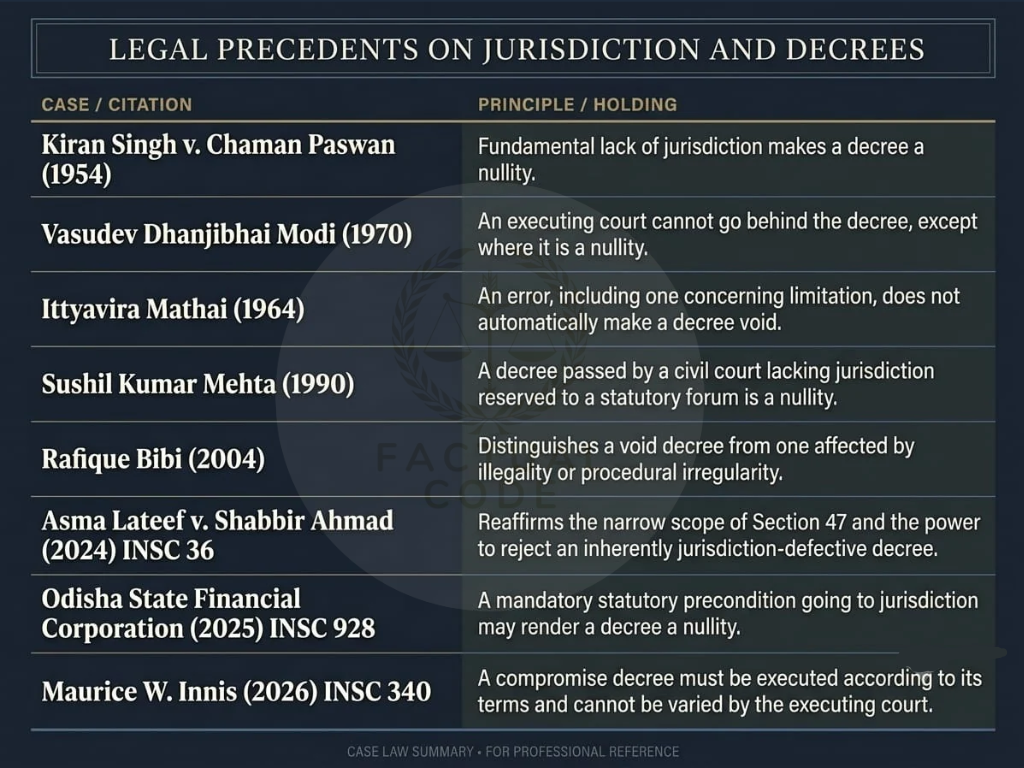
7. How should the executing court examine an objection?
The court should: (1) identify whether the objection concerns execution, discharge or satisfaction and is raised by a party or representative; (2) examine the decree and record; (3) distinguish inherent lack of jurisdiction from mere error or irregularity; (4) apply relevant provisions, including Sections 13, 21, 44A and 50 CPC; and (5) either execute the decree according to its terms or refuse execution where a nullity or legal bar is established. Section 47 must not be used to retry the suit.
Conclusion
Section 47 CPC protects finality while preventing enforcement of a decree that the law does not recognise as valid. The executing court is not an appellate court; it may refuse execution only where the decree is a nullity or otherwise legally inexecutable.
The decisive question is whether the court had legal authority to pass the decree, not merely whether it decided the case correctly. An erroneous decree must ordinarily be challenged through appeal or another prescribed remedy; a fundamental jurisdictional defect may be raised under Section 47 CPC.
Lack of inherent jurisdiction.
Violation of a statutory precondition affecting jurisdiction.
Decree against a deceased party in legally invalid circumstances.
Decree obtained by fraud upon the court.
Lack of legally required representation of a minor or person of unsound mind.
P = Pecuniary jurisdiction objection
T = Territorial jurisdiction objection
VOID DECREE
May be refused execution if nullity is established.
ERRONEOUS DECREE
Must ordinarily be challenged through the proper legal remedy.
EDS → Rule → Exception → Nullity → JM DFF → EPT → Conclusion
HOW TO SCORE IN A 15-MARK ANSWER
Section 47 CPC | Nullity of Decree
| Weak approach | Better approach |
|---|---|
| Every illegal decree is void. | Explain the difference between jurisdictional nullity and ordinary legal error. |
| Executing court can reconsider the original case. | Explain the general rule and its narrow exception. |
| Only list case names. | Connect each judgment with its legal principle. |
| Write provisions without explanation. | Explain how Section 47 operates in execution proceedings. |
4. Final Examination Advice
- Use clear headings and underline important legal expressions.
- Give priority to the rule, exception and distinction.
- Use relevant judgments rather than unnecessarily listing many cases.
- Do not repeat the same legal principle under different headings.
- Keep your conclusion short, precise and legally accurate.