
1. Introduction
Section 64 of the Code of Civil Procedure, 1908 (CPC) prevents a judgment-debtor from defeating an attachment by privately transferring or delivering attached property, or by receiving payment contrary to the attachment. It preserves property for execution and protects claims enforceable under the attachment. Its effect is not absolute: the transfer is void only against those protected claims. Section 64(2), inserted in 2002, creates an exception for a transfer made pursuant to a contract entered into and registered before attachment.
2. Statutory Provision: Section 64 CPC
Section 64 – Private alienation of property after attachment to be void
(1) Where an attachment has been made, any private transfer or delivery of the property attached or of any interest therein and any payment to the judgment-debtor of any debt, dividend or other monies contrary to such attachment, shall be void as against all claims enforceable under the attachment.
(2) Nothing in this section shall apply to any private transfer or delivery of the property attached or of any interest therein, made in pursuance of any contract for such transfer or delivery entered into and registered before the attachment.
Explanation.— For the purpose of this section, claims enforceable under an attachment include claims for the rateable distribution of assets.
Section 64(2) was inserted by the Code of Civil Procedure (Amendment) Act, 2002, with effect from 1 July 2002; the original provision was renumbered as Section 64(1). The Explanation on rateable distribution was inserted by the 1976 amendment, effective from 1 February 1977.
3. Essential Conditions Under Section 64(1)
1. Valid attachment: The property must have been attached in accordance with the CPC. Relevant procedures include Order XXI Rules 43 (movables), 46 (debts and certain intangible property) and 54 (immovable property). Attachment before judgment is governed by Order XXXVIII.
2. Private dealing after attachment: There must be a private transfer or delivery of the attached property or an interest in it, or payment to the judgment-debtor of an attached debt, dividend or other money contrary to the attachment. The provision covers sale, gift, mortgage and delivery of attached movables. A judicial sale in execution is not a private transfer.
3. Timing: The transaction must occur after attachment. A completed transfer predating attachment is not invalidated by Section 64 merely because the property is later attached. The attaching creditor ordinarily reaches only the right, title and interest remaining in the judgment-debtor. A prior transfer may nevertheless be challenged under Section 53 of the Transfer of Property Act, 1882 (TPA), if fraudulent intent is proved.
4. Protected claim: The transfer must be asserted against a claim enforceable under the attachment. The Explanation expressly includes eligible claims for rateable distribution under Section 73 CPC.
4. Legal Effect of Section 64: Relative, Not Absolute, Invalidity
A transfer under Section 64(1) is void as against claims enforceable under the attachment. It is not necessarily void against the whole world or a nullity for every purpose. The transferee cannot rely on it to defeat the protected execution claim, though the transaction may have consequences between transferor and transferee.
Attachment does not transfer ownership to the decree-holder or itself create a charge. It restricts dealings and preserves the property for execution. A subsequent purchaser cannot ordinarily obtain release merely by producing a post-attachment sale deed; any independent title or statutory exception must be adjudicated.
5. Exception Under Section 64(2): Prior Registered Contract
Section 64(2) excludes a private transfer or delivery made in pursuance of a contract for that transfer or delivery which was entered into and registered before attachment. The requirements are cumulative:
A genuine contract for transfer or delivery must exist.
It must have been entered into before attachment.
It must have been registered before attachment.
The later transfer must be made in pursuance of that contract.
An oral or unregistered antecedent agreement does not satisfy the express registration condition where amended Section 64(2) applies. The person claiming the exception must plead and prove the prior contract, its registration and the connection between it and the subsequent transfer.
This requirement is distinct from general contractual remedies. Under Section 54 TPA, an agreement for sale does not itself create an interest in or charge on the property. Sections 40 TPA and 19(b) of the Specific Relief Act, 1963 may nevertheless make contractual obligations enforceable against certain subsequent transferees, subject to their conditions. An unregistered document may also be received as evidence of a contract in a specific-performance suit under the proviso to Section 49 of the Registration Act, 1908. These rules do not dispense with the separate prior-registration requirement under Section 64(2) for a post-attachment transfer claiming that exception.
6. Important Judicial Decisions on Section 64 CPC
A. Vannarakkal Kallalathil Sreedharan v. Chandramaath Balakrishnan, (1990) 3 SCC 291
The Court held that an agreement for sale entered into before attachment creates an obligation attached to ownership; the attaching creditor gets no better right than the judgment-debtor possessed. A later conveyance pursuant to the antecedent agreement was held effective against attachment.
The judgment predates Section 64(2). Where the amended provision applies, its express requirement of prior registration must also be met.
B. Salem Advocate Bar Association, Tamil Nadu v. Union of India, (2005) 6 SCC 344
The Supreme Court explained that Section 64(2) protects a later transfer made pursuant to a contract entered into and registered before attachment. Registration was required to prevent false or frivolous antecedent contracts being set up to defeat attachment. An unregistered contract does not qualify for the exception.
C. Hamda Ammal v. Avadiappa Pathar, (1991) 1 SCC 715
A sale deed was executed before attachment but registered afterwards. Applying Section 47 of the Registration Act, the Court held that, upon registration, the deed operated from its execution date and prevailed over the later attachment. This concerns a sale deed executed before attachment, not an agreement followed by a post-attachment sale.
D. Dokala Hari Babu v. Kotra Appa Rao, Special Leave to Appeal (C) No. 4382 of 2022, order dated 28 March 2022; 2022 LiveLaw (SC) 342.
The Supreme Court rejected a purchaser’s objection where the Order XXI Rule 58 application did not plead the alleged prior oral agreement, bona fide purchase and payment before attachment. A claimant must properly plead and prove the facts relied upon for Section 64(2) protection; the decision does not remove the statutory registration requirement.
E. L.K. Prabhu v. K.T. Mathew, 2025 INSC 1364, decided 28 November 2025
The registered sale deed was executed on 28 June 2004; the creditor’s suit was instituted on 18 December 2004 and attachment before judgment was ordered on 13 February 2005.
The Supreme Court held that Order XXXVIII Rule 5 cannot attach property already transferred before institution of the suit. It further held, on the facts before it, that the claim procedure under Order XXXVIII Rule 8 read with Order XXI Rule 58 could not be expanded into a substantive inquiry to set aside the earlier transfer under Section 53 TPA. Fraud must be proved; suspicion, relationship or inadequate consideration alone is insufficient.
This decision concerns attachment before judgment and a pre-suit transfer, not the Section 64(2) exception for a post-attachment conveyance.
7. Remedies of a Third-Party Claimant
Order XXI Rule 58 permits a person claiming that attached property is not liable to attachment to raise a claim or objection.
Under Rule 58(2), all relevant questions between the parties—including right, title or interest in the property—must be determined by the court dealing with the objection, not by a separate suit.
Under Rule 58(3), the court may release the property wholly or partly, disallow the objection, continue attachment subject to an existing interest, or make another appropriate order. An adjudicated order has the force of a decree under Rule 58(4). Rule 58(5) preserves a suit where the court refuses to entertain a claim on the grounds in Rule 58(1).
Under Order XXI Rule 59, where the property has been advertised for sale, the court may postpone the sale or, for immovable property, direct that the sale not be confirmed until the claim is decided. Order XXXVIII Rule 8 applies the Rule 58 procedure to claims concerning property attached before judgment.
8. Distinction Between Section 64 CPC and Sections 52 and 53 TPA
Section 64 CPC concerns a private transfer made after attachment; proof of fraudulent intention is not a separate ingredient.
Section 53(1) TPA concerns a transfer of immovable property made with intent to defeat or delay creditors. Such a transfer is voidable at the option of a creditor so defeated or delayed, subject to the protection of a transferee in good faith and for consideration. Section 53 does not require an existing attachment and is commonly invoked against pre-suit or pre-attachment transfers.
Section 52 TPA embodies lis pendens. During a non-collusive proceeding in which rights to immovable property are directly and specifically in question, a party cannot transfer the property so as to affect another party’s rights under the eventual decree, except with the court’s authority. A transfer pendente lite is not automatically void; it remains subject to the decree.
9. Chronology: Applying Section 64 CPC
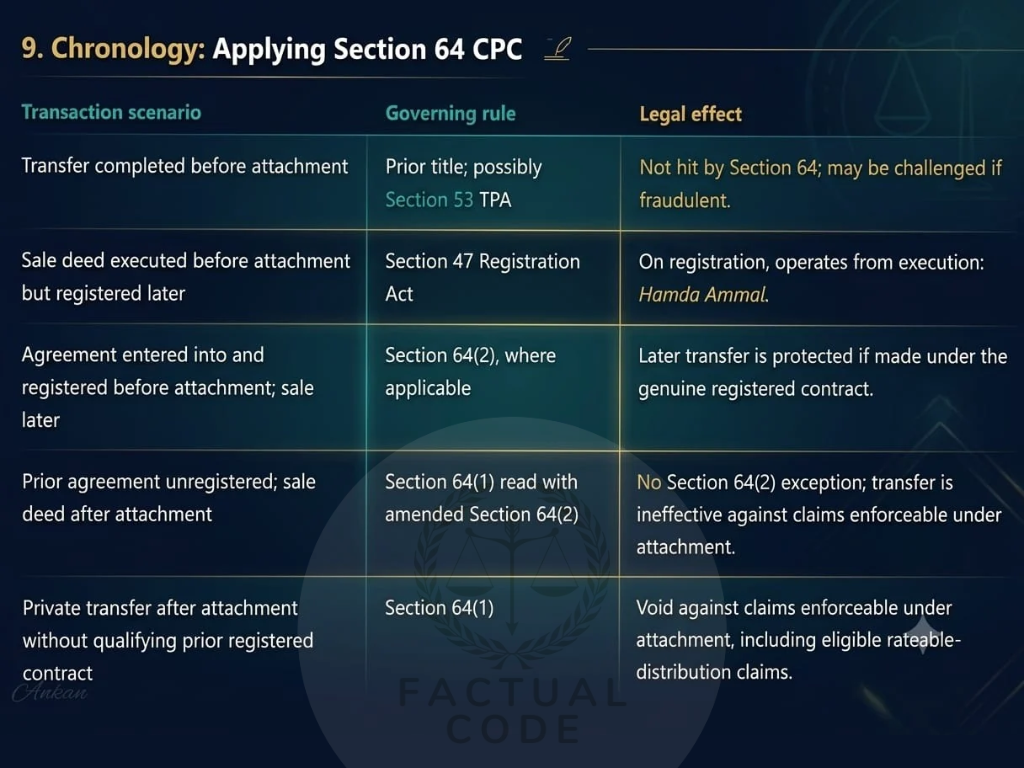
Situation 1: No Valid Attachment
Section 64 CPC does not apply.
Situation 2: Valid Attachment Followed by Private Transfer
A judgment-debtor privately transfers or delivers the attached property after attachment.
General Rule – Section 64(1)
The transfer is void against all claims enforceable under the attachment.
Situation 3: Prior Contract and Registration
The transfer is made pursuant to a contract that was both entered into and registered before the attachment.
Exception – Section 64(2): Such transfer may be protected from the general rule under Section 64(1).
10. Conclusion
Section 64 CPC preserves the efficacy of attachment by preventing private dealings from defeating claims enforceable under it. Its effect is relative, not an absolute invalidation of every transaction. The 2002 amendment provides a defined exception for transfers made pursuant to contracts entered into and registered before attachment.
The decisions in Vannarakkal, Hamda Ammal, Salem Advocate Bar Association, Dokala Hari Babu and L.K. Prabhu demonstrate why the date and legal character of each transaction must be examined separately.
Last-Minute Revision Tips – Section 64 CPC
Section 64(1): Attachment → Subsequent private dealing → Relative invalidity.
Section 64(2): Prior contract + Prior registration → Possible statutory exception.