
1. Introduction
Sections 91 and 92 of the Code of Civil Procedure, 1908 (CPC), in Part V on special proceedings, provide representative remedies for protecting collective interests. Section 91 concerns public nuisance and other wrongful acts affecting, or likely to affect, the public. Section 92 protects public charitable and religious trusts against breach of trust and improper administration. They address situations where ordinary individual remedies may be inadequate, while guarding against vexatious or privately motivated litigation.
2. Section 91: Public Nuisances and Other Wrongful Acts Affecting the Public
Meaning and Scope
A public nuisance is an unlawful act or omission causing common injury, danger, obstruction or annoyance to the public, or interfering with a right enjoyed by the public. Examples include obstruction of a public road, pollution of a public waterbody and danger to users of a public place. Section 270 of the Bharatiya Nyaya Sanhita, 2023 defines public nuisance for criminal-law purposes; Section 91 CPC provides a civil remedy.
Public nuisance affects the community or a section of it, whereas private nuisance primarily affects particular persons. Section 91 also covers wrongful acts beyond nuisance in its narrow sense, if they affect or are likely to affect the public.
Who May Sue and Essential Conditions
Under Section 91(1), a suit may be instituted:
By the Advocate-General; or
By two or more persons with the leave of the Court.
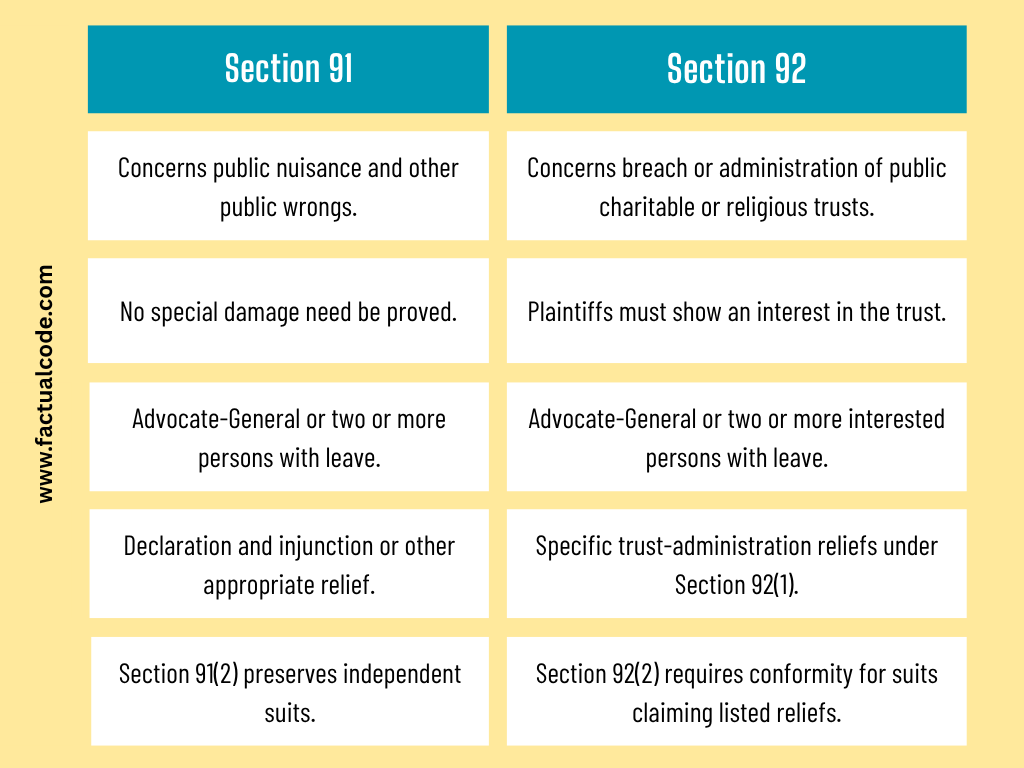
The second route requires at least two plaintiffs and prior leave. They need not prove special damage. A single private individual cannot institute this representative suit merely by asserting public interest.
Reliefs and Independent Suits
Section 91 permits a suit for a declaration and injunction, or such other relief as may be appropriate in the circumstances. The Court may restrain a threatened or continuing public wrong and grant suitable consequential relief.
Section 91(2) preserves any right of suit existing independently of the section. A person suffering distinct or special injury may therefore bring an ordinary civil action on the basis of an individual right, subject to the general law. Section 91 adds a representative remedy; it does not extinguish independent remedies.
Important Case Law
A.C. Muthiah v. Board of Control for Cricket in India (2011) 6 SCC 617
The Supreme Court referred to Section 91 as a means of instituting a public-interest suit against public nuisance or another wrongful act affecting the public. It noted that private plaintiffs proceeding under the provision must join as at least two plaintiffs and obtain leave. The case is procedural guidance; it was not itself a substantive Section 91 nuisance suit.
3. Section 92: Public Charitable and Religious Trusts
Object and Scope
Section 92 protects public charitable and religious trusts against breach of trust and improper administration. Such trusts hold property for charitable or religious purposes benefiting the public or a section of it, rather than a closed group of private beneficiaries. Temples, religious endowments, hospitals and educational institutions may qualify if their legal character and dedication satisfy the statutory test.
Section 92 applies where there is an alleged breach of an express or constructive trust created for public charitable or religious purposes, or where directions of the Court are necessary for its administration. A suit may be contentious or non-contentious.
Three Essential Conditions
The Supreme Court has identified three essential requirements:
Public Trust: There must be an express or constructive trust created for public purposes of a charitable or religious nature.
Breach or Need for Directions: There must be an alleged breach of trust or a real necessity for judicial directions concerning administration. A bare assertion that directions are required is insufficient; the plaint should state facts showing the administrative defect or need.
Specified Relief: The suit must claim one or more reliefs specified in Section 92(1), including a relief falling within clause (h).
The suit must also be representative and brought to vindicate public rights, not merely to settle a plaintiff’s personal dispute.
In Mahant Pragdasji Guru Bhagwandasji v. Patel Ishwarlalbhai Narsibhai, 1952 SCR 513, the Court held that a bare declaration of public-trust status cannot sustain a Section 92 suit where breach is not established and no administrative direction is sought.
In Swami Parmatmanand Saraswati v. Ramji Tripathi (1974) 2 SCC 695, it held that the suit’s dominant purpose, assessed from the plaint, is material.
Persons Entitled to Sue
A suit may be instituted by the Advocate-General, or by two or more persons having an interest in the trust and having obtained the Court’s leave. The Advocate-General does not require prior leave. The plaintiffs in the second category must show a genuine interest in the trust.
In Operation Asha v. Shelly Batra, 2025 INSC 932, the Supreme Court held that the interest must be present and substantial, clear and direct, and not merely sentimental, remote, fictitious or illusory.
A proprietary interest is not invariably necessary, but a stranger’s general concern for public welfare is insufficient.
Constructive Trusts and Registered Societies
In Operation Asha, the Supreme Court held that registration under the Societies Registration Act, 1860, does not automatically make a society or all its assets trust property. Section 5 provides for society property to vest in trustees or, where there are none, in the governing body; this does not itself create an express trust.
A constructive trust may nevertheless arise by operation of law where a fiduciary receives or controls property which, in the circumstances, cannot conscientiously be retained, and the facts show withholding or misapplication contrary to the purpose for which it was received.
The Court held that pleaded allegations of diversion of charitable funds in that case could proceed to trial; they were not finally proved. Thus, not every charitable society is automatically a public trust.
Leave of Court and Revocation
For a suit brought by two or more interested persons, leave is a condition precedent.
In R.M. Narayana Chettiar v. N. Lakshmanan Chettiar (1991) 1 SCC 48, the Supreme Court held that prior notice to proposed defendants is normally desirable, but not mandatory. Leave granted without notice does not invalidate the suit; defendants may seek its revocation on merits. The judgment also recognised the position where all beneficiaries join in instituting the suit.
Revocation is distinct from rejection under Order VII Rule 11 CPC, which applies only if a specific ground under that rule is made out, such as absence of a cause of action or a legal bar apparent from the plaint.
Forum and Territorial Jurisdiction
A Section 92 suit lies in the Principal Civil Court of Original Jurisdiction or another Court empowered by the State Government, within whose local limits the whole or any part of the subject matter of the trust is situated.
In Sri Jeyaram Educational Trust v. A.G. Syed Mohideen (2010) 2 SCC 513, the Supreme Court held that these are alternative forums; empowering another Court does not exclude the Principal Civil Court.
The special forum and territorial test in Section 92 govern and cannot be displaced by the ordinary lowest-grade rule in Section 15 CPC.
Reliefs Available under Section 92(1)
The Court may grant the following reliefs:
Clause (a): Removal of a trustee.
Clause (b): Appointment of a new trustee.
Clause (c): Vesting trust property in a trustee.
Clause (cc): Direction to a removed trustee, or a person who has ceased to be a trustee, to deliver possession of trust property to the person entitled to it.
Clause (d): Direction for accounts and inquiries.
Clause (e): Declaration of the proportion of trust property or of the interest therein to be allocated to a particular object of the trust.
Clause (f): Authorisation to let, sell, mortgage or exchange all or part of trust property.
Clause (g): Settlement of a scheme for proper administration.
Clause (h): Further or other relief required by the nature of the case.
Clause (h) is not unlimited. In Charan Singh v. Darshan Singh (1975) 1 SCC 298, explained in Operation Asha, a “further” relief must be consequential or additional to a relief under clauses (a)–(g); an “other” relief must be akin to or of the same nature as those specified reliefs.
Section 92(2): Restriction on Other Suits
Section 92(2), subject to exceptions under the Religious Endowments Act, 1863 and corresponding laws for former Part B States, bars suits claiming Section 92(1) reliefs unless they conform to Section 92.
It does not bar every independent action concerning trust property. In Bishwanath v. Shri Thakur Radhaballabhji (1967) 2 SCR 618, a worshipper’s suit on behalf of an idol to protect the idol’s own property rights was treated as an independent action, not a representative suit under Section 92.
Section 92(3): Doctrine of Cy-près
The doctrine of cy-près (“as near as possible”) allows the Court to apply trust property or income to a purpose as near as possible to the original spirit.
Under Section 92(3), this is permitted where the purposes have been fulfilled as far as possible or become impossible; only part of the property is needed; combination with other property would be more effective; the relevant area has ceased to be a unit for the purpose; or the purposes are already provided for, useless or harmful, no longer legally charitable, or otherwise unsuitable.
It preserves the charitable intention when the original purpose cannot operate effectively.
4. Distinction between Sections 91 and 92
5. Connected Provisions and Conclusion
Under Section 93, outside the Presidency-towns, the Collector or a State-appointed officer may also exercise the Advocate-General’s powers under Sections 91–92 with the State Government’s previous sanction. An order refusing leave under either section is appealable under Section 104(1)(ffa).
In conclusion, Section 91 protects the community against public nuisance and other public wrongs, while Section 92 safeguards public charitable and religious trusts through representative proceedings and judicial supervision. Both provisions balance public protection with safeguards against vexatious litigation, ensuring that collective rights and charitable property can be protected where ordinary individual remedies are inadequate.